This case study turns to a sector whose demands differ sharply from other industries. If automotive calls for mass production with tight tolerances, construction and infrastructure have their own character: large parts, massive structural loads, and a service life that must last decades outdoors.
Common Cast Components in Construction
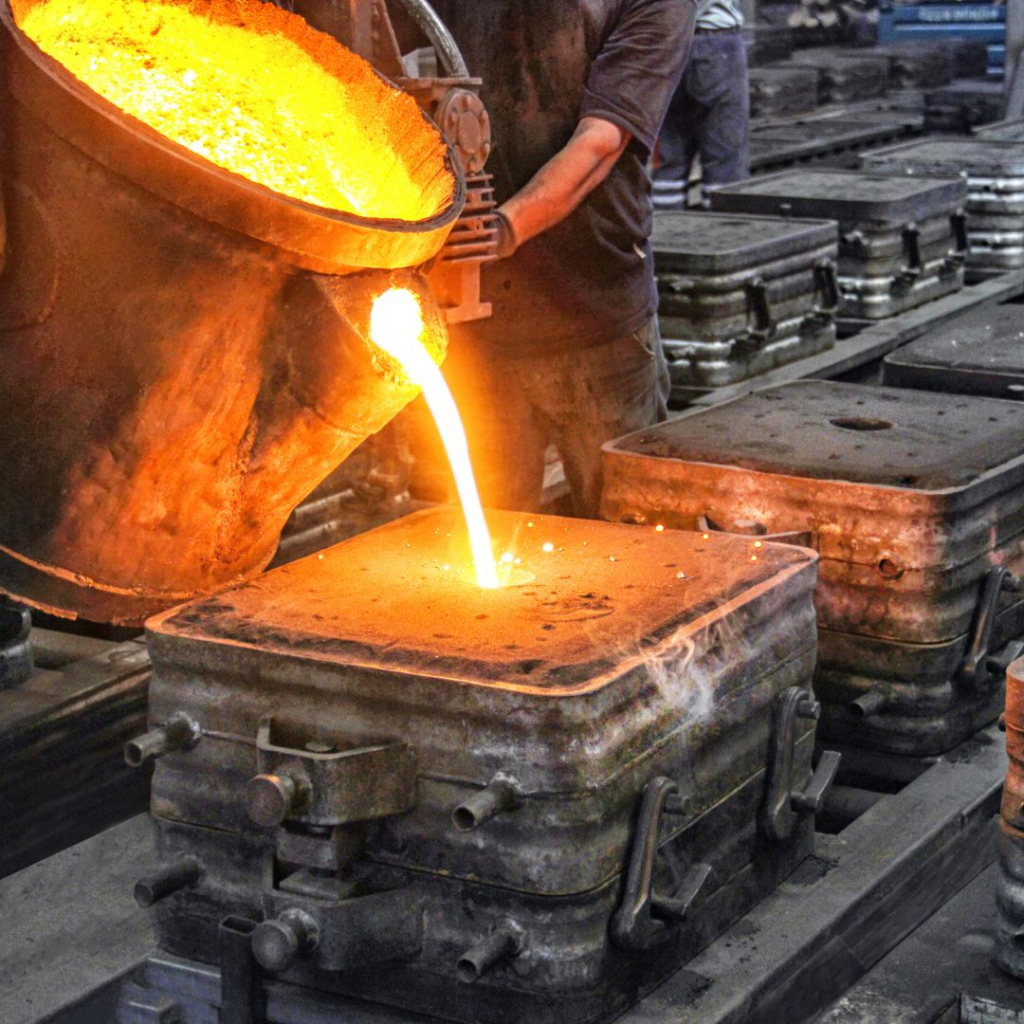
Manhole covers and drainage gratings. Produced in large volumes from cast iron thanks to a combination of low cost, high compressive strength under vehicle traffic, and ease of mass production by sand casting.
Pipe fittings and valves for infrastructure. Large pipe joints, elbows, and valves for city water and gas networks are often made using centrifugal casting for pipes, combined with sand casting for fittings of complex shape.
Structural bridge components. Some joint elements (bearing pads, expansion joints) on large bridges use cast steel designed to withstand dynamic loads from traffic and thermal movement of the structure.
Streetlight poles and decorative railings. These artistic and structural components often use cast aluminum or cast iron, combining structural function with architectural aesthetics.
Unique Production Challenges for the Construction Sector
Much larger part sizes. Unlike relatively small, precise automotive components, construction parts such as manhole covers or large pipe fittings need much larger mold volumes, which brings its own challenges in designing gating and riser systems so the mold fills evenly without defects.
Looser dimensional tolerances, but extreme durability demands. Construction parts generally do not need the dimensional precision of automotive or aerospace components, but must survive decades of exposure to weather, moisture, and repeated loading without structural failure. This calls for serious attention to corrosion resistance and fatigue.
Highly variable production volumes. Some components (such as standard manhole covers) are made in very large volumes to a fixed design, while project-specific structural components (such as bridge bearings) are often made to order in small quantities to a project’s engineering specification.
Public safety standards and regulation. Because many of these components are used in public spaces and critical infrastructure, quality standards and certification are generally stricter than for ordinary consumer products, including periodic non-destructive testing of critical structural components.
Critical Corrosion Resistance Considerations
Unlike automotive components, which are usually protected from direct weather exposure, many construction components are exposed to rain, ground moisture, or even seawater (for coastal infrastructure). This makes understanding the types of corrosion, especially uniform corrosion and galvanic corrosion at joints between different materials, a design consideration that cannot be ignored from the planning stage.
Common solutions include galvanizing (zinc coating) of cast iron components for outdoor use, choosing material grades with better corrosion resistance for aggressive environments such as coastal areas, and designing joints that minimize galvanic corrosion risk between dissimilar materials.
Lessons That Apply Across Industries
This construction case study shows that a “one size fits all” approach does not work when choosing material and casting method. Different priorities, low cost and long-term durability for construction versus precision and light weight for automotive, demand a design and material selection approach fully adapted to the end application, not a template borrowed from another industry.
Related Articles
- Choosing Materials for Metal Casting: Cast Iron, Cast Steel, and Aluminum Alloys
- Other Metal Casting Methods: Centrifugal, Continuous, and Lost Foam Casting
- Case Study: Metal Casting in Household Appliance Components