
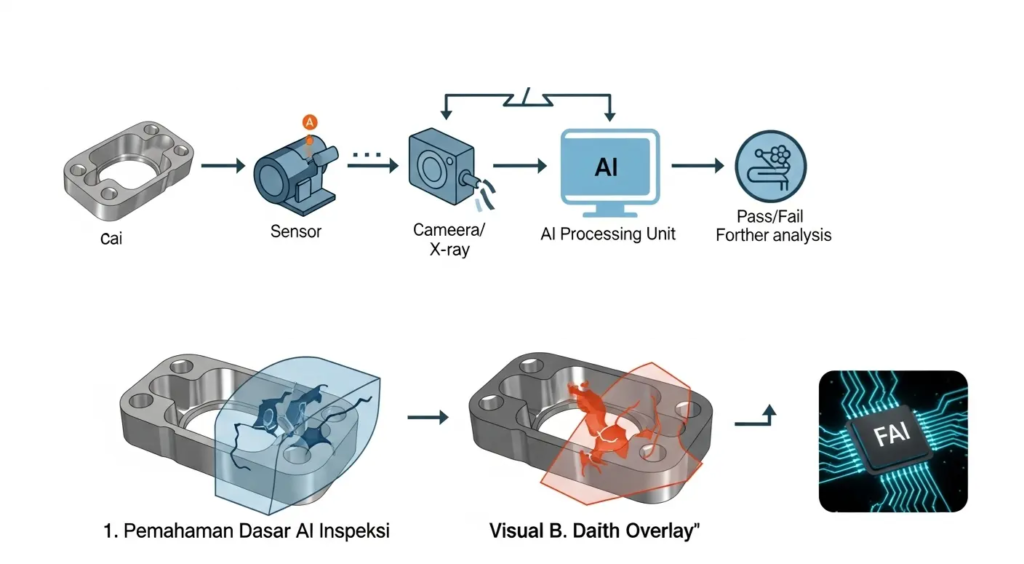
Analyzing hundreds or thousands of radiographic or ultrasonic images every day in search of microscopic defects is exhausting work for human inspectors, and it is prone to human error from fatigue or inconsistency between inspectors. This is where artificial intelligence (AI) is starting to play a significant role, helping to speed up defect detection in metal castings and make it more consistent.
The Limits of Manual Defect Detection
Conventional inspection methods such as those covered in non-destructive testing (NDT) , including radiographic testing, ultrasonic testing, and similar techniques, are very effective at detecting internal defects. Traditionally, however, interpreting the results still depends heavily on the eyes and judgment of human inspectors, which brings some structural limitations:
- Fatigue and inconsistency. Inspectors reviewing hundreds of images per shift tend to lose accuracy as visual fatigue sets in
- Variation between inspectors. Two experienced inspectors can interpret the same defect differently, especially in ambiguous cases near the tolerance threshold
- Limited speed. High production volumes need more trained inspectors, who are not always available or economical
How AI Detects Defects in Inspection Images
AI defect detection systems generally use deep learning-based computer vision, especially convolutional neural networks (CNNs), a machine learning architecture designed specifically to recognize visual patterns in images.
How the model is trained:
- Thousands to tens of thousands of radiographic or ultrasonic images are collected, including images with defects (porosity, inclusions, cracks) and without defects
- Expert inspectors label each image, marking the location and type of any defect
- The AI model is trained on this labeled data to learn the visual patterns that distinguish defects from normal conditions
- Once trained, the model can analyze new images automatically, identifying and classifying any defects it finds
Advantages of AI Over Purely Manual Inspection
Tireless consistency. An AI system applies exactly the same criteria to every image, unaffected by fatigue or the subjective variation between human inspectors.
Processing speed. A trained AI model can analyze an image in seconds, much faster than the time a human inspector needs for a careful review.
Detecting subtle patterns the human eye can miss. For very small or low-contrast defects, a well-trained model can pick up patterns a human might overlook, especially defects at an early stage that are not yet obvious.
Automatic documentation and trend analysis. AI detection results can feed directly into wider production data systems, as part of the Industry 4.0 transformation in casting plants, allowing defect trends to be analyzed against process parameters systematically and in real time.
AI as a Partner, Not a Replacement for Inspectors
It is important to understand that AI in defect detection should ideally not replace human inspectors entirely. It works best as an assistive tool that makes their work more efficient and accurate:
- AI can carry out first-pass screening on large volumes of images, highlighting suspicious areas for closer review by a human inspector
- For ambiguous cases, or parts where failure would have very serious consequences (safety-critical parts), the final decision should still involve human professional judgment and accountability
- Combining AI with human inspectors (human-in-the-loop) often achieves better accuracy than either working alone
Challenges of Implementing AI Defect Detection in Industry
The need for large, high-quality training data. An accurate model needs a large dataset of labeled images, which means investing expert inspectors’ time and effort in accurate labeling.
Generalizing across parts and materials. A model trained to detect defects in one type of part or material cannot always be applied directly to other parts or materials without adjustment and retraining.
Explainability. For safety-critical applications, an AI system should not just give a “defect/no defect” verdict but also an auditable explanation of why it reached that decision.
Infrastructure and expertise costs. Implementing AI systems requires adequate computing infrastructure and data science expertise that may not yet be widely available in every foundry, especially small and medium-sized ones.
The Future of AI-Based Defect Detection in Metal Casting
As computer vision technology advances and computing infrastructure becomes more affordable, AI defect detection is expected to spread more widely across the metal casting industry, including in Indonesia. Combining proven conventional NDT methods with a layer of artificial intelligence to speed up analysis and make it more consistent creates a far more robust quality control system than relying on either approach alone.
For quality control engineers and foundry management, understanding both the potential and the limitations of this technology is key to making the right investment decisions: not simply following a technology trend, but genuinely solving real challenges in production quality inspection.


