
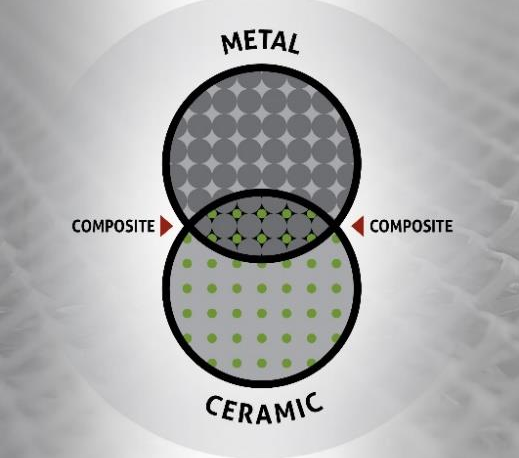
What if a material could have strength approaching steel but weight approaching aluminum? That is the promise of metal matrix composites (MMC): composite materials that combine a metal matrix with a reinforcement of ceramic fibers or particles, creating combined properties that conventional metals cannot achieve on their own.
What Is a Metal Matrix Composite?
An MMC has two main components: a metal matrix (usually aluminum, magnesium, or titanium because they are lightweight) and a reinforcing material embedded in it, typically ceramic particles such as silicon carbide (SiC) or alumina (Al2O3), or continuous fibers such as carbon or boron fibers.
The basic principle resembles reinforced concrete in construction. The metal matrix distributes load and provides ductility, while the reinforcing particles or fibers add stiffness and strength far beyond what the matrix metal can offer by itself.
Types of Reinforcement in MMCs
Particulate-reinforced MMCs. These use fine ceramic particles (such as SiC or Al2O3) dispersed evenly through the metal matrix. This type is relatively easy to produce at scale and gives significant gains in stiffness and wear resistance at a manageable production cost.
Continuous fiber-reinforced MMCs. These use continuous fibers (such as carbon or boron) laid in a set direction within the metal matrix, giving much larger strength gains than particle reinforcement, but at far higher cost and production complexity. They are generally only economical for high-value aerospace applications.
Whisker-reinforced MMCs. These use short single-crystal fibers (whiskers), offering a compromise between particulate and continuous fiber reinforcement in terms of strength and ease of production.
How Metal Matrix Composites Are Produced
Stir casting. The most economical method, in which reinforcing particles are mixed directly into molten metal by mechanical stirring before pouring into a mold. It works much like conventional metal casting, with an added particle mixing step.
Powder metallurgy. Metal powder and reinforcement powder are mixed, compacted, then sintered at high temperature to form a solid material. This method gives more precise control over how the reinforcement is distributed than stir casting.
Infiltration. Molten metal “infiltrates” a preform of reinforcing fibers that has been arranged in advance. It is commonly used for continuous fiber MMCs that need precise fiber orientation.
MMC-based additive manufacturing. Recent work explores combining metal additive manufacturing with composite materials, making it possible to produce MMC parts with complex geometries that conventional methods struggle to achieve.
Main Applications of Metal Matrix Composites
Aerospace. Structural components for aircraft and satellites use aluminum-SiC MMCs to cut weight without sacrificing structural stiffness, which is critical because every kilogram of aircraft weight directly affects fuel consumption.
High-performance automotive components. Pistons, brake discs, and suspension components in high-performance vehicles use MMCs for their combination of high wear resistance and low weight, improving fuel efficiency and handling performance.
Electronics and thermal management. Aluminum-SiC MMCs are also used as heat sink material in high-power electronics, combining aluminum’s high thermal conductivity with the better dimensional stability of the ceramic reinforcement.
High-performance sports equipment. Some racing bicycle components and other precision sports equipment use MMCs for the combination of low weight and optimal structural stiffness.
Challenges Limiting Wider Adoption
Production costs are still high. Producing MMCs, especially with continuous fiber reinforcement, is far more expensive than producing conventional metals, which limits adoption to high-value applications that can absorb the extra cost.
Difficult machinability. Hard ceramic particles in the metal matrix make MMCs much harder to machine and wear out conventional cutting tools quickly, so special tooling (such as diamond-coated tools) is needed.
Consistent reinforcement distribution. Especially with stir casting, achieving a truly even distribution of reinforcing particles through the whole volume is a significant technical challenge. Uneven distribution can create local weak points in the material.
Limited recyclability. Unlike conventional metals, which are relatively easy to recycle, MMCs require a much more complex process to separate the metal matrix from the reinforcement, an important consideration for long-term product sustainability.
Outlook
As production technology becomes more efficient and industry demand for lightweight, high-strength materials keeps growing, driven by the need for energy efficiency in transportation and aerospace, metal matrix composites are expected to be adopted more widely beyond the high-value niche applications that have dominated their use so far. Further research to lower production costs and simplify manufacturing will be the key factor in how quickly adoption spreads to more mainstream industrial applications.


