
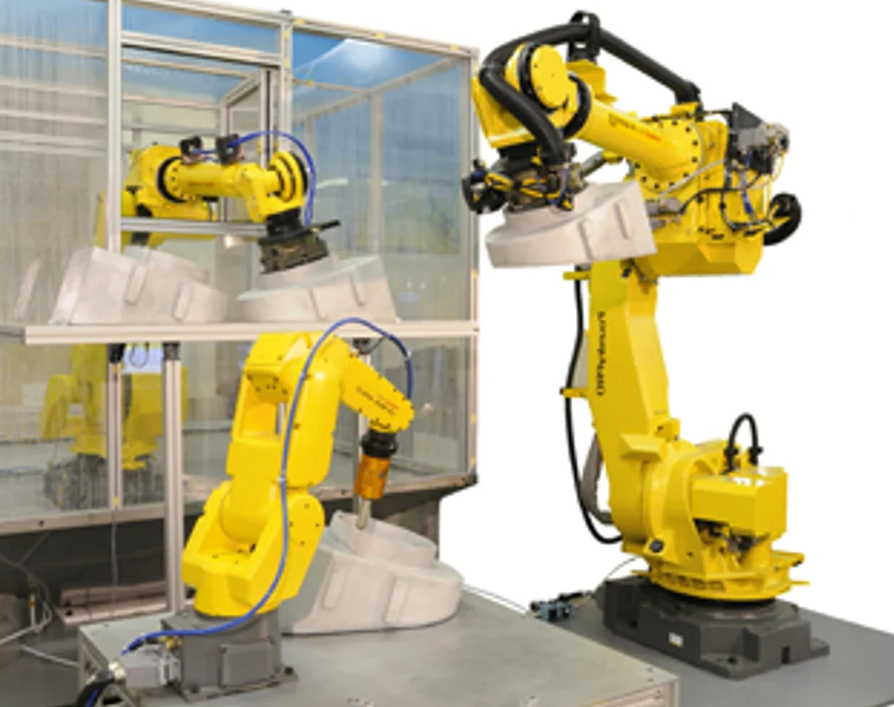
The foundry floor has traditionally meant heavy, hot, and high-risk work for human operators, from pouring molten metal at hundreds of degrees to repetitive, exhausting fettling. Industrial robots are now taking over more and more of these steps, not just for efficiency but for much better workplace safety.
Robots for Pouring Molten Metal (Automated Pouring)
One of the most impactful uses of robotics in a foundry is automated pouring of molten metal, a job that has always been very risky for human operators because of the extreme heat and the danger of molten metal splashes.
How the system works: a robot arm holds the ladle and is driven by a precision control system that sets pouring speed and volume according to parameters determined earlier through digital simulation.
Advantages over manual pouring:
- Far more precise and consistent pouring speed and volume from one production cycle to the next, reducing quality variation between batches
- No risk of operator injury from direct exposure to high-temperature molten metal
- Continuous operation without fatigue, increasing production throughput
Robots for Fettling and Finishing
Fettling , removing leftover gating, risers, and flash from cast parts, has traditionally been done by hand with grinders or cutting tools. The work is repetitive, produces metal dust, and carries a long-term risk of musculoskeletal injury for operators.
Modern fettling robots use machine vision to automatically identify the location of gating and flash on parts of varying shape, then guide cutting or grinding tools to exactly the right spot with a precision and consistency that manual work cannot match at high production volumes.
Robots for Inspection and Quality Control
Robots are also increasingly used for quality inspection, especially when combined with artificial intelligence for defect detection.
Automated visual scanning robots move around a part to capture images from many angles, enabling thorough surface inspection without an operator having to turn each part by hand.
Robots for positioning NDT equipment. On large parts or complex geometries, robots position ultrasonic testing probes or radiography cameras precisely and consistently at predefined inspection points.
Material Handling: The Often Overlooked Role
Beyond the core casting process, robots play a large role in material handling: moving parts between workstations, loading and unloading molds, and managing internal plant logistics:
- Mold-handling robots in fully automated die casting systems, enabling high-speed production cycles with no manual intervention in each cycle
- Palletizing robots that automatically stack finished parts onto pallets before they move to the next production stage or shipping
- Automated Guided Vehicles (AGVs) that transport material between production areas in large plants
Challenges of Implementing Robotics in Foundries
A harsh environment for electronics. High temperatures, dust, and metal particles in a foundry demand robots and sensors rated for extreme (rugged) conditions, which means higher investment than standard industrial robots built for clean environments such as electronics assembly.
High variation in part geometry. Unlike the automotive industry, where parts are highly standardized, foundries often produce parts with very different geometries from one order to the next. Robotic systems need to be flexible enough to handle this variation without full reprogramming for every new part.
Significant upfront capital. Industrial robotic systems, especially those with machine vision and high-precision control, require large upfront investment, a real challenge for the small and medium-sized foundries that dominate the casting industry in Indonesia.
New skills required. Operators and technicians need retraining to program, operate, and maintain robotic systems, a shift from physical manual work toward more technical and digital roles.
Part of a Wider Foundry Digitalization
Robotics does not stand alone. It is an integral part of the larger move toward Industry 4.0 in casting plants, where robots, IoT sensors, and AI systems work together to create production lines that are safer, more consistent, and more efficient than conventional approaches that rely entirely on manual labor.
For Indonesian foundries that want to compete in the high-precision manufacturing market, investing in robotics step by step, starting with the riskiest and most repetitive processes such as pouring and fettling, can be a strategic move toward operations that are more modern, safer, and globally competitive.


