
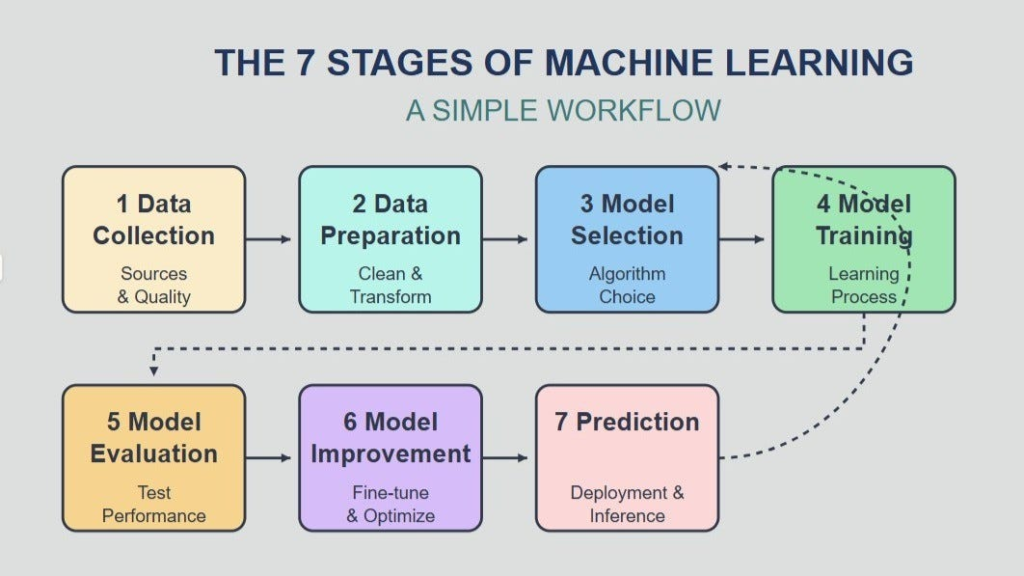
Developing a new metal alloy has traditionally been slow work: melt a composition, process it, test it, and repeat. With dozens of elements that can be combined in many proportions and under many processing conditions, the space of possibilities is far larger than any laboratory can explore. Machine learning is now being used to narrow that search space so that experiments focus on the most promising candidates.
Why a Data-Driven Approach Is Needed
An alloy’s properties are determined by a long chain of relationships: composition determines which phases form, processing (casting, heat treatment, forming) determines the microstructure, and the microstructure determines the mechanical properties. These relationships are nonlinear and involve many variables, which makes them hard to predict from intuition or simple formulas alone.
The General Workflow
- Collecting data. From in-house experiments, the literature, and materials databases: composition, processing conditions, and measured properties such as strength, hardness, or corrosion resistance.
- Adding data from simulation. Thermodynamic calculations (such as the CALPHAD method) and atomic-scale simulations can generate phase and property data without physical experiments, filling gaps in sparse data.
- Training a model. A machine learning model learns the relationship between composition, processing, and properties, then predicts new candidate compositions.
- Choosing candidates intelligently. Techniques such as Bayesian optimization or active learning pick the most informative next experiment instead of trying compositions at random.
- Experimental validation. The best candidates are melted and tested, the results are fed back into the model, and the cycle repeats.
Example Application Areas
High-entropy alloys. Alloys with several principal elements have an enormous composition space, so a data-driven approach helps find combinations that are stable and perform well.
Lightweight alloys. The search for aluminum and magnesium formulations with high strength and adequate ductility, relevant to automotive and aerospace, including the casting alloys covered in choosing materials for metal casting.
Magnetic materials. Research into new magnet candidates that reduce dependence on rare earth elements uses computational screening to filter candidates before synthesis.
High-temperature alloys. The search for superalloys and heat-resistant alloys that balance creep strength, oxidation resistance, and castability.
Links with Other Research
Data-driven alloy design complements other advanced materials research, such as nanostructured materials, because models can help find compositions that support a particular microstructure or behavior. On the manufacturing side, model results should ideally be connected to casting process simulation so that a new alloy is proven to be producible, not just good on paper.
Challenges to Watch For
Small, inconsistent datasets. Compared with other fields, materials data is often limited, comes from different test methods, and rarely records full processing conditions. Models trained on data like this are prone to bias.
Predicting beyond the data. Models generally do well on compositions similar to their training data but are less reliable when asked to extrapolate far outside that range.
Interpretability. Engineers need the physical reasoning behind a prediction, so a model that is purely a “black box” is hard to trust for critical decisions.
Manufacturability. An alloy that excels in the lab still has to be melted, cast, and processed at industrial scale at a reasonable cost.
Validation is still essential. A model’s prediction is a hypothesis, not proof. Experimental testing and certification cannot be replaced.
Opportunities for Research and Industry in Indonesia
This approach is relatively affordable to start learning because many open-source software packages and libraries are available. Collaboration between universities, research institutions, and industry could build structured domestic materials databases, for example for local casting alloys or the characteristics of domestic raw materials. Databases like these are a valuable asset, because data quality matters more to the results than the sophistication of the algorithm.


