
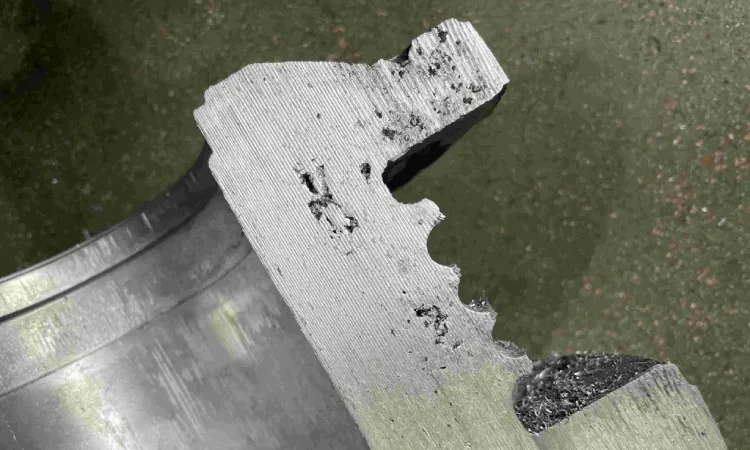
Alongside other casting defects such as porosity, hot tearing, cold shuts, and misruns, there is one more category that is often overlooked yet can seriously damage part integrity: inclusions and contamination, meaning foreign material that ends up inside the structure of the cast metal.
What Is an Inclusion Defect?
An inclusion is a particle of foreign material trapped inside the solid metal after solidification. It can be a metal oxide, leftover slag, mold sand, or refractory material eroded from melting equipment.
Why inclusions are dangerous: these foreign particles create structural weak points in the material, interrupt the continuity of the metal structure, and can become crack initiation points when the part is loaded. This is the same stress concentration principle that makes designers avoid sharp corners in favor of fillets and radii.
The Main Sources of Contamination
Oxidation of molten metal during melting. Almost all molten metals react with oxygen in the air during melting, forming an oxide layer on the surface. If this oxide is not removed before pouring (by skimming or fluxing), particles can be carried into the mold with the molten metal.
Erosion of furnace and ladle refractories. Melting furnace walls and pouring ladles are lined with refractory materials that withstand extreme heat, but these linings can still be worn away gradually by flowing molten metal, especially under excessive turbulence. The eroded particles are then carried along in the melt.
Sand mold erosion. Overly turbulent flow or excessive pouring speed can erode the surface of a sand mold, especially in gating areas with fast flow, carrying sand particles into the mold cavity with the molten metal.
Contamination from scrap feedstock. In processes that use recycled scrap as feedstock, contaminants such as paint, oil, or other foreign material on the scrap can enter the melt if the scrap is not properly cleaned and sorted beforehand.
Chemical reactions between molten metal and the mold. Some combinations of molten metal and mold binders can react chemically at high temperatures, producing reaction products that become trapped as inclusions in the metal.
How Inclusions Affect Mechanical Properties
Lower fatigue strength. Inclusions often act as crack initiation sites for fatigue cracks, significantly shortening the service life of parts under repeated cyclic loading, such as automotive or machine components that move constantly.
Lower ductility and toughness. A significant concentration of inclusions reduces the material’s ability to absorb energy before fracture, raising the risk of sudden brittle failure, especially under shock loads.
Problems during machining. Hard inclusion particles (such as oxides or refractory particles) can damage cutting tools during machining, causing faster tool wear and potential surface defects on the machined part.
Cosmetic problems in some applications. For parts that need a smooth, visually flawless surface (such as decorative components), inclusions exposed after machining or polishing can ruin the product’s appearance.
Effective Prevention Strategies
Proper fluxing and skimming. Using chemical flux to bind oxides and other impurities into a slag layer that can be skimmed off the surface of the melt before pouring is a basic but crucial step.
Ceramic filters in the gating system. Porous ceramic filters placed in the gating channels trap larger inclusion particles before the molten metal reaches the main mold cavity, a technique increasingly common in modern gating system design.
Controlling turbulence in the metal flow. Gating designs that minimize excessive turbulence, through control of both flow velocity and channel geometry, reduce the erosion of molds and refractories that causes contamination.
Sorting and cleaning scrap. Making sure scrap used as feedstock is free of contaminants before melting, including mechanical or chemical cleaning where needed.
Controlling the melting atmosphere. For metals that oxidize very easily, such as aluminum, using an inert atmosphere or protective flux during melting significantly reduces the formation of oxides that could become inclusions.
Detecting Inclusions in Castings
Small inclusions are often invisible to the naked eye and need specialized inspection methods to detect. These include radiographic testing for internal inclusions and metallographic examination (cutting a sample and studying its microstructure under a microscope) for in-depth analysis of the type and distribution of inclusions. These approaches complement the other non-destructive testing methods covered earlier.


