Once rare earth ore has been mined and undergone initial processing, as discussed in Rare Earth Extraction and Refining, the real challenge begins: separating the 17 mixed rare earth elements into individual, high-purity elements. This is what makes separation technology — not mining alone — the true critical bottleneck in the global REE supply chain.
Why Is Separating REE Elements So Challenging?
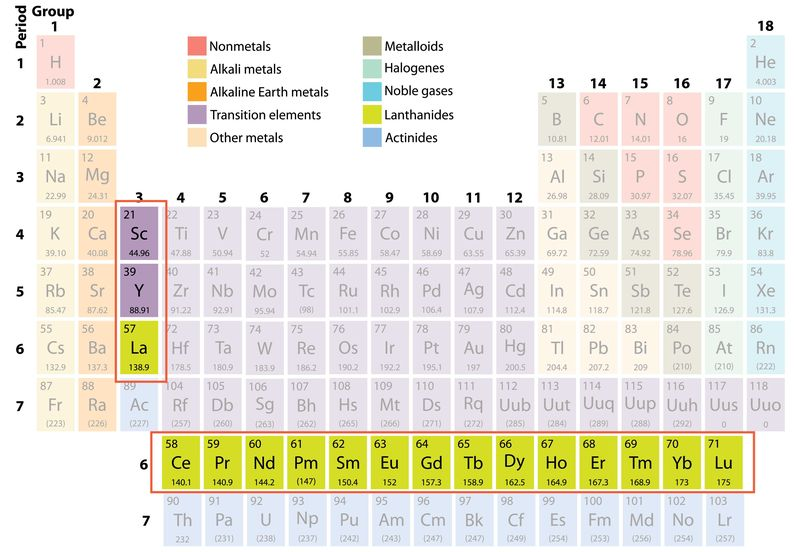
Elements within the lanthanide series have remarkably similar chemical properties — far more similar than the differences typically seen between metals in general. This similarity stems from the unique electron structure of lanthanide elements, where additional electrons fill an inner orbital (4f) that doesn’t significantly affect an element’s external chemical behavior relative to its neighboring elements.
Practical consequence: conventional chemical separation methods effective for separating metals with vastly different chemical properties (such as separating iron from copper) aren’t precise enough to separate, for example, neodymium from praseodymium, whose chemical properties are nearly identical.
Solvent Extraction: The Industry’s Go-To Separation Method
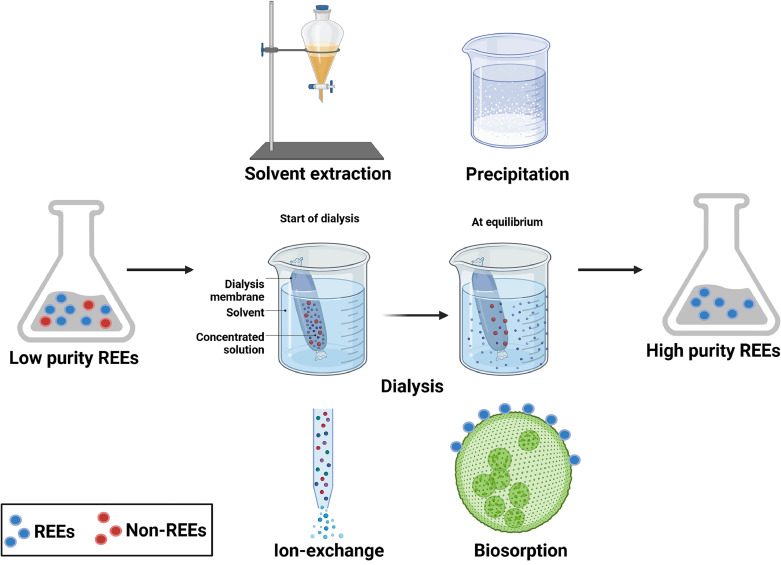
Solvent extraction has become the dominant method used commercially to separate rare earth elements, exploiting extremely subtle solubility differences between elements across a system of two immiscible solvents.
Basic process principle:
- A mixed REE solution is contacted with an organic solvent containing a specific extractant agent
- Each REE element has a slightly different affinity for the organic phase versus the aqueous phase, though the difference is very small
- After contact, the two phases are separated — the organic phase will be marginally richer in certain elements compared to the aqueous phase
- This process is repeated many times across a series of stages (mixer-settlers), which can reach hundreds of sequential stages to achieve the separation and purity levels required for industrial applications
Why so many stages are needed: because the affinity difference between neighboring REE elements is so small, a single extraction stage only yields marginal enrichment. Achieving high purity (often above 99% for electronics and magnet applications) requires massive repetition of the process — one key reason why REE refining facilities require enormous, complex infrastructure investment.
Key Technical Challenges in Solvent Extraction
Extreme process control precision. Small variations in pH, concentration, temperature, or contact time between phases can significantly affect separation efficiency, demanding highly precise and consistent process control across hundreds of extraction stages.
Very large volumes of organic solvent. Given the number of stages required, the volume of organic solvent circulating through the system is substantial, creating chemical waste management challenges and potential environmental risks if not managed within a tightly controlled, closed-loop system.
HREE elements are more challenging than LREE. As discussed in the LREE vs HREE comparison , separating neighboring HREE elements (such as dysprosium from holmium) generally requires more extraction stages than separating LREE, contributing to the significantly higher production cost of HREE.
Alternative Separation Technologies Under Research
Given the complexity and high cost of conventional solvent extraction, research continues to explore potentially more efficient alternative methods:
Ion exchange chromatography. Uses specialized resins that bind REE elements with differing affinities, potentially offering higher selectivity for HREE separation compared to conventional solvent extraction, though generally less economical for very large-scale production.
Bioleaching and biosorption. Research is exploring the use of specific microorganisms that can selectively bind particular REE elements, potentially offering a more environmentally friendly alternative to solvent extraction based on intensive chemical solvents — though this technology remains in the research stage and is not yet commercially mature at scale.
Membrane separation. Specialized membrane technology designed to separate REE elements based on ion size or chemical affinity, potentially reducing the need for massive volumes of organic solvent compared to conventional solvent extraction.
Implications for Indonesia’s Downstream Strategy
The complexity of this separation technology explains why REE downstream development in Indonesia isn’t as simple as merely extracting byproduct minerals from mining tailings — investment in advanced separation technology becomes an unavoidable necessity if the goal is to produce high-value REE products (individual high-purity elements) rather than merely exporting low-value mixed REE concentrate.
A strategic choice to consider: building domestic separation capacity from scratch requires significant investment and technology transfer, while partnering with a country that already possesses mature separation technology could accelerate the process but creates a different form of technological dependence.
Why Understanding This Technology Matters
Understanding the technical complexity of solvent extraction and REE separation challenges helps clarify why refining capacity — not merely mine reserve ownership — is the true determining factor in the global REE production power map . Whichever country or company controls this high-precision separation technology holds the key to far greater economic value-add than simply exporting raw ore or concentrate.
Related Articles
- Rare Earth Extraction and Refining
- Light vs Heavy Rare Earth Elements: LREE vs HREE Explained
- Global Rare Earth Reserves and Production: Which Countries Dominate?
- Indonesia’s Rare Earth Downstream Push