The automotive industry is one of the sectors most dependent on metal casting technology. Almost every vehicle on the road has dozens of components produced by casting, from core engine parts to exterior components. This article looks at how metal casting is applied in the automotive industry, the challenges involved, and the trends shaping the sector.
Why Does the Automotive Industry Depend So Much on Casting?
Automotive components demand a combination of properties that is hard to achieve with other production methods: complex geometry, high structural strength, resistance to extreme temperatures, and efficient mass production at an affordable cost. Metal casting meets these needs because it can produce complex shapes in a single process while remaining efficient at large scale.
Key Components Produced by Casting
Some vehicle components commonly produced by metal casting include:
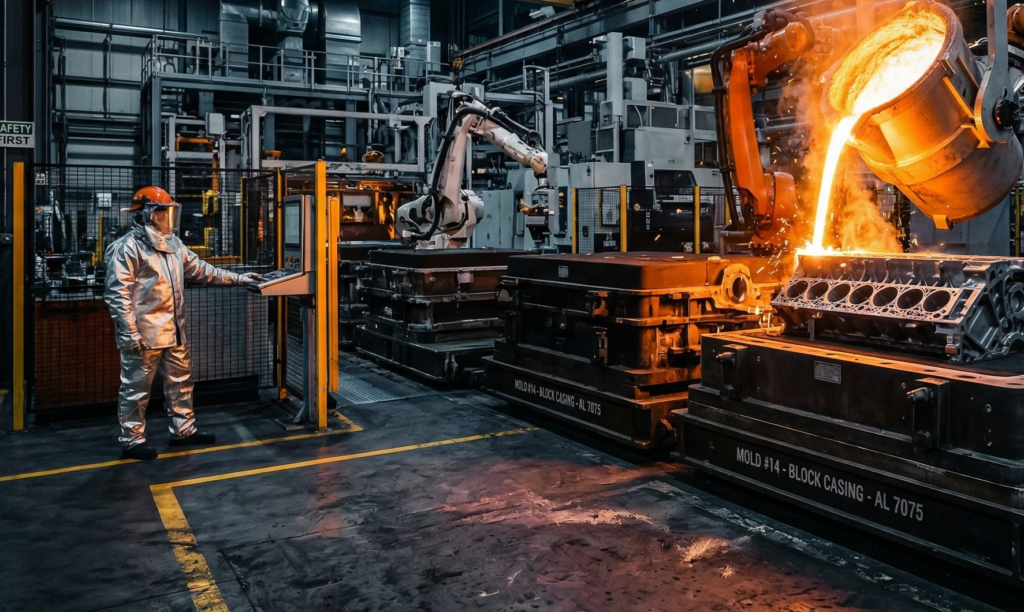
Engine block. This core engine component is generally produced by high-pressure die casting in aluminum alloy, chosen because it is light yet strong enough to withstand the pressure and high temperatures of combustion.
Pistons. Produced by gravity casting or die casting, pistons need very tight dimensional precision because they move constantly inside the engine cylinder with very small clearances.
Wheels (rims). Cast aluminum wheels are a popular choice over conventional steel wheels because they are lighter, which helps fuel efficiency while also improving the vehicle’s appearance.
Transmission and differential housings. These housings are generally produced by die casting, because they need complex shapes to accommodate the many mechanical parts inside.
Brake calipers. These braking components need materials with high heat resistance and are usually produced by sand casting or die casting depending on the vehicle’s specifications.
Challenges in Practice
Applying metal casting in the automotive industry comes with some distinctive challenges:
- High precision requirements. Automotive components have far tighter dimensional tolerances than general applications, because they must work precisely within complex mechanical systems.
- Cost efficiency pressure. Mass production demands the lowest possible cost per unit without sacrificing quality or safety.
- The trend toward lighter vehicles. This is pushing casting away from cast iron toward lighter aluminum and magnesium alloys, which requires adjustments to the production process. Material options are covered in choosing materials for metal casting.
- Strict safety standards. Even the smallest defect in a critical component such as a brake caliper or engine block can be fatal, which makes quality control crucial.
Emerging Trends in the Industry
As electric vehicles (EVs) grow, demand for cast components is shifting too. EV drive motors need high-precision metal housings to protect the electronics and magnets inside, while EV batteries need metal casings that are light yet impact resistant. This is pushing automotive component makers to adopt more precise casting technology, including digital simulation and automation, as covered in our article on technological innovation in metal casting.
Conclusion
The automotive industry is one of the clearest examples of how vital metal casting is in everyday life, from hidden components such as engine blocks to visible parts such as wheels. As the shift to electric vehicles continues, the demands for precision and efficiency in automotive casting will keep growing, bringing both new opportunities and new challenges for industry players.
METALURGIKA.COM will continue to cover case studies of metal casting across other industrial sectors. Stay tuned for in-depth insights into the world of metallurgy.