
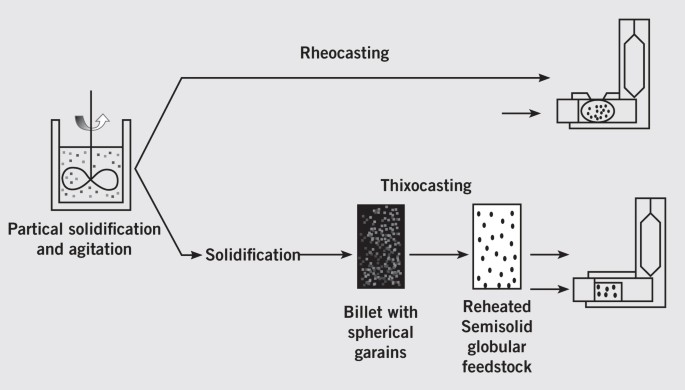
What if metal could be cast in a “half-solid, half-liquid” state, thick enough to be controlled precisely like a soft material yet still able to flow and fill a mold like a fluid? That is the principle behind semi-solid metal casting (SSM), a technology that combines the advantages of conventional casting and solid metal forming (forging) in a single process.
What Is Semi-Solid Casting?
Semi-solid casting uses metal at a temperature between its melting point and its fully solid point (the solidus-liquidus range), where the metal is a mixture of round (globular) solid particles suspended in liquid. Unlike the dendritic structure that forms in ordinary conventional casting, this globular structure in the semi-solid state gives very different and beneficial flow behavior.
Why the globular structure matters: semi-solid metal with a globular structure behaves thixotropically, meaning its viscosity drops sharply under shear force and thickens again when the shear is removed. This unique property lets semi-solid metal be injected into a mold with far more controlled, less turbulent flow than fully molten metal.
Two Main Approaches: Thixocasting vs Rheocasting
Thixocasting starts from a solid metal billet that already has a special globular microstructure (created by an earlier metallurgical process), which is then reheated into the semi-solid range just before injection into the mold. This approach offers very precise process control because the starting microstructure is guaranteed to be consistent, but it adds the cost of producing the special billets.
Rheocasting takes a different approach. The metal is first fully melted, then cooled under control while being stirred (usually by electromagnetic or mechanical stirring) until it reaches the semi-solid state, with the globular structure forming directly in one continuous process and no separate billet-making step. This approach is generally more economical but needs very precise control of stirring and cooling.
Advantages over Conventional Casting
Much lower porosity. The more laminar, less turbulent flow of semi-solid metal significantly reduces the risk of gas becoming trapped in the metal, addressing one of the main causes of porosity defects in conventional casting.
Less solidification shrinkage. Because part of the metal is already solid before injection, volume shrinkage during final solidification is much smaller than when casting from a fully liquid state, reducing the risk of shrinkage porosity and the need for complex risers.
Mechanical properties close to forgings. The fine, uniform globular microstructure of semi-solid castings gives mechanical properties, especially fatigue strength and ductility, that are much better than conventional castings, approaching the quality of forged components while keeping the geometric flexibility of casting.
Longer die life. Process temperatures are lower than in conventional die casting (because the metal is not fully molten), which reduces thermal shock on metal dies and can extend die life and lower long-term tooling costs.
Applications That Benefit Most
Safety-critical automotive components. Suspension components, structural brackets, and parts carrying significant dynamic loads in vehicles benefit greatly from the combination of superior mechanical properties and complex geometry that semi-solid casting offers.
Precision electronics components. Housings for electronic devices that need thin walls, high surface quality, and freedom from porosity are a growing application for this technology, especially with magnesium and aluminum alloys.
Lightweight aerospace components. The combination of lightweight aluminum or magnesium alloys with near-forging mechanical properties makes this technology attractive for major non-structural components in weight-sensitive aerospace applications.
Challenges Limiting Wider Adoption
Complex process control. Keeping the metal within the narrow semi-solid temperature range requires very precise control of temperature and time. Small deviations can leave the metal too liquid (losing the semi-solid advantage) or too solid (struggling to fill the mold).
Cost of specialized equipment. Both thixocasting and rheocasting need special equipment for precise temperature control and, for rheocasting, electromagnetic stirring systems, adding capital investment compared with conventional die casting lines.
Limited choice of alloys. Not every alloy shows the ideal thixotropic behavior for semi-solid casting. Certain aluminum and magnesium alloys give the best results, while adapting the process to other alloys such as steel still faces significant technical challenges.
An operational learning curve. Optimizing process parameters for specific applications and alloys requires specialist expertise and experience that is not yet as widely available in industry as conventional casting know-how.
Its Place in the Casting Technology Ecosystem
Semi-solid casting fills a spot in the evolving range of metal manufacturing technologies. On one side is conventional casting, mature and economical for high volumes. On the other is additive manufacturing for very complex geometries at low volumes. Semi-solid casting sits between them, offering near-forging quality with geometric flexibility close to conventional casting, which suits applications that need both at once.
For high-precision manufacturers considering new technology investments, understanding where semi-solid casting sits in this trade-off between quality, flexibility, and cost is important for deciding whether it fits a specific application better than more mature and economical conventional alternatives.
Related Articles
- Metal Additive Manufacturing: The Future of High-Precision Manufacturing
- Metal Matrix Composites (MMC): Applications and Production Challenges
- Case Study: Metal Casting in the Aerospace Industry


