
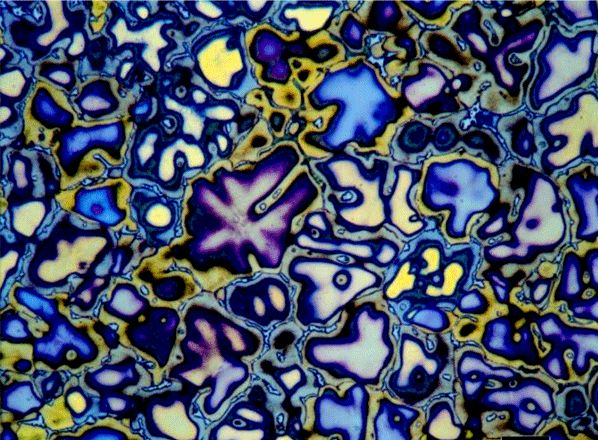
Unlike digital casting simulation, which predicts molten metal flow and solidification patterns at a macro scale, there is a far more detailed level of simulation: predicting how individual grain structure and phases form inside the metal during solidification. This is the domain of microstructure simulation, combining materials physics with computation to see what happens at the microscopic scale long before a physical sample is examined under a microscope.
Why Microstructure Needs Its Own Simulation
Conventional casting process simulation gives valuable information about temperature distribution and flow patterns, but does not predict in detail how individual grains grow, how a second phase forms, or how alloying elements distribute within grains (microsegregation). Yet as discussed in the article on heat treatment, it is this microstructure that ultimately determines a material’s final mechanical properties, making accurate microstructure prediction just as important as predicting macro defects such as porosity.
Cellular Automaton: Modeling Grain Growth
The cellular automaton method divides the simulation domain into a grid of small cells, where each cell can change state (for example, from liquid to solid) based on rules that account for the condition of neighboring cells and local thermal variables such as temperature and cooling rate.
How this method predicts grain structure: by applying nucleation rules (when a new grain begins forming) and growth rules (how the grain boundary spreads to neighboring cells) repeatedly across the grid, the simulation can produce a visual map of the resulting grain structure, including predicting whether the structure will tend toward equiaxed (grains uniform in all directions) or columnar (grains elongated along the direction of heat flow), a crucial factor also relevant to the directional solidification technique used for aerospace turbine blades.
The advantage of this approach: relatively efficient computationally compared with other methods, so it can be simulated over a fairly large domain in a reasonable time, suited to predicting grain structure patterns at full component scale.
Phase-Field Modeling: Capturing Phase Interface Evolution
Phase-field modeling takes a different approach, modeling the evolution of the interface between phases (for example between liquid and solid, or between two different solid phases) continuously using differential equations, without needing to explicitly track the interface position as conventional geometric methods do.
Main advantage: able to capture very complex interface morphology, including the branching dendrite growth characteristic of metal solidification, with far finer geometric detail than cellular automaton, making it a choice for research that needs a deep understanding of structure-formation mechanisms at a very small scale.
Computational trade-off: this high level of detail comes at the cost of far greater computing power, limiting the practical simulation domain compared with cellular automaton. Phase-field modeling is often applied to a small domain to understand fundamental mechanisms, rather than to predict microstructure across a full-scale component.
Practical Applications for Industry
Alloy composition optimization. Microstructure simulation helps predict how a change in alloy composition or cooling rate affects the final structure, complementing the machine learning alloy design approach with a mechanistic understanding of why a particular composition delivers the desired properties.
Microsegregation prediction. Simulation can identify areas at risk of excessive alloying element segregation, valuable information for designing the right homogenization heat treatment before further processing.
Additive manufacturing process design. For additive manufacturing of metals, where cooling rates are extremely fast and vary depending on laser parameters, microstructure simulation helps predict and optimize the resulting grain structure, which is heavily influenced by these specific process conditions.
Challenges and Limitations
Experimental validation is still required. As with macro process simulation, microstructure simulation results need to be validated against actual metallographic observation before being fully trusted for critical design decisions.
Need for accurate material data. The thermodynamic and kinetic parameters a model needs, such as interfacial energy and diffusion coefficients, are not always accurately available for every alloy combination, limiting prediction reliability for less-studied material systems.
Computational complexity for complex alloy systems. Alloys with many elements, such as the high-entropy alloys discussed in the context of data-driven alloy design, present far greater computational challenges than simple binary alloy systems.
Completing the Metallurgical Simulation Ecosystem
Microstructure simulation complements, rather than replaces, the macro process simulation discussed earlier. Both work at different scales but together provide a complete picture from the pouring of molten metal to the final mechanical properties of the material. For researchers and engineers who want to understand the root cause of material property variation in depth, microstructure simulation offers a window into mechanisms that macro process simulation alone cannot reveal.


