Two parts made from metal with identical chemical composition can have very different hardness, ductility, and wear resistance, purely because of the heat treatment each one received. That is what makes heat treatment one of the most fundamental processes in physical metallurgy, and a topic anyone who works with metals needs to understand, whether in an engineering classroom or on the production floor.
What Is Heat Treatment?
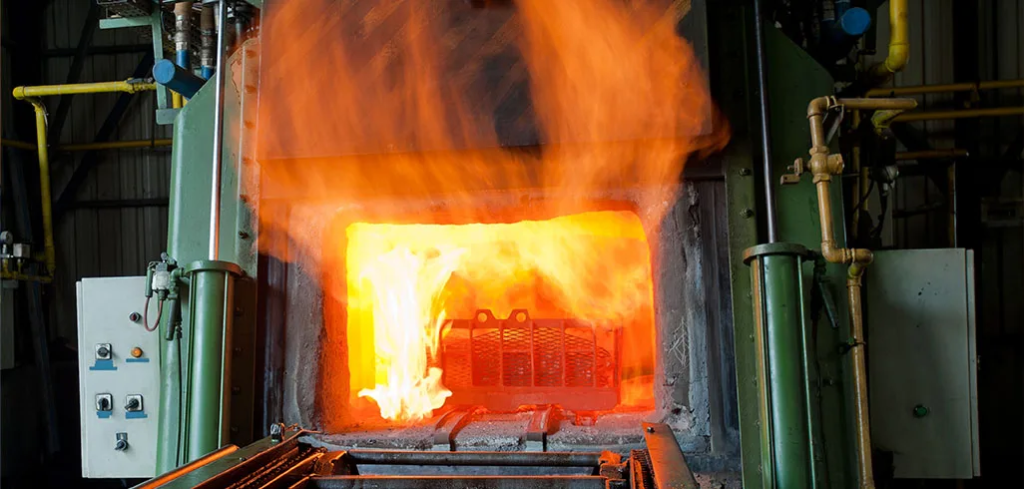
Heat treatment is the controlled heating and cooling of metal to change its microstructure, without changing the part’s physical shape or overall chemical composition. This change in microstructure is what ultimately determines the metal’s final mechanical properties, such as hardness, tensile strength, ductility, and toughness.
Every heat treatment process controls three main variables:
- Heating temperature: how hot the metal is heated
- Holding time: how long the metal is held at that temperature so its internal structure becomes fully homogeneous
- Cooling rate: how fast the metal is cooled, which has the greatest influence on the final microstructure
Types of Heat Treatment Processes
Annealing: Softening and Relieving Internal Stress
Annealing heats metal to a set temperature, holds it long enough for the grain structure to even out, then cools it slowly (usually inside the furnace itself).
Main purposes of annealing:
- Softening metal that has hardened from earlier cold working, such as after rolling or drawing
- Relieving internal residual stress that could cause distortion or cracking in later production stages
- Improving machinability before further processing
- Homogenizing the grain structure before other heat treatment processes
Because cooling is slow, annealing leaves the metal relatively soft and ductile, which makes it a good preparation step before further forming or machining.
Normalizing: Refining the Grain Structure
Normalizing is similar to annealing in the heating stage but differs in cooling: the metal is cooled in open air rather than inside the furnace. The cooling rate is therefore faster than annealing, though still slower than quenching.
The result: a finer, more uniform grain structure than the as-cast or as-forged condition, with mechanical properties slightly stronger and harder than annealed metal while remaining reasonably ductile. Normalizing is often used as a preparation step before hardening, to make sure the starting structure is uniform.
Quenching: Hardening Metal Drastically
Quenching cools metal very rapidly from a high temperature (for steel, usually above the critical austenite temperature) using a cooling medium such as water, oil, or even high-pressure air, depending on the hardness required.
This rapid cooling “freezes” the austenite structure into martensite, a phase that is much harder but also more brittle than the other phases in steel. The faster the cooling rate, the higher the hardness achieved, but the risk of quench cracking and part distortion rises too.
Choosing the quenching medium is critical:
- Water: the fastest cooling and the highest hardness, but the greatest risk of cracking
- Oil: more moderate cooling, commonly used for alloy steels that are more sensitive to cracking
- Air: for high-alloy steels that harden even with slower cooling (air-hardening steels)
Tempering: Balancing Hardness and Ductility
Because quenched metal tends to be very hard but brittle, quenching is almost always followed by tempering: reheating the quenched metal to a temperature well below the hardening temperature, holding it for a period, then cooling it again under control.
Tempering reduces internal stress and lowers hardness slightly, but it significantly improves ductility and toughness. That is why almost every hardened steel part, from springs and shafts to cutting tools, goes through a quench-and-temper combination rather than quenching alone. The tempering temperature chosen sets the final balance between hardness and ductility to suit the application.
Case Hardening: Hard on the Outside, Tough on the Inside
For parts that need a very hard, wear-resistant surface (such as gears or bearing shafts) but still need a ductile core so they do not fracture under shock loads, case hardening is used. Common methods include:
- Carburizing: adding carbon to the surface of the metal at high temperature so the surface becomes carbon-rich and can be hardened, while the core keeps a low carbon content and stays ductile
- Nitriding: adding nitrogen to the surface at a lower temperature than carburizing, producing a very hard surface with minimal part distortion
- Induction hardening: heating only the surface layer of the part locally using electromagnetic induction, then quenching it immediately, without affecting the core structure
All surface hardening methods are compared in our full guide to surface hardening.
Why Heat Treatment Matters So Much in Product Design
Choosing the right heat treatment process is not just about making metal harder or softer. It is about balancing mechanical properties that often pull in opposite directions: hardness versus ductility, strength versus toughness under shock loads. Getting the heat treatment parameters wrong, whether the temperature is too high, the cooling rate is unsuitable, or the holding time is off, can cause a part to fail in service even when its chemical composition meets specification.
For engineers and materials engineering students, understanding the relationship between phase diagrams, cooling curves, and the resulting microstructure is the foundation for designing heat treatment processes that hit their target, rather than following a standard recipe without understanding why each step is needed.