
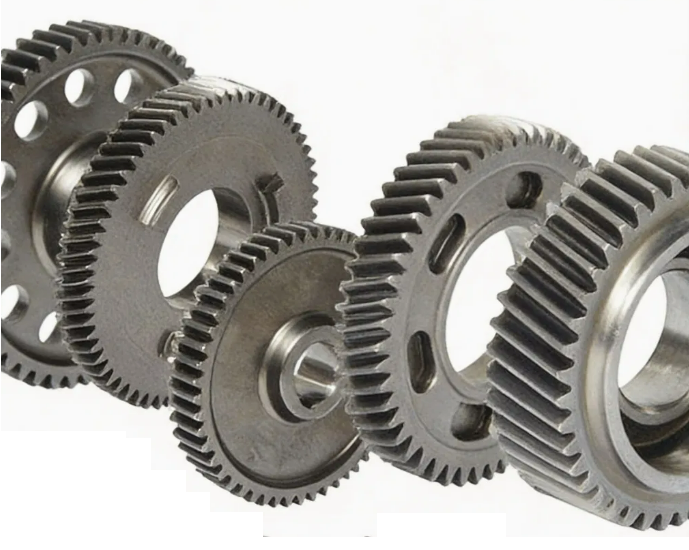
Gears, shafts, and camshafts need surfaces that resist wear, yet they must not snap under shock loads. Make the whole part very hard and it becomes brittle. Make it all ductile and the surface wears quickly. The answer is surface hardening: a group of processes that make the outer layer of steel hard and wear-resistant while the core stays ductile and tough.
In industry, surface hardening is often called case hardening. Our article on types of heat treatment introduces it briefly. This guide goes further: the two families of methods, how each method works, how they compare, how to choose, how case depth is measured, and the problems that often come up.
What Is Surface Hardening?
Surface hardening is a group of heat treatment processes that harden only the surface layer of a part, from a few tens of micrometers to several millimeters deep. The result is a part with two zones:
- The case: hard, wear-resistant, able to carry high contact stress, and more fatigue-resistant because it usually holds compressive residual stress.
- The core: softer, ductile, and tough, so the part does not fail in a brittle way under shock or bending loads.
Typical surface-hardened parts include gears, transmission shafts, camshafts, crankshafts, pins, bearing races, machine tool guideways, dies, and cutting tools.
Case Hardening vs. Surface Hardening
In everyday use, the two terms are often interchangeable. To be more precise:
- Surface hardening is the general term for every process that hardens the surface.
- Case hardening is most often used for diffusion processes that add elements to the surface, especially carburizing. The hardened layer is called the case, and its thickness the case depth.
This article uses “surface hardening” for all of them and names the specific method where it matters.
The Two Families of Surface Hardening Methods
All surface hardening methods fall into two broad families.
1. Thermal hardening (composition unchanged). The steel surface is heated rapidly into the austenite range, then cooled quickly so it transforms into hard martensite. The core never gets hot enough, so it stays soft. Because nothing is added, the steel must already contain enough carbon to harden, usually about 0.35 to 0.55% C. Examples: induction hardening, flame hardening, and laser hardening.
2. Diffusion or thermochemical hardening (surface composition changes). Carbon, nitrogen, or both are diffused into the steel surface at high temperature. This enriched layer becomes hard, either directly or after quenching. These methods suit low-carbon steels that cannot be hardened thermally. Examples: carburizing, nitriding, carbonitriding, and nitrocarburizing.
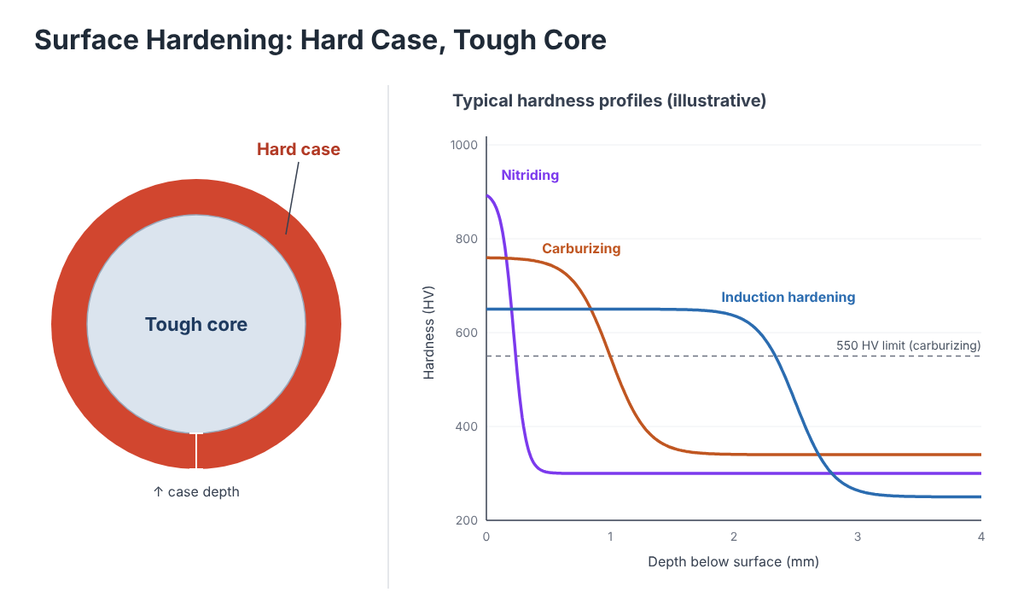
The graph above gives the general picture: nitriding produces the hardest but thinnest case, carburizing sits in the middle, and induction hardening produces the deepest case with slightly lower hardness. Exact values depend on the steel grade and process parameters.
Induction Hardening
How it works. The part is placed inside or near a copper coil carrying high-frequency alternating current. The changing magnetic field induces eddy currents in the steel surface, which heat it within seconds. As soon as the austenitizing temperature is reached, the surface is sprayed with water or a polymer solution and transforms into martensite.
Frequency controls depth. Induced current concentrates at the surface, and the higher the frequency, the thinner the heated layer. High frequencies (hundreds of kHz) are used for thin cases of about 0.5 to 1.5 mm, while medium frequencies (a few kHz) give cases several millimeters deep. Overall, the case depth in induction hardening ranges from about 0.5 to 6 mm.
Techniques. There are two main approaches:
- Single shot: the entire area to be hardened is heated at once, then quenched. Suited to short parts such as pins and bearing seats.
- Progressive (scanning): the coil and quench spray travel slowly along the part. Suited to long shafts and piston rods.
Materials. Medium-carbon and alloy steels such as 1045 and 4140 are the most common choices, with surface hardness typically around 50 to 60 HRC. Ductile iron and pearlitic gray cast iron can also be induction hardened.
Afterward. Parts are usually tempered at a low temperature, about 150 to 200 °C (300 to 390 °F), to reduce the brittleness of the martensite. The principle is covered in our article on quenching and tempering.
Pros and cons. The process is very fast, energy-efficient because only the surface is heated, easy to automate, relatively low in distortion, and able to harden selected areas only. On the downside, each part shape needs its own coil, so it is most economical in high-volume production.
Flame Hardening
Flame hardening works on the same principle, but the heat source is a gas flame, usually oxyacetylene or oxy-propane. The surface is heated with the flame and immediately sprayed with water.
It is best suited to large parts or one-off jobs, such as large-diameter gears, machine guideways, rolls, and sprocket teeth, where building a dedicated induction coil would not pay off. The equipment is simple and portable. Case depth is about 1.5 to 6 mm. The drawback is less precise temperature control than induction, so results depend more on operator skill. Suitable materials are the same as for induction hardening: medium-carbon steels, alloy steels, and cast irons.
Laser Hardening
Laser hardening uses a high-power laser beam to heat a narrow track on the surface. Because the heated volume is so small, the heat is drawn straight into the metal underneath and the surface cools itself (self-quenching) without any quench medium. The case is thin, about 0.2 to 1.5 mm, with very little distortion. It suits cutting edges, small areas on dies, and hard-to-reach spots, but the equipment is expensive.
Carburizing
How it works. Low-carbon steel is heated to about 850 to 950 °C (1,560 to 1,740 °F) in a carbon-rich environment. Carbon diffuses into the surface until it reaches about 0.7 to 1.0%, while the core stays low in carbon. The part is then quenched so the high-carbon case becomes very hard martensite, and tempered at about 150 to 200 °C (300 to 390 °F).
Types of carburizing:
- Pack carburizing: parts are buried in a box of charcoal and an energizer, then heated. It is the simplest method and is still used by small shops, but it is slow and hard to control.
- Gas carburizing: parts are heated in a furnace with a carbon-rich gas atmosphere (for example endothermic gas enriched with natural gas). It is the most widely used industrial method because surface carbon can be controlled.
- Vacuum carburizing (low pressure carburizing): carried out in a vacuum furnace with a gas such as acetylene at low pressure. The result is clean, with no intergranular oxidation, and parts are usually quenched in high-pressure gas, which reduces distortion.
- Liquid (salt bath) carburizing: parts are dipped into molten salt. It is now rarely used because of environmental concerns.
Process steps, case depth versus time, and the types of carburizing are covered in detail in our guide to carburizing.
Materials. Low-carbon and low-alloy steels with about 0.1 to 0.25% carbon, such as 1018, 8620, and 20MnCr5, which is popular for automotive gears. These steels are discussed in our article on low carbon steel.
Results. Case depth is typically 0.5 to 2 mm (deeper for large gears with long cycle times), with surface hardness of about 58 to 64 HRC. Carburizing is the first choice for gears that carry very high contact and bending loads.
Nitriding
How it works. Nitrogen is diffused into the steel surface at a much lower temperature, about 500 to 550 °C (930 to 1,020 °F) for gas nitriding. The nitrogen reacts with alloying elements such as chromium, aluminum, molybdenum, and vanadium to form very fine, hard nitrides. Because the temperature is below the steel’s transformation range, no quench is needed, so distortion is very small.
Types of nitriding:
- Gas nitriding: uses ammonia that dissociates at the steel surface. The process is long, often 10 to more than 60 hours.
- Plasma (ion) nitriding: uses a glow discharge in a low-pressure nitrogen-hydrogen gas. It is faster and easier to control, and areas that should not be nitrided can simply be masked mechanically.
- Salt bath nitriding: carried out in molten salt, now mostly used for nitrocarburizing.
Materials. Alloy steels containing nitride-forming elements, such as 4140, aluminum-bearing nitralloy steels, H13 tool steel, and some stainless steels. Before nitriding, the steel is usually quenched and tempered to give a strong core, with a tempering temperature above the nitriding temperature so the core does not soften during the process.
Results. The case is thin, about 0.1 to 0.6 mm, but very hard: around 600 HV on 4140 and above 1,000 HV on nitralloy. Nitriding also improves fatigue strength and slightly improves corrosion resistance. It is widely used for crankshafts, hydraulic cylinders, extruder screws, and plastic injection molds.
Carbonitriding and Nitrocarburizing
Both processes add carbon and nitrogen together, but in different ways and for different purposes.
- Carbonitriding is similar to carburizing but runs at a lower temperature (about 760 to 870 °C, or 1,400 to 1,600 °F) with ammonia added to the furnace atmosphere. Nitrogen raises the hardenability of the case, so plain carbon steels can be quenched in a milder oil with less distortion. The case is thinner, about 0.1 to 0.75 mm. It suits small mass-produced parts such as nuts, bolts, and sewing machine components.
- Ferritic nitrocarburizing (FNC) is carried out at about 560 to 590 °C (1,040 to 1,090 °F), still in the ferrite range, with no harsh quench. It produces a compound layer (also called the white layer) about 10 to 25 µm thick on top of a diffusion zone. This layer resists wear, galling, and, especially when followed by oxidation, corrosion. FNC is widely used for automotive parts, hydraulic rods, and components that were previously hard chrome plated.
Comparison of Surface Hardening Methods
| Method | Process temperature | Case depth | Surface hardness | Common materials | Distortion |
|---|---|---|---|---|---|
| Induction hardening | Rapid austenitizing, then quench | 0.5 – 6 mm | 50 – 60 HRC | Medium-carbon steel (1045, 4140), cast iron | Low to medium |
| Flame hardening | Rapid austenitizing, then quench | 1.5 – 6 mm | 50 – 60 HRC | Medium-carbon steel, cast iron | Medium |
| Laser hardening | Local austenitizing, self-quench | 0.2 – 1.5 mm | 55 – 65 HRC | Medium-carbon steel, tool steel | Very low |
| Carburizing | 850 – 950 °C (1,560 – 1,740 °F), then quench | 0.5 – 2 mm | 58 – 64 HRC | Low-carbon steel (1018, 8620, 20MnCr5) | Medium to high |
| Carbonitriding | 760 – 870 °C (1,400 – 1,600 °F), then quench | 0.1 – 0.75 mm | 58 – 63 HRC | Low-carbon steel | Medium |
| Nitriding (gas) | 500 – 550 °C (930 – 1,020 °F), no quench | 0.1 – 0.6 mm | 600 – 1,100 HV | Cr-Mo-Al alloy steel, tool steel | Very low |
| Ferritic nitrocarburizing | 560 – 590 °C (1,040 – 1,090 °F), no harsh quench | Compound layer 10 – 25 µm | Very hard compound layer | Carbon and alloy steel | Low |
The values in this table are general ranges. Exact figures depend on the steel grade, part size, and each heat treater’s process parameters.
How to Choose a Surface Hardening Method
No single method is best for every case. These questions help narrow the choice:
- What is the part made of? Low-carbon steel can only be hardened by diffusion methods (carburizing, carbonitriding). Medium-carbon steel and cast iron suit induction or flame hardening. Nitriding needs a steel with nitride-forming elements.
- How deep does the case need to be? High contact loads on large gears call for a deep case (carburizing or induction). Wear and fatigue resistance on precision parts can be met with a thin case (nitriding or FNC).
- How much distortion can be tolerated? Parts that are already finish-machined and hard to regrind are better suited to nitriding, FNC, or laser hardening.
- Does only part of the surface need hardening? Induction, flame, and laser hardening can harden selected areas. With diffusion methods, areas that should stay soft must be masked with paste or copper plating.
- What is the production volume? Induction is very economical for high volumes but expensive for one or two parts. Flame hardening is the opposite.
Choosing the right steel at the design stage is also covered in our article on material selection for metal casting.
How Case Depth Is Measured
Case depth is usually specified as the effective case depth: the distance from the surface to the point where hardness drops to a specified limit. To measure it, a section of the part is polished and tested for microhardness (Vickers) at set intervals from the surface inward, producing a hardness profile like the one in the graph above.
The limit value differs by method:
- Carburizing and carbonitriding: depth to a hardness of 550 HV (about 52 HRC).
- Induction and flame hardening: depth to a limit hardness that is usually 80% of the minimum required surface hardness.
- Nitriding: depth to a hardness 50 HV above the core hardness.
These measurement methods are brought together in ISO 18203. There is also the total case depth, the depth at which hardness or microstructure matches the core. When ordering surface hardening, state clearly which depth you mean and the limit value, because the two can differ considerably.
Common Problems
- Quench cracking: happens when quenching is too severe, when sharp corners, holes, or keyways sit in the hardened zone, or when the steel’s carbon content is too high for a thermal method. Designing with generous radii helps a great deal.
- Distortion: uneven expansion and contraction can bend shafts or change bore sizes. It is usually handled by leaving grinding stock, straightening, or choosing a lower-temperature method.
- Decarburization: the surface loses carbon because the furnace atmosphere is not controlled, leaving the case softer than intended.
- Excess retained austenite: in carburizing, if surface carbon is too high, some austenite does not transform into martensite, lowering hardness and allowing dimensional change in service.
- Soft spots: soft patches caused by uneven quenching, for example from vapor bubbles, scale, or blocked spray nozzles.
- Thick or brittle compound layer: in nitriding, a thick white layer can spall and is usually limited or ground off.
Fine hardening cracks often only show up with non-destructive testing (NDT), such as magnetic particle or eddy current testing.
Mechanical Surface Hardening
Besides thermal and diffusion methods, a metal surface can also be hardened mechanically by shot peening, deep rolling, or burnishing. These processes do not form martensite or a new layer. Instead, they work-harden the surface and leave compressive residual stress, which is very effective at improving fatigue life. Shot peening resembles shot blasting, but its purpose is different and its parameters are far more tightly controlled. Shot peening is also often applied after carburizing on highly loaded gears.
Frequently Asked Questions
What is surface hardening? Surface hardening is a group of heat treatment processes that harden only the outer layer of a steel part, while the core stays ductile and tough. The result is a wear-resistant surface and a core that does not break easily.
What is the difference between case hardening and surface hardening? Surface hardening is the general term for all methods that harden the surface. Case hardening is most often used for diffusion methods, especially carburizing, that add elements to the surface. In everyday use, the two terms are often interchangeable.
What is the difference between induction hardening and flame hardening? Both heat the surface and then quench it. Induction hardening uses induced current from a coil, is faster and more precise, and suits high-volume production. Flame hardening uses a gas flame, needs simple equipment, and suits large parts or small quantities.
Which steels are suitable for carburizing? Low-carbon and low-alloy steels with about 0.1 to 0.25% carbon, such as 1018, 8620, and 20MnCr5. Carburizing adds carbon to the surface so the case can be hardened, while the low-carbon core stays ductile.
Why does nitriding cause so little distortion? Because nitriding is carried out at about 500 to 550 °C (930 to 1,020 °F), below the steel’s transformation range, and needs no quench. Without a phase change or rapid cooling, the part’s dimensions change very little.


