
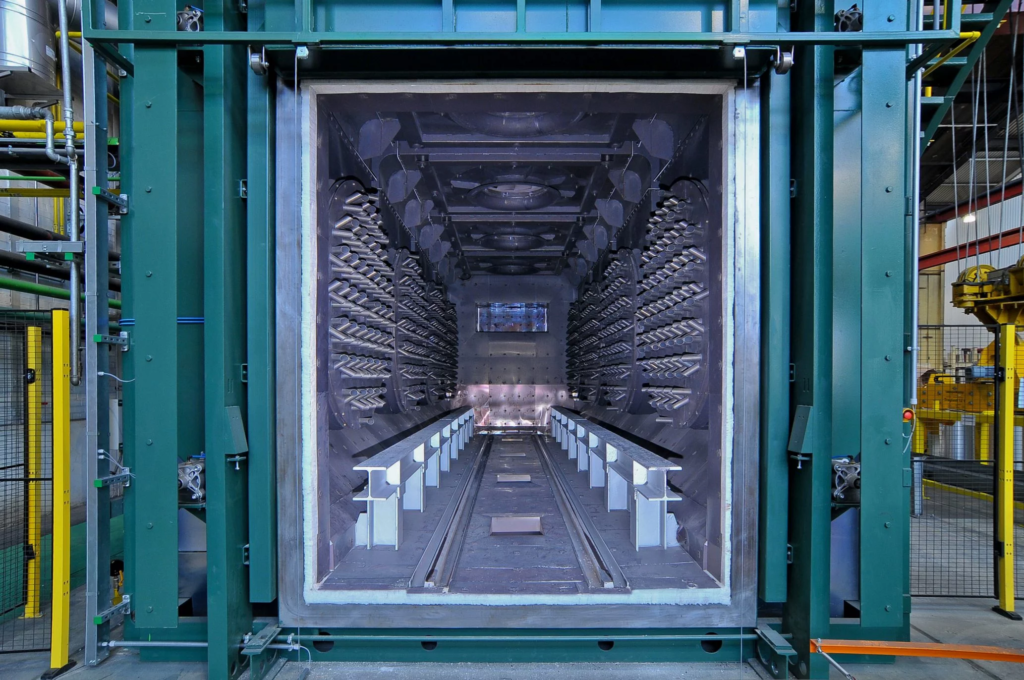
Annealing is a heat treatment in which a metal is heated to a set temperature, held there, and then cooled slowly. The purpose is to soften the metal, restore its ductility, and relieve internal stress, so that it can be formed, machined, or cold worked further without cracking.
Annealing is one of the core processes in our guide to the types of heat treatment of metals. It is the opposite of hardening: where quenching and tempering cools fast to gain strength, annealing cools slowly to gain softness.
Why Metals Are Annealed
- To reverse work hardening. Rolling, drawing, and bending make metal harder and less ductile. Annealing resets it so that forming can continue.
- To improve machinability. A softer, more uniform structure cuts more easily and extends tool life.
- To relieve internal stress left by casting, welding, or machining.
- To refine or homogenize the structure, especially in castings.
- To restore electrical conductivity in copper and aluminum wire.
The Three Stages of Annealing
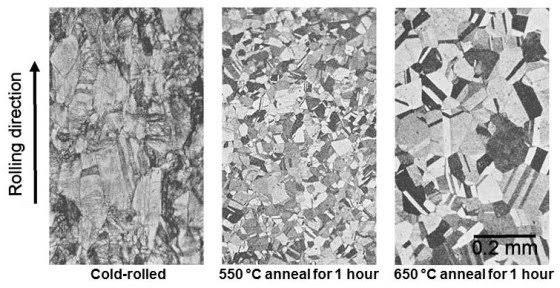
What happens inside a cold-worked metal as it is heated can be divided into three stages.
| Stage | What happens | Effect on properties |
|---|---|---|
| Recovery | Internal stresses relax as defects in the crystal structure rearrange | Stress falls, hardness barely changes |
| Recrystallization | New, strain-free grains form and replace the deformed ones | Hardness drops sharply, ductility returns |
| Grain growth | The new grains grow larger if heating continues | Further softening, but coarse grains reduce toughness and surface quality |
Good annealing practice reaches full recrystallization and stops before significant grain growth.
Types of Annealing
Full annealing
Steel is heated into the austenite range, about 30–50°C above its upper transformation temperature for steels below roughly 0.8% carbon, and then cooled very slowly, usually inside the furnace. The result is coarse pearlite: the softest, most ductile condition for a given steel. It is slow and costly, so it is used where maximum softness is needed.
Process annealing
Also called subcritical or intermediate annealing. Cold-worked low carbon steel is heated to roughly 550–700°C, below the transformation temperature, so that it recrystallizes without changing phase. This is the workhorse treatment between cold-forming steps for sheet and wire.
Stress relief annealing
The part is heated to a lower temperature, about 550–650°C for steel, held, and cooled slowly. The structure does not change. Only residual stress is removed. When this is applied to welds it is known as post weld heat treatment.
Spheroidizing
High carbon and tool steels are held for many hours just below, or cycled around, the lower transformation temperature. The hard carbide plates break up into small spheres in a soft ferrite matrix. This gives high carbon steel its best machinability and formability.
Isothermal annealing
The steel is austenitized, cooled quickly to a temperature just below the transformation point, and held there until transformation is complete. It gives a result similar to full annealing in a shorter and more controllable cycle.
Homogenizing (diffusion annealing)
Castings and ingots are held at very high temperature, often above 1,000°C for steel, for a long time. This evens out the chemical segregation that forms during solidification.
Solution annealing
Austenitic stainless steels are heated to about 1,040–1,120°C and cooled rapidly. This dissolves chromium carbides and restores corrosion resistance. Unlike other annealing treatments, the cooling here is fast.
Bright annealing
Any annealing carried out in a protective atmosphere or vacuum so that the surface stays clean and free of oxide scale.
Annealing Types Compared
| Type | Temperature relative to transformation | Cooling | Main purpose |
|---|---|---|---|
| Full annealing | Above | Very slow, in furnace | Maximum softness |
| Process annealing | Below | Slow, in air or furnace | Restore ductility between forming steps |
| Stress relief | Well below | Slow | Remove residual stress |
| Spheroidizing | Just below or around | Very slow, long hold | Machinability of high carbon steel |
| Homogenizing | Far above | Slow | Even out composition in castings |
| Solution annealing | Far above | Fast | Corrosion resistance of stainless steel |
Annealing Non-Ferrous Metals
Non-ferrous metals have no phase transformation like steel, so annealing them is simply a matter of recrystallization.
| Metal | Typical annealing temperature | Notes |
|---|---|---|
| Copper | About 400–650°C | Can be cooled in water without hardening |
| Brass | About 425–700°C | Depends on zinc content and required grain size |
| Aluminum alloys | About 345–415°C | Produces the “O” temper |
These are indicative ranges. The right temperature depends on the alloy, the amount of prior cold work, and the grain size required. Copper alloys are discussed in our article on non-ferrous casting.
Annealing vs Normalizing vs Tempering
| Annealing | Normalizing | Tempering | |
|---|---|---|---|
| Heated to | Above transformation (full anneal) | Above transformation | Below transformation |
| Cooling | Slow, in furnace | In still air | In air |
| Starting condition | Any | Any | Quenched steel |
| Result | Softest, most ductile | Finer grain, somewhat stronger and harder | Tougher, less brittle |
| Cost and time | Highest | Lower | Lower |
Normalizing is often chosen over full annealing for steel castings and forgings, because it is faster and gives a finer, stronger structure.
Common Annealing Problems
- Grain growth from too high a temperature or too long a hold. Coarse grains cause a rough “orange peel” surface when sheet is formed.
- Oxidation and scale when no protective atmosphere is used.
- Decarburization, the loss of carbon from the surface of steel.
- Incomplete softening from too low a temperature or too short a time.
- Sticking of tightly wound coils or stacked sheets at temperature.
- Uneven properties when a large furnace load heats unevenly.
Hardness testing and, where it matters, grain size measurement confirm that the anneal reached its target.
Frequently Asked Questions
What is annealing in simple terms? Heating a metal and cooling it slowly to make it softer and easier to work.
Does annealing make metal weaker? It lowers hardness and strength, and raises ductility. That is the intended trade: the metal becomes easier to form or machine, and can be hardened again later if needed.
How is steel annealed at home or in a small shop? The usual method is to heat the steel to a dull red-orange, hold it, and let it cool as slowly as possible, for example buried in dry ash or vermiculite. Results are far less controlled than in a furnace.
Why can copper be quenched after annealing but steel cannot? Copper has no hardening transformation, so the cooling rate does not matter. Steel that is cooled quickly from the austenite range forms hard martensite instead of soft pearlite.
What is the difference between annealing and stress relieving? Stress relieving uses a lower temperature and does not change the grain structure. Annealing recrystallizes the metal.
Conclusion
Annealing softens metal through recovery, recrystallization, and controlled grain growth. The type to use depends on the goal: full annealing for maximum softness, process annealing between forming steps, stress relief for residual stress, spheroidizing for high carbon steels, and solution annealing for stainless steel. In every case, temperature and cooling rate decide the result.


