
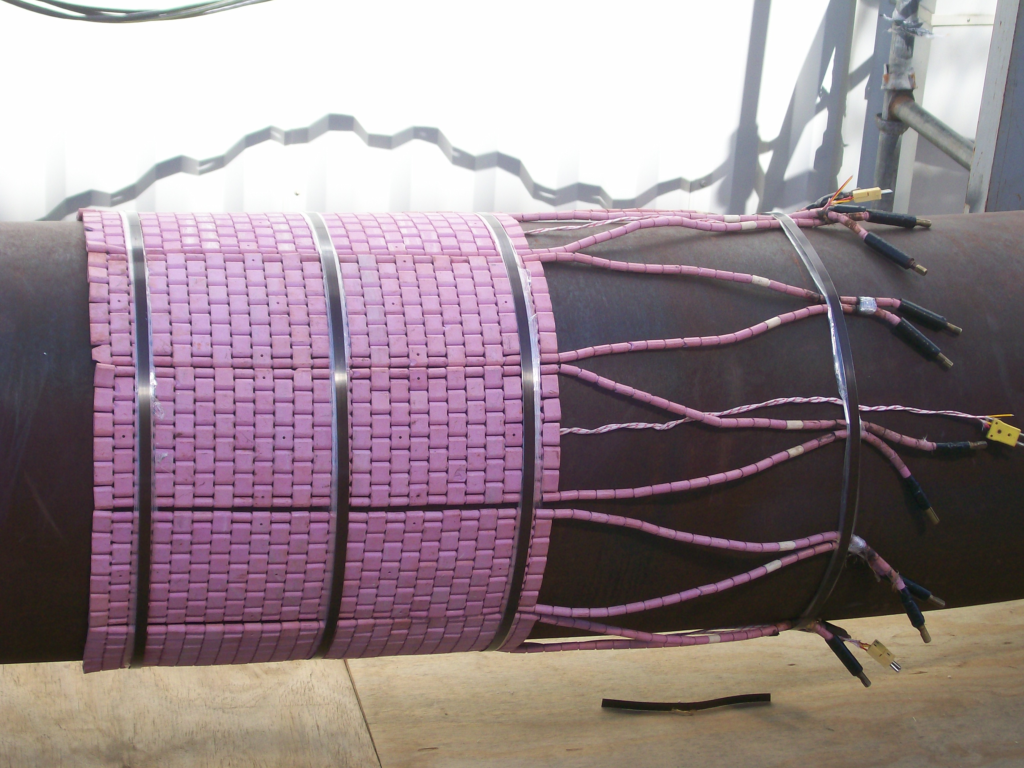
Post weld heat treatment (PWHT) is a controlled heating and cooling cycle applied to a welded component after welding is complete. The steel is heated to a temperature below its lower transformation point, held there, and cooled slowly. The aim is to reduce the residual stress left by welding and to soften the hard, brittle zones next to the weld.
PWHT is a specific application of the processes described in our guide to the types of heat treatment of metals. In everyday shop language it is often simply called stress relieving.
Why Welds Need It
Welding heats a narrow band of metal to melting point while the surrounding steel stays cold. As the weld cools and contracts, the cold metal around it resists. Two problems result:
- Residual stress. Stress locked into the weld zone can approach the yield strength of the steel, even with no external load applied.
- A hard heat-affected zone (HAZ). In hardenable steels, the metal beside the weld cools fast enough to form martensite, which is hard and brittle.
What PWHT Achieves
| Benefit | How it happens |
|---|---|
| Lower residual stress | At temperature, the steel’s yield strength drops and the locked-in stress relaxes |
| Tempered HAZ | Hard martensite is tempered into a tougher, softer structure |
| Hydrogen removal | Hydrogen trapped during welding diffuses out, lowering the risk of delayed cracking |
| Dimensional stability | Parts hold their shape during later machining |
| Better resistance to stress corrosion cracking | Lower stress and hardness reduce cracking in sour, caustic, and amine service |
The PWHT Cycle
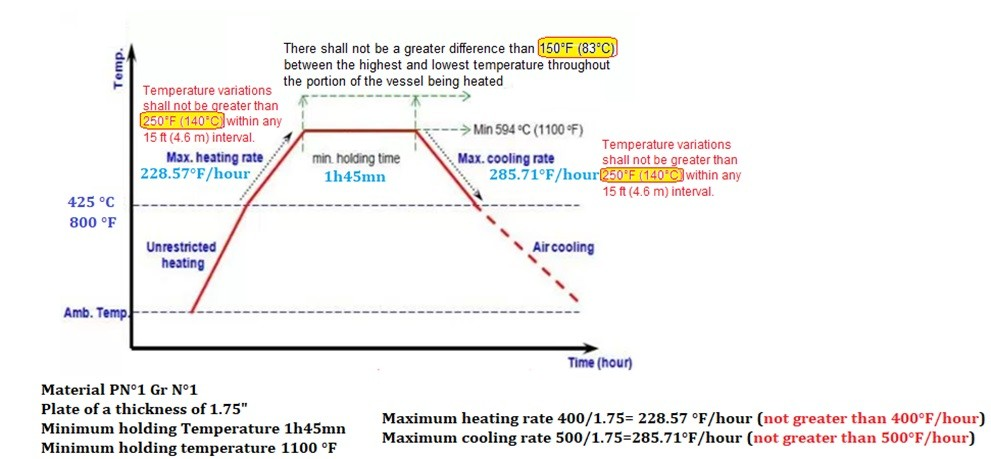
1. Heating. The component is heated at a controlled rate. Codes limit the rate above roughly 300–425°C, and the limit gets tighter as thickness increases, so that thick and thin areas do not heat unevenly.
2. Soaking. The part is held at the specified temperature. A common rule is one hour per 25 mm (1 inch) of thickness, with a minimum time set by the code.
3. Cooling. The part is cooled at a controlled rate down to roughly 300–425°C, then allowed to cool in still air.
Thermocouples attached to the component record the whole cycle, and the chart becomes part of the quality record.
Typical PWHT Temperatures
| Material | Typical soak temperature |
|---|---|
| Carbon steel | About 595–650°C |
| 1¼Cr-½Mo steel | About 650–705°C |
| 2¼Cr-1Mo steel | About 675–760°C |
| 9Cr-1Mo-V steel (Grade 91) | About 730–775°C |
| Austenitic stainless steel | Usually not required |
These ranges are indicative. The exact temperature, holding time, and heating and cooling rates always come from the governing code and the qualified welding procedure specification (WPS).
When Is PWHT Required?
The requirement depends on four things:
- The code. Pressure vessel, piping, and structural codes such as ASME Section VIII, ASME B31.1, ASME B31.3, and AWS D1.1 each set their own rules.
- Material. Alloy steels with chromium and molybdenum almost always need PWHT. Plain carbon steel needs it only above a certain thickness.
- Thickness. Thicker sections hold more restraint and more residual stress, so codes set thickness limits above which PWHT becomes mandatory.
- Service. Sour gas, caustic, amine, and low-temperature service can require PWHT regardless of thickness.
For low carbon steel in thin sections and ordinary service, PWHT is usually not needed.
Methods of Applying PWHT
| Method | How it works | Best suited to |
|---|---|---|
| Furnace PWHT | The whole component is heated in a furnace | Vessels and assemblies that fit in the furnace |
| Local electric resistance | Ceramic heating pads are wrapped around the weld and insulated | Pipe welds and field joints |
| Induction heating | Coils induce heat directly in the steel | Thick-wall pipe, fast and uniform heating |
| Internal firing | Burners heat a large vessel from the inside, with insulation outside | Vessels too large for any furnace |
With local PWHT, the heated band must extend well beyond the weld on each side. A band that is too narrow creates steep temperature gradients and can introduce new stress instead of removing it.
PWHT, Stress Relief, and Post-Heating
These terms are often mixed up.
- PWHT is the general term for any heat treatment after welding. For carbon and low-alloy steels, it almost always means a subcritical stress relief.
- Stress relief describes the purpose. It can also be applied to castings and machined parts that were never welded.
- Post-heating, or hydrogen bake-out, is a lower-temperature hold, typically around 200–350°C, carried out immediately after welding to let hydrogen escape. It does not relieve stress and is not a substitute for PWHT.
Risks and Common Mistakes
- Over-tempering. Holding too hot or too long reduces strength. On quenched and tempered steels, PWHT must stay below the original tempering temperature. See quenching and tempering.
- Too many cycles. Each repair and repeat PWHT adds to the total time at temperature, and codes limit the cumulative effect on properties.
- Reheat cracking. Some chromium-molybdenum-vanadium steels can crack in the HAZ during PWHT itself.
- Sensitization. Holding austenitic stainless steel in the PWHT range can cause chromium carbides to form at grain boundaries, which lowers corrosion resistance.
- Distortion. Poor support in the furnace lets heavy components sag at temperature.
- Poor thermocouple placement. If the coldest and hottest points are not monitored, the record does not prove the cycle was met.
PWHT and Castings
PWHT is not limited to fabricated vessels and pipe. Steel castings that are repaired by welding often need a stress relief or a full re-heat treatment afterward, depending on the size of the repair. This is covered in repair welding of metal castings.
Frequently Asked Questions
What does PWHT stand for? Post weld heat treatment. It is heat treatment carried out after welding to relieve stress and temper the weld zone.
What is the PWHT temperature for carbon steel? Typically about 595–650°C, held for around one hour per 25 mm of thickness. The governing code sets the exact values.
Is PWHT the same as annealing? No. PWHT is done below the transformation temperature and does not recrystallize the steel. Full annealing heats the steel above that temperature and produces a much softer structure.
Can PWHT be skipped? Only where the code permits. Some codes allow alternatives such as higher preheat or temper bead welding in specific cases, and these must be qualified.
Conclusion
PWHT lowers residual stress, tempers the heat-affected zone, and drives out hydrogen. Whether it is required, and at what temperature and time, is decided by the code, the material, the thickness, and the service. The cycle itself is simple. The quality of the result depends on controlled rates, the correct soak, and a temperature record that proves it.


