
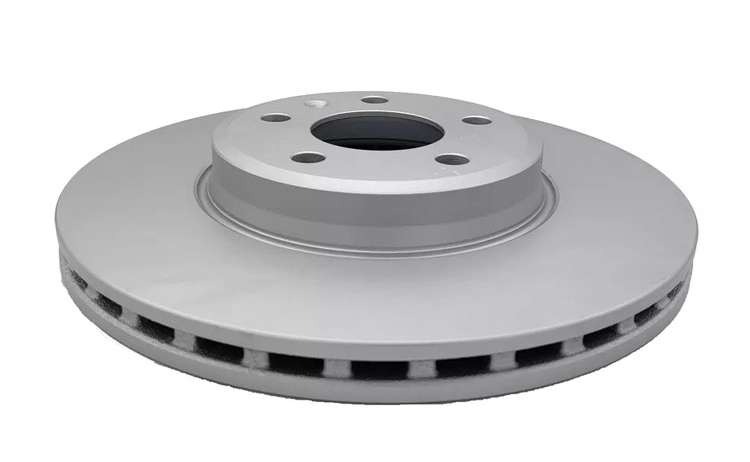
Car brake rotors, engine blocks, lathe beds, and the manhole covers in the street have one thing in common: they are usually made of gray cast iron. Gray cast iron is cast iron in which most of the carbon is present as flakes of graphite. The name comes from the dull gray color of its fracture surface, because cracks run along those graphite flakes. Gray cast iron is the most widely produced cast iron in the world. It is cheap, easy to cast, easy to machine, and outstanding at damping vibration. Its weaknesses come from the same flakes: it is brittle and weak in tension.
This guide covers the microstructure, grades and standards, properties, casting practice, and uses of gray cast iron. An overview of all five types of cast iron is in our article what is cast iron.
Composition and Carbon Equivalent
Gray iron (also spelled grey cast iron) typically contains:
| Element | Typical range | Role |
|---|---|---|
| Carbon (C) | 2.5–4.0% | Source of graphite |
| Silicon (Si) | 1.0–3.0% | Pushes carbon to form graphite instead of carbide |
| Manganese (Mn) | 0.2–1.0% | Ties up sulfur and strengthens pearlite |
| Phosphorus (P) | Up to about 0.2% | Improves fluidity but adds brittleness |
| Sulfur (S) | Up to about 0.15% | Neutralized by manganese |
Carbon and silicon are read together as the carbon equivalent (CE):
CE = %C + (%Si + %P) / 3
At a CE of 4.3% the iron is eutectic and freezes at a single temperature, which makes it easiest to cast. Most gray iron is made slightly below that. A higher CE gives more graphite and better castability but lower strength. A lower CE gives stronger iron, but thin sections are more likely to turn into hard, brittle white iron.
Gray Cast Iron Microstructure
The microstructure of gray cast iron has two parts: the graphite flakes and the metal matrix around them.
Graphite Flake Types
ASTM A247 classifies the arrangement of graphite flakes into five types:
- Type A: flakes evenly spread with random orientation. This is the preferred form for most parts.
- Type B: flakes grouped in rosettes, usually from somewhat fast cooling.
- Type C: large, coarse flakes, found in hypereutectic iron (CE above 4.3%).
- Type D: fine flakes between dendrites, caused by fast cooling or poor inoculation.
- Type E: fine flakes aligned between dendrites, typical of low-CE iron.
Types D and E are often surrounded by ferrite, which lowers strength and wear resistance.
Matrix
The matrix around the graphite can be:
- Pearlite: stronger and more wear resistant. Used for Class 35 and higher, brake rotors, and engine blocks.
- Ferrite: soft and easy to machine, but low in strength.
- Mixed ferrite and pearlite: the most common structure in low to medium grades.
Section Sensitivity
The microstructure of gray cast iron depends strongly on cooling rate. Thin sections cool fast and can form carbides at the edges (chill), which are too hard to machine. Thick sections cool slowly, so their graphite flakes are coarse, their matrix contains more ferrite, and their strength drops. As a result, one casting with varied wall thickness can have different strength from place to place. Keeping wall thickness uniform is covered in our article on design for castability.
Gray Cast Iron Grades and Standards
Gray iron grades are defined by minimum tensile strength, measured on a separately cast test bar (typically 30 mm, about 1.2 in, in diameter). The three standards met most often:
| ASTM A48 (US) | JIS G5501 (Japan) | EN 1561 (Europe) | Minimum tensile strength |
|---|---|---|---|
| Class 20 | FC150 | EN-GJL-150 | About 140–150 MPa (20–22 ksi) |
| Class 30 | FC200 | EN-GJL-200 | About 200–210 MPa (29–30 ksi) |
| Class 35 | FC250 | EN-GJL-250 | About 240–250 MPa (35–36 ksi) |
| Class 40–45 | FC300 | EN-GJL-300 | About 280–300 MPa (40–44 ksi) |
| Class 50 | FC350 | EN-GJL-350 | About 345–350 MPa (50–51 ksi) |
The equivalents in this table are approximate because each standard tests differently. The number in an ASTM class is the minimum tensile strength in thousands of psi (Class 30 means 30,000 psi), while the numbers in the JIS and EN grades are in MPa.
ASTM A48 Class 30 and Class 35 are the general-purpose grades in North America, used for pump housings, machine frames, and counterweights. Class 35 to 40 covers more heavily loaded parts such as engine blocks, large gears, and brake rotors. In Asia, the same roles are filled by FC200 and FC250.
Gray Iron Properties
Strengths:
- The best vibration damping of any engineering metal. Graphite flakes absorb vibration energy far better than steel. This is why machine tool beds are made of gray iron: the cut comes out smoother.
- High thermal conductivity. Interconnected graphite flakes carry heat well, so brake rotors and drums shed heat quickly and resist thermal cracking.
- Excellent machinability. Graphite lubricates the cutting edge and breaks up the chips, allowing fast cutting and long tool life.
- High compressive strength, about three to four times its tensile strength. Well suited to bases, frames, and supports.
- Good wear resistance, especially with a pearlitic matrix, because graphite holds lubricant on sliding surfaces. This is why gray iron is used for cylinder liners.
- Low cost and easy casting. It melts at a low temperature (about 1150–1200 °C, 2100–2190 °F) and flows well.
Weaknesses:
- Brittleness. Elongation before fracture is under 1%. The sharp tips of the graphite flakes concentrate stress and start cracks.
- Low tensile strength and poor resistance to impact.
- Difficult welding. Local heating and cooling easily form white iron that cracks. Repairs are still possible with preheating and nickel electrodes, as covered in our article on repair welding of metal castings.
- Properties that depend on section thickness, as explained in the microstructure section.
How Gray Cast Iron Is Cast
Gray iron is melted in a cupola or an induction furnace. A cupola is economical for large volumes, while an induction furnace gives tighter control of chemistry. The two are compared in our guide to melting furnaces for metal casting. Pouring temperature is usually 1350–1450 °C (2460–2640 °F), depending on wall thickness.
Three things set gray iron casting apart from other metals:
- Inoculation. Just before or during pouring, ferrosilicon containing small amounts of calcium, barium, or strontium is added (about 0.1–0.4% of the metal weight). The inoculant creates more sites for graphite to grow, so evenly spread type A flakes form and carbides do not appear in thin sections. The effect fades within minutes, so the iron must be poured promptly.
- Low shrinkage. The graphite that forms during solidification expands and offsets the shrinkage of the metal. Near-eutectic gray iron needs only small risers, sometimes none at all, as long as the mold is rigid enough. The basics of riser sizing are shown in how to calculate riser size.
- High fluidity. Gray iron fills thin walls and fine detail well, as explained in our article on the fluidity of molten metal.
Most gray iron castings are made in a sand mold, mainly green sand for mass production.
Gray Cast Iron Uses
| Field | Parts | Why gray iron is used |
|---|---|---|
| Automotive | Brake rotors and drums, engine blocks, cylinder heads, cylinder liners, clutch housings | Thermal conductivity, wear resistance, vibration damping |
| Machine tools | Lathe and milling machine beds, machine tables, frames | Vibration damping, dimensional stability, compressive strength |
| Pumps and valves | Pump housings, low-pressure valve bodies, impellers | Easy to cast in complex shapes, low cost |
| Infrastructure | Manhole covers, drainage grates, lamp posts | Compressive strength, low cost, weather resistance |
| Household | Skillets, griddles, wood stoves | Holds and spreads heat evenly |
| Other | Counterweights, flywheels, pulleys | Low cost, dense, easy to machine |
Real applications in vehicle component plants are discussed in our case study of metal casting in the automotive industry.
Gray Iron vs Ductile Iron vs Malleable Iron
These three cast irons have similar chemistry. The main difference is the shape of the graphite, and that shape decides whether the iron is brittle or ductile.
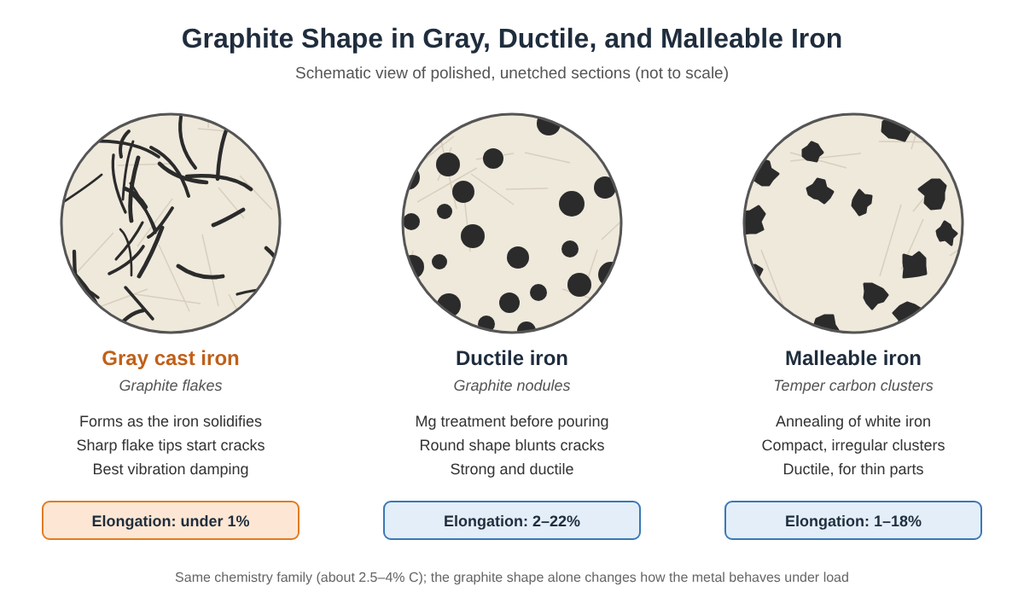
| Property | Gray cast iron | Ductile iron | Malleable iron |
|---|---|---|---|
| Graphite shape | Flakes | Nodules (spheres) | Temper carbon clusters |
| How it forms | Directly on solidification | Magnesium treatment before pouring | Annealing of white iron |
| Tensile strength | 100–350 MPa (15–51 ksi) | 350–900 MPa (51–130 ksi) | 300–800 MPa (44–116 ksi) |
| Elongation | Under 1% | 2–22% | 1–18% |
| Vibration damping | Excellent | Moderate | Moderate |
| Thermal conductivity | High | Moderate | Moderate |
| Cost | Lowest | Moderate | Higher (long anneal) |
If a part must carry tension, impact, or bending loads, ductile iron is almost always the better choice. The other two are covered in our articles on ductile iron and malleable cast iron. Cast iron is compared with cast steel and aluminum alloys in our guide to choosing materials for metal casting.
Heat Treatment of Gray Cast Iron
Gray iron is rarely through-hardened, but a few heat treatments are common:
- Stress relieving at about 500–600 °C (930–1110 °F), followed by slow furnace cooling. Used for machine beds and precision parts so that they keep their dimensions after machining.
- Ferritizing anneal at about 700–790 °C (1290–1455 °F) to turn pearlite into ferrite, making the iron softer and easier to machine. Strength drops as well. The basics are covered in our article on annealing.
- Surface hardening by induction or flame on pearlitic iron, for machine slideways and other sliding surfaces.
An overview of heat treatment types is in our guide to metal heat treatment.
FAQ
What is gray cast iron? Gray cast iron is cast iron with about 2.5–4% carbon, most of it present as graphite flakes. Its fracture surface is gray, which gives it its name. It is spelled “gray” in American English and “grey” in British English.
What is the difference between gray and white cast iron? In gray iron, carbon forms graphite. In white iron, carbon is bound as iron carbide (cementite), so the iron is very hard and brittle, and its fracture is bright white. White iron forms when cooling is too fast or silicon is too low.
What does ASTM A48 Class 30 mean? It is a gray iron grade with a minimum tensile strength of 30,000 psi (about 207 MPa), measured on a separately cast test bar. It is roughly equivalent to JIS FC200 and EN-GJL-200.
Why are brake rotors made of gray cast iron? Because gray iron conducts heat well, resists wear, damps vibration and brake squeal, and is inexpensive. Rotors for high-performance vehicles sometimes use high-carbon gray iron or ceramic composites.
Can gray cast iron be welded? Yes, but it is difficult. The part needs preheating, a nickel-based electrode, and slow cooling to avoid cracking. For parts that must be welded often, ductile iron or cast steel is a better choice.


