
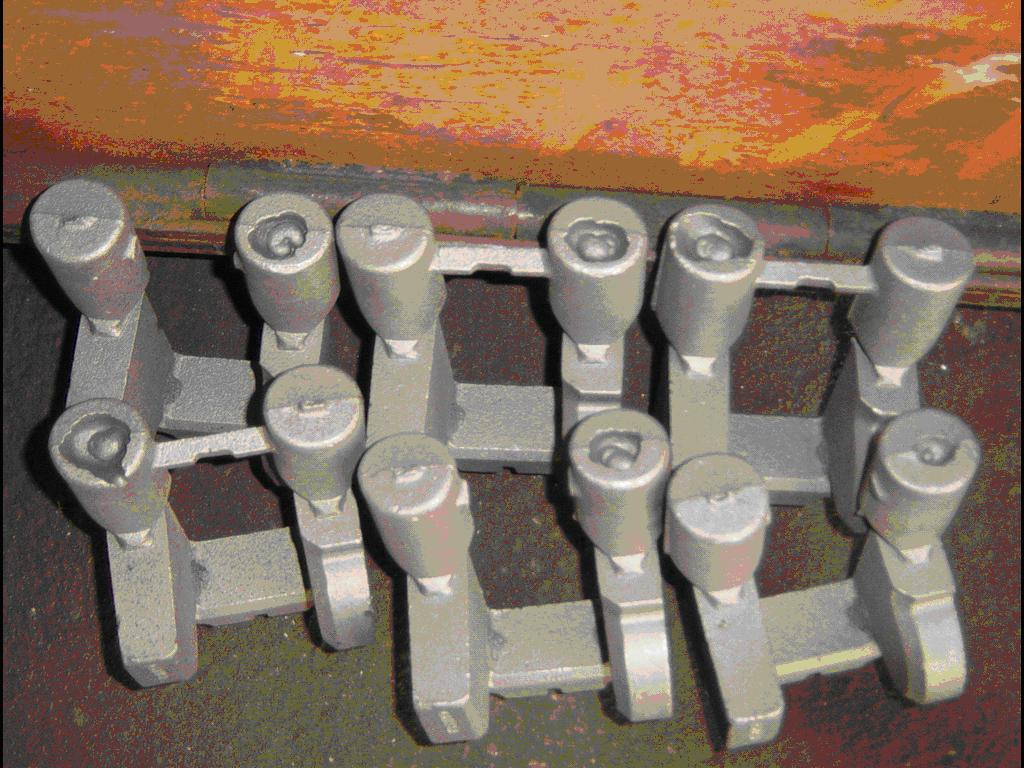
A riser, also called a feeder, is a reservoir of molten metal attached to a casting to make up for shrinkage during solidification. This guide shows how to calculate riser size with the modulus method, the approach most foundries use: the riser is made to freeze later than the section it feeds, and its volume is then checked.
This article works through the numbers. The general principles of gating and risers are covered in our guide to gating and riser system design.
The Basis: Chvorinov’s Rule
Chvorinov’s rule states that solidification time is proportional to the square of the ratio of volume to cooling surface area:
t = B × (V/A)²
- t = solidification time
- V = volume
- A = surface area that loses heat
- B = a constant that depends on the metal and the mold
The ratio V/A is called the modulus (M), and its unit is length (cm). A section with a larger modulus freezes later. Because the casting and the riser sit in the same mold, the constant B does not need to be known. Comparing the two moduli is enough.
Three Conditions for a Correct Riser
- Time: the riser freezes later than the casting. The common rule is M riser ≥ 1.2 × M casting.
- Volume: the riser holds enough liquid metal to make up for the shrinkage.
- Distance: the section being fed lies within reach of the riser.
Worked Example
Problem: a cast steel plate measuring 200 × 100 × 40 mm is poured in a sand mold. Find the size of a cylindrical riser placed on top of it.
Step 1: Calculate the casting modulus
- Volume: 20 × 10 × 4 = 800 cm³
- Surface area: 2 × (20×10 + 20×4 + 10×4) = 2 × 320 = 640 cm²
- Casting modulus: 800 ÷ 640 = 1.25 cm
Step 2: Set the riser modulus
M riser = 1.2 × 1.25 = 1.5 cm
Step 3: Size the riser
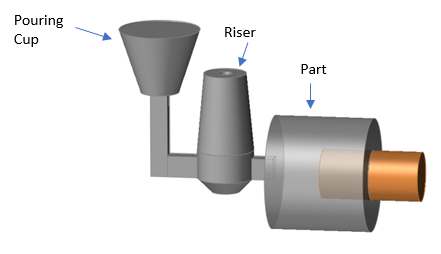
For a cylindrical riser whose height equals its diameter (H = D):
- Volume: V = π × D³ ÷ 4
- Surface area (side, top, and base): A = 1.5 × π × D²
- Modulus: M = D ÷ 6
So D = 6 × 1.5 = 9 cm, and H = 9 cm.
Riser volume = π × 9³ ÷ 4 ≈ 573 cm³.
The formula M = D ÷ 6 counts the base of the riser as a cooling surface. On a top riser the base actually sits on the casting, so the result is slightly on the safe side.
Step 4: Check the volume
Minimum riser volume:
V riser ≥ (α × V casting) ÷ (η − α)
- α = volumetric shrinkage during solidification. For carbon steel, 4% is used here.
- η = riser efficiency, the share of the riser volume that can actually flow into the casting. For a plain cylindrical riser in a sand mold it is about 14%.
Minimum V riser = (0.04 × 800) ÷ (0.14 − 0.04) = 32 ÷ 0.10 = 320 cm³
The calculated riser holds 573 cm³, which is more than 320 cm³. The volume condition is met.
Step 5: Check the feeding distance
For a steel plate in a sand mold, the classic rule for feeding distance from the edge of the riser to the end of the casting is about 4.5 × plate thickness. With a thickness of 4 cm, the reach is about 18 cm.
If the 9 cm riser sits at the center of the 20 cm plate, the distance from the riser edge to the end of the plate is only (20 − 9) ÷ 2 = 5.5 cm. The distance condition is met with one riser.
Result: one cylindrical riser, 90 mm in diameter and 90 mm high, at the center of the plate.
Shrinkage Values for Other Metals
| Metal | Solidification shrinkage (range) |
|---|---|
| Carbon steel | 3–4% |
| Aluminum alloys | 3.5–8% |
| Brass | 4–6% |
| Gray cast iron | 0–2%, may expand |
| Ductile iron | Varies with mold rigidity |
These figures are indicative ranges. Cast iron behaves differently because the graphite that forms during solidification expands and offsets part of the shrinkage, so its risers can be much smaller than steel risers.
The Riser Neck
The neck connects the riser to the casting. It must freeze after the casting but before the riser, so its modulus is set between the two:
M casting : M neck : M riser = 1 : 1.1 : 1.2
A neck that is too small freezes first and cuts off the feed. A neck that is too large is hard to cut off and adds work at the fettling stage, described in our article on finishing metal castings.
Ways to Make the Riser Smaller
- Insulating or exothermic sleeves: slow the cooling of the riser, so a smaller riser works like a large one.
- Hot topping powder: holds heat at the top surface of an open riser.
- Chills: metal inserts at the end of the casting that speed up freezing there and extend the feeding distance.
- Blind risers: closed risers inside the mold that lose less heat than open ones.
Common Mistakes
- Calculating the modulus of the whole casting, when the thickest section or a wall junction (the hot spot) is what matters.
- Meeting the modulus condition without checking the volume.
- Ignoring feeding distance on long castings.
- Using the same factors for every metal.
- Raising the pouring temperature to cure shrinkage cavities. Pouring temperature mainly affects the fluidity of molten metal, and raising it adds liquid shrinkage.
Frequently Asked Questions
What is the casting modulus? The ratio of volume to cooling surface area. It indicates how long a section takes to freeze.
Why are risers cylindrical? Among shapes that are easy to mold, a cylinder has a small surface area for its volume, so its modulus is high. A sphere is more efficient still, but hard to mold.
Is manual calculation still needed when simulation is available? Yes. The modulus calculation gives a sensible starting size, and casting simulation is then used to check and refine it on complex shapes.
Conclusion
Calculating a riser with the modulus method comes down to three checks: the riser modulus is at least 1.2 times the casting modulus, the riser volume covers the shrinkage, and the whole casting lies within the feeding distance. The result is a starting point. For castings with complex shapes, it is checked again with solidification simulation or trial pours.
Related Articles
- Gating and Riser System Design in Metal Casting
- Metal Casting Defect Case Study: Porosity and Hot Tearing in Manufacturing
- Digital Simulation in Metal Casting: Preventing Defects Before Physical Production
- Fluidity of Molten Metal: Definition, Factors, and How to Test It
- Brass Casting: Process, Pouring Temperature, and Common Defects


