
Most metal casting defects, such as the porosity and hot tearing covered in our casting defect case study, can actually be prevented long before molten metal is poured: at the stage of designing the gating system and risers. Many new practitioners focus on material selection and melting parameters, yet poor gating and riser design is one of the most common causes of failed castings, from misruns and cold shuts to shrinkage porosity.
This article covers the technical principles behind gating and riser system design: the components, how to calculate the right channel ratios, and standard industry methods for sizing and positioning risers.
What Is a Gating System and Why Does Its Design Matter?
A gating system is the network of channels that carries molten metal from the pouring point into the mold cavity. Its purpose is not simply to “deliver” metal but to control three things at once: flow velocity, flow direction, and the level of turbulence. A poor design causes excessive turbulence (trapping gas and oxides in the casting), erodes the walls of sand molds (causing sand inclusions), or lets the metal freeze before the cavity is completely filled (causing misruns and cold shuts).
Main Components of a Gating System
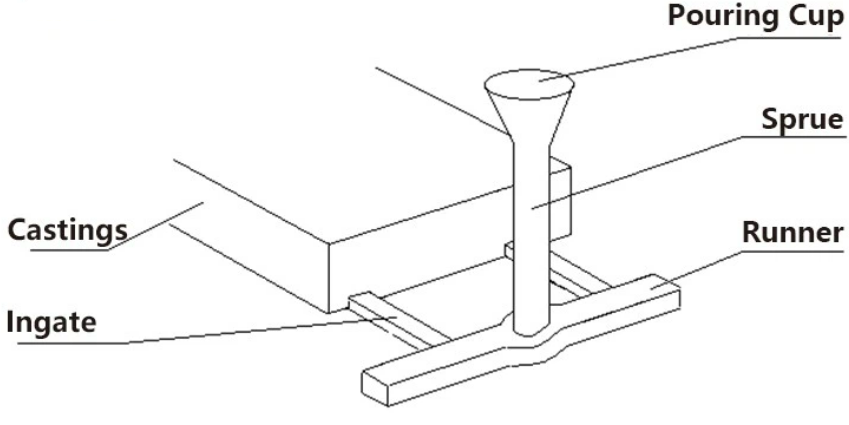
Pouring basin (pouring cup). A small reservoir at the top of the mold that dampens the momentum of the molten metal before it enters the sprue, while also holding back coarse dirt.
Sprue. The vertical channel that carries metal from the pouring basin down to the lower part of the mold. Sprues are usually tapered (narrowing toward the bottom) to keep flow velocity under control and prevent air aspiration.
Runner. The horizontal channel that distributes metal from the base of the sprue to the ingates. The runner also slows down the metal after its free fall through the sprue.
Ingate (gate). The final channel connected directly to the mold cavity. The size and position of the ingates determine the speed and direction of the metal as it enters the cavity.
Riser (feeder). An extra reservoir of molten metal that acts as a reserve to compensate for volume shrinkage as the metal solidifies.
Gating Ratio: Pressurized or Unpressurized
One of the most important parameters in gating design is the gating ratio: the ratio of the cross-sectional areas of the sprue, runner, and ingates (written As : Ar : Ag). This ratio determines whether the system works as pressurized or unpressurized:
Pressurized systems. The total ingate area is smaller than the runner and sprue (for example a ratio of 1 : 2 : 1 or 2 : 1 : 1). This keeps the channels full of molten metal, so air aspiration is minimal, which suits ferrous metals. The trade-off is that turbulence at the ingates tends to be higher.
Unpressurized systems. The cross-sectional area grows toward the mold cavity (for example a ratio of 1 : 2 : 2 or 1 : 3 : 3). Flow is calmer and turbulence is low, but the channels risk not running full, making them more prone to trapping air and producing gas porosity.
As a starting point, many foundries set the runner area at around 2 to 4 times the total ingate area, with metal velocity at the ingates kept within about 0.5 to 1.5 m/s to avoid eroding sand molds while also preventing premature freezing. These figures still need to be adjusted for the type of metal, the section thickness of the casting, and simulation results. They are not a fixed formula to apply blindly.
Basic Principles of Riser Design
The job of a riser is to make sure the thickest part of the casting (usually the last point to solidify) keeps receiving molten metal throughout solidification, so that the shrinkage cavity forms inside the riser rather than in the body of the casting that becomes the final product.
Chvorinov’s Rule as the Basis for Calculation
The core principle of riser design rests on Chvorinov’s rule, which states that the solidification time of a section of a casting is proportional to the square of its modulus:
t = B × (V/A)²
where t is the solidification time, B is the mold constant (which depends on the metal and the type of mold), V is the volume of the casting section, and A is its cooling surface area. The ratio V/A is called the geometric modulus. The larger a section’s modulus, the longer it takes to solidify.
The most fundamental principle of riser design is this: a riser must solidify later than the section of the casting it feeds. In modulus terms, the riser modulus (M_riser) must be larger than the modulus of the target casting section (M_casting), usually by a factor of about 1.2 to 1.5 as a safety margin.
The Modulus Method for Sizing Risers
Practical steps for sizing a riser with the modulus method:
- Calculate the modulus of the most critical casting section (usually the thickest section or a junction of several walls, which is likely to become a hot spot).
- Set a target riser modulus of 1.2 to 1.5 times that casting modulus.
- For a cylindrical riser (the most common shape, because its modulus is efficient relative to its volume and it is easy to mold), choose a height-to-diameter ratio, usually around 1.0 to 1.5, then calculate the dimensions that meet the target modulus.
- Make sure the riser volume is enough to compensate for shrinkage. As a starting point, riser volume is typically set at 1.5 to 2.0 times the volume of the fed section.
For a full worked example, from modulus to the volume and feeding distance checks, see how to calculate riser size.
Besides the modulus method, there is also Caine’s method, which plots the riser-to-casting volume ratio (X) against the riser-to-casting surface area ratio (Y) on a reference curve. It helps verify whether the riser proportions fall in the safe zone for a given metal.
Feeding Distance: When You Need Additional Risers
A riser can only feed molten metal effectively up to a certain feeding distance from its position. The longer the feeding distance a section needs, the greater the risk of isolated liquid pools forming out of the riser’s reach, and those end up as hidden shrinkage defects in the middle of the casting. For long or complex castings, the solution is not to oversize a single riser but to add more risers at the different hot spots.
Top Risers vs Side Risers
Top risers sit directly above the section they feed, feeding vertically. They suit thick sections where feeding straight down is possible.
Side risers sit alongside the casting and feed laterally. They are practical when space in the mold is limited, but their feeding efficiency can be lower than a top riser on very thick sections, because the direction of the feed metal does not line up with the direction of solidification.
Common Mistakes That Lead to Defects
Some of the most frequent gating and riser design mistakes seen on the shop floor:
- Ingates too small for the section they serve, causing excessive flow velocity, mold erosion, and turbulence that traps gas.
- Risers too small or in the wrong place, so the riser freezes before the section it is supposed to feed. The result is shrinkage in the body of the casting even though a riser is fitted.
- Sprues that are not tapered or are too long, triggering air aspiration and premature freezing before the metal reaches the runner.
- Ignoring feeding distance on complex geometries, forcing one riser to cover an area that actually needs additional risers.
- Gating ratios not matched to the metal. A ratio that works for aluminum alloys is not necessarily right for cast iron or steel, because each metal has different fluidity and shrinkage behavior.
The Role of Simulation in Modern Design
Manual calculation with Chvorinov’s rule and the modulus method remains relevant as the theoretical foundation, but complex castings, with many changes in thickness and hot spots that are hard to predict by hand, are now often validated first with solidification simulation software, as covered in digital simulation in metal casting. Simulation lets designers see hot spots and potential porosity before the physical mold is made, making gating and riser design iterations far cheaper than trial and error on the production floor.
Conclusion
Gating and riser system design is not just a matter of drawing channels on a mold. It is a technical calculation that decides whether a casting will be defect-free or will contribute to a high reject rate. Understanding gating ratios, Chvorinov’s rule, the modulus method, and feeding distance gives engineers and foundry operators a solid basis for diagnosing root causes when defects such as porosity or hot tearing keep recurring, instead of only changing melting parameters without touching the real cause in the gating system.


