
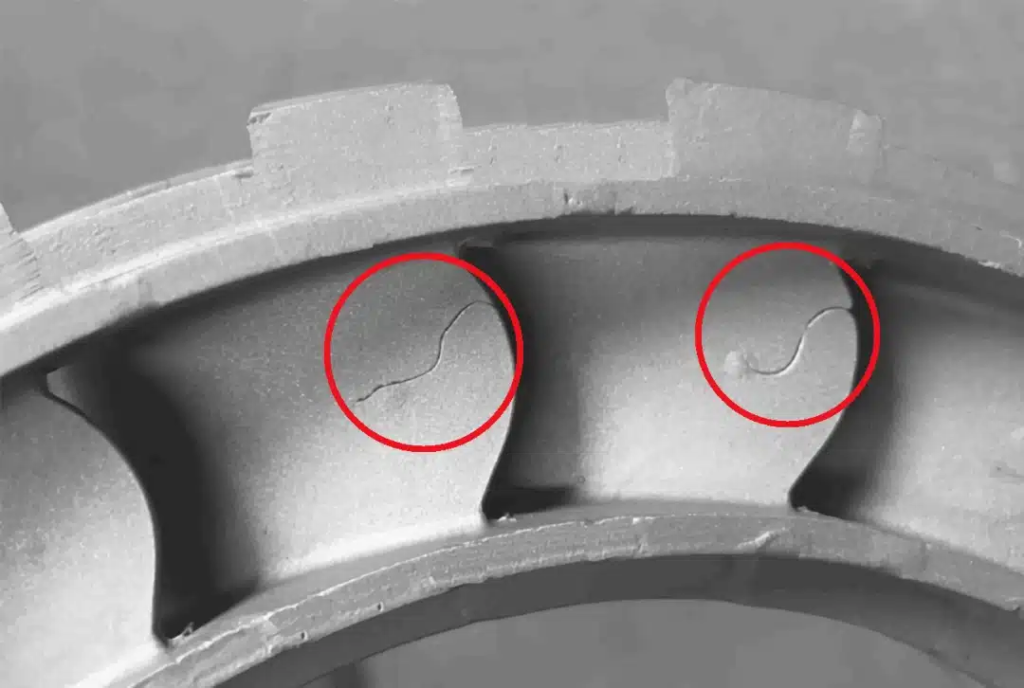
Alongside porosity and hot tearing, there are two other defects every casting engineer needs to understand: cold shuts and misruns. Unlike porosity, which is related to gas or shrinkage, both of these defects come purely from mold filling problems: the molten metal fails to fill the mold cavity completely before it solidifies.
What Is a Cold Shut?
A cold shut in casting occurs when two separate streams of molten metal meet in the mold but do not fuse completely, leaving a weak joint line that looks like a fine crack with rounded edges on the part surface.
How it happens: when molten metal flows from two different directions (for example from two separate gates, or around a core), both streams lose enough heat before meeting that the temperature at the meeting point is too low for proper metallurgical fusion. The result is a mechanically weak joint, even though it may not look very obvious.
How to identify it: a line with rounded edges (not sharp like an ordinary crack), often found in areas far from the main gate or around holes and openings in the part.
What Is a Misrun?
A misrun is a failure of the molten metal to fill the entire mold cavity before solidifying, leaving part of the casting incompletely formed. It usually appears as a section that looks “cut off” or unfinished, especially in areas of the mold farthest from the pouring point or with the thinnest sections.
How it happens: the molten metal loses fluidity (thickens and begins to solidify) before it reaches every part of the mold cavity, especially in very thin walls or geometry far from the gating.
The Main Causes of Cold Shuts and Misruns
Both defects share similar root causes, closely tied to the fluidity of the molten metal and the design of the filling system:
Pouring temperature too low. Metal poured too close to its freezing point has low fluidity and quickly loses its ability to flow, significantly increasing the risk of both defects.
Inadequate gating design. A poorly designed gating and riser system, for example with channels that are too small or gates in the wrong position, can make the molten metal lose heat too quickly before filling the whole cavity.
Uneven wall thickness. Sudden transitions from thick to very thin walls create misrun-prone spots, because thin sections freeze much faster than the thick sections around them.
Pouring too slowly. Slow pouring gives the molten metal more time to lose heat before filling the mold, especially for large parts or complex geometries.
Inherently low material fluidity. Some alloys naturally have lower fluidity than others. Cast steel, for example, generally has lower fluidity than cast iron or aluminum-silicon alloys, so it needs extra attention to temperature and gating design.
Effective Prevention Strategies
Optimizing pouring temperature. Raising the pouring temperature (within safe limits that do not cause other problems such as excessive gas porosity) gives a larger fluidity margin for filling the mold completely before solidification.
Improving gating system design. Making sure gating channels are large enough and positioned to minimize the distance and time the metal needs to reach the farthest parts of the mold, often validated with digital simulation before the physical mold is made.
Designing parts with the casting process in mind. Avoiding overly abrupt changes in wall thickness and keeping minimum wall thickness within what the chosen material’s fluidity can reliably fill, as covered in design for castability.
Controlling pouring speed and pressure. Especially in die casting, injection speed needs to be optimized so the metal fills the mold quickly enough before losing fluidity.
Adequate mold preheating. For methods such as die casting, heating the metal die to its optimal working temperature before production reduces how fast the molten metal loses heat once it enters the die.
Detection and Verification
Cold shuts in particular can be hard to see (the joint line is sometimes very fine), so non-destructive testing such as liquid penetrant or radiographic testing is often needed for critical parts. This matters because a cold shut creates a structural weak point that can become the starting point of a crack when the part is loaded in service.


