
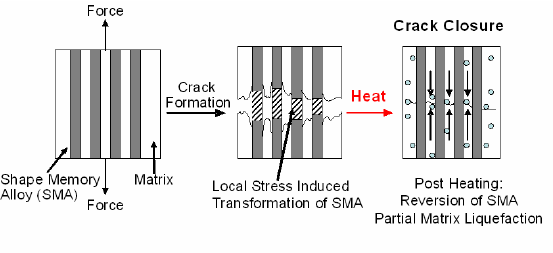
Imagine a metal component that can “remember” its original shape and return to it after being deformed, or micro-cracks that close themselves without human intervention. This is not science fiction. It is the focus of research into smart alloys and self-healing materials, one of the most promising fields in advanced metallurgy today.
Shape Memory Alloys: Metals That “Remember” Their Shape
Shape memory alloys (SMAs) are metal alloys that can undergo significant deformation and then return to their original shape when heated to a certain temperature. This ability comes from a reversible crystal phase transformation in the metal’s microstructure, not from any conventional mechanical mechanism.
Nitinol (nickel-titanium) is the most widely used commercial SMA. It relies on a phase transformation between martensite (at low temperature, easy to deform) and austenite (at high temperature, returning to its original “memorized” shape).
How the mechanism works: unlike conventional heat treatment, which produces permanent structural change, the phase transformation in an SMA is reversible and can happen again and again without damaging the material, as long as the material stays within safe deformation limits (known as the super-elastic limit).
Applications already on the market:
- Orthodontic wires that apply a constant corrective force over time without needing adjustment as often as conventional wires
- Medical stents that can be inserted folded small through a catheter, then “remember” their expanded shape once they reach body temperature
- Actuators and mechanical components in aerospace applications that need movement without conventional electric motors
Self-Healing Materials: Repairing Damage on Their Own
Unlike SMAs, which focus on shape recovery, self-healing materials are designed to repair micro-scale structural damage, such as fine cracks, automatically. This extends component life and can potentially catch problems before they grow into serious structural failures.
The microcapsule approach. One of the more mature methods (although more common in polymer composites than in pure metals) embeds microcapsules containing a healing agent in the material. When a crack forms and breaks the microcapsules, the agent flows into the crack and hardens, effectively “closing” the damage.
Liquid metal-based self-healing. Research on some metal alloys explores embedding microscopic networks filled with low-melting-point liquid metal that can flow into micro-cracks as they form, then solidify to seal the gap.
Controlled precipitation-based self-healing. Some aluminum and magnesium alloys show a limited natural self-healing ability through the precipitation of second-phase particles concentrated around micro-cracks, gradually “plugging” further crack growth. The effect is still far from perfect and is a focus of ongoing research.
Why Combining with Sensors and Monitoring Matters More and More
Smart alloy research is increasingly connected with the wider Industry 4.0 trend. Smart materials that give a signal (such as a change in electrical resistance) when deformed or micro-damaged open the door to structural monitoring that is far more proactive than periodic inspection with conventional non-destructive testing.
Challenges Limiting Wider Industrial Adoption
Production costs are still very high. Both shape memory alloys and self-healing metals require much stricter and more expensive production and composition control than conventional metals, limiting adoption to high-value applications such as medical devices and aerospace.
Limited SMA working cycles. Although designed to be reversible, shape memory alloys still have a limit on the number of deformation-recovery cycles before material fatigue sets in and they gradually lose their shape memory.
Self-healing effectiveness is still limited. Self-healing in metals today is generally effective only for very small-scale micro-damage, far from the ability to repair significant structural damage that popular expectations often imagine.
Complex characterization and certification. For safety-critical applications, validating the long-term reliability of materials with complex “smart” behavior requires testing and certification protocols that are still being developed, unlike the well-established standards for conventional materials.
Future Research Directions
Research into smart alloys and self-healing metallurgy is moving in several promising directions: developing SMA formulations with longer working lives and adjustable transformation temperatures for a wider range of applications; combining self-healing mechanisms with nanostructured materials to improve micro-repair effectiveness; and developing more economical production methods to open up applications beyond the medical and aerospace sectors that dominate commercial use today.
For researchers and engineers following advanced metallurgy, smart alloys and self-healing materials represent an interesting paradigm shift: from simply choosing materials with fixed, static properties toward materials that actively respond and adapt to their operating conditions.


