
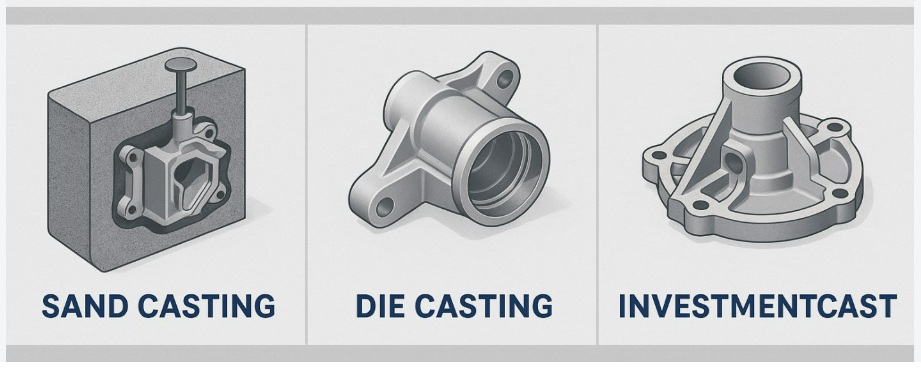
Once the basics of metal casting are clear, the next question that comes up most often, on the production floor and at the design desk alike, is this: which casting method is best for a particular part? The three methods most widely used in industry, sand casting, die casting, and investment casting, differ greatly in dimensional tolerance, surface quality, the metals they can use, and their production economics.
This article compares the three from a technical point of view, so that choosing a casting method is based not on habit but on how well it fits the part geometry, production volume, and budget.
Sand Casting: Flexible and Economical for Large Parts
Sand casting uses a single-use sand mold formed around a pattern. Molten metal is poured into the mold cavity by gravity.
Advantages:
- The lowest tooling cost of the three. Patterns can be made from wood or even 3D printed within days.
- Able to cast very large parts, from a few grams up to hundreds of tons, which is beyond the reach of both die casting and investment casting.
- Compatible with almost every metal, both ferrous (cast iron, steel) and non-ferrous.
- The most economical option for low volumes, suited to prototypes, spare parts, and small to medium production runs.
Disadvantages:
- The cast surface is relatively rough and dimensional tolerances are looser than the other two methods, so parts often need additional machining to reach precise final dimensions, and that extra step adds cost per unit.
- Less efficient at very high production volumes, because the space, labor, and handling needed for large quantities of sand molds become impractical compared with methods that use permanent molds.
Typical applications: engine blocks, structural frames, large pump and valve bodies, and components for heavy equipment, agriculture, and construction.
Die Casting: High Precision for Mass Production
Die casting injects molten metal into a permanent metal mold (die) under high pressure. Because of this pressure, the metal fills the cavity, including narrow gaps and intricate details, very quickly and precisely.
Advantages:
- The tightest dimensional tolerances of the three. For aluminum, tolerances can reach around ±0.05 mm on certain components.
- A smooth cast surface, often ready to use without much additional finishing.
- Very efficient for high-volume production (generally above a thousand units), because one die can be used over and over with fast production cycles.
- Very high dimensional consistency from part to part, which matters for precision components such as electronics housings or automotive parts.
Disadvantages:
- Dies are very expensive to make and take a long time to design and test, so die casting only becomes economical when that cost is spread over large production volumes.
- Generally suited only to non-ferrous metals with relatively low melting points, such as aluminum, zinc, magnesium, and copper. It is not an option for cast iron or steel.
- The size of parts that can be cast is far more limited than with sand casting.
- Turbulence from injecting metal at high pressure can cause gas porosity if the gating design is wrong, a principle covered in gating and riser system design.
Typical applications: electronics housings, automotive housings, structural components for electric vehicles, and high-volume consumer products.
Investment Casting: Intricate Detail with a Fine Surface
Investment casting (also known as lost-wax casting) forms a pattern from wax, coats it with a ceramic shell, then melts the wax out before molten metal is poured into the remaining cavity.
Advantages:
- Able to produce parts with very complex geometry, thin walls, and fine details that are hard to achieve with other methods.
- Tight dimensional tolerances and a very fine surface finish (typically a roughness of around Ra 63 to 125 microinches), so the need for additional machining is greatly reduced.
- Near-net-shape parts, so material waste is relatively low.
- Flexible in terms of metals, including alloys that are difficult to machine.
Disadvantages:
- Generally more expensive per cycle than sand casting or die casting at low volumes, because a new wax pattern and ceramic shell must be made for every casting cycle.
- Longer production cycle times than the other two methods, because building the ceramic shell takes many layers.
- The practical part size is far more limited than with sand casting, generally under 100 kg, with a practical upper limit of around 450 kg.
Typical applications: turbine components and airfoils in aerospace, medical parts, pressure-tight valve and pump components, and high-value products with complex geometry.
Comparison Summary Table
| Aspect | Sand Casting | Die Casting | Investment Casting |
|---|---|---|---|
| Initial tooling cost | Low | High | Medium to high |
| Ideal volume | Low to medium | High (thousands of units) | Low to medium, scalable |
| Dimensional tolerance | Loose | Very tight | Tight |
| Surface quality | Rough | Smooth | Very smooth |
| Part size | Very flexible (grams to hundreds of tons) | Limited | Limited (generally under 450 kg) |
| Metals | Ferrous and non-ferrous | Mostly non-ferrous | Flexible, including hard-to-machine alloys |
| Need for further machining | High | Low | Low |
How to Choose: Key Questions Before Deciding on a Method
What is the production volume? Tens to hundreds of units lean toward sand casting; thousands of units and up are more economical with die casting; investment casting sits in between but excels when part complexity is high.
How large and heavy is the part? Very large parts (engine blocks, heavy frames) are practically only possible with sand casting.
How tight are the tolerances and how smooth does the surface need to be? If the part needs high precision without much further machining, die casting or investment casting beats sand casting.
Which metal will be used? Cast iron and carbon steel generally point to sand casting; aluminum, zinc, and magnesium are open to all three methods depending on volume and complexity. Material options are covered further in choosing materials for metal casting.
Total cost of ownership (TCO), not just price per unit. Sand casting may be cheap in tooling, but if the part needs extensive machining again and again, the total cost can end up higher than investment casting with its minimal finishing.
Conclusion
No single casting method is “best” in every situation. Each of the three wins under different conditions. Sand casting wins on size flexibility, tooling speed, and low-volume economics. Die casting wins on precision and mass production efficiency. Investment casting wins on geometric complexity and surface quality without much further processing. Choosing the right method at the design stage, rather than adapting the design to whichever method happens to be available, is what decides whether a part can be produced efficiently and without the defect risks that often arise from a mismatch between part geometry and the characteristics of the casting process.


