
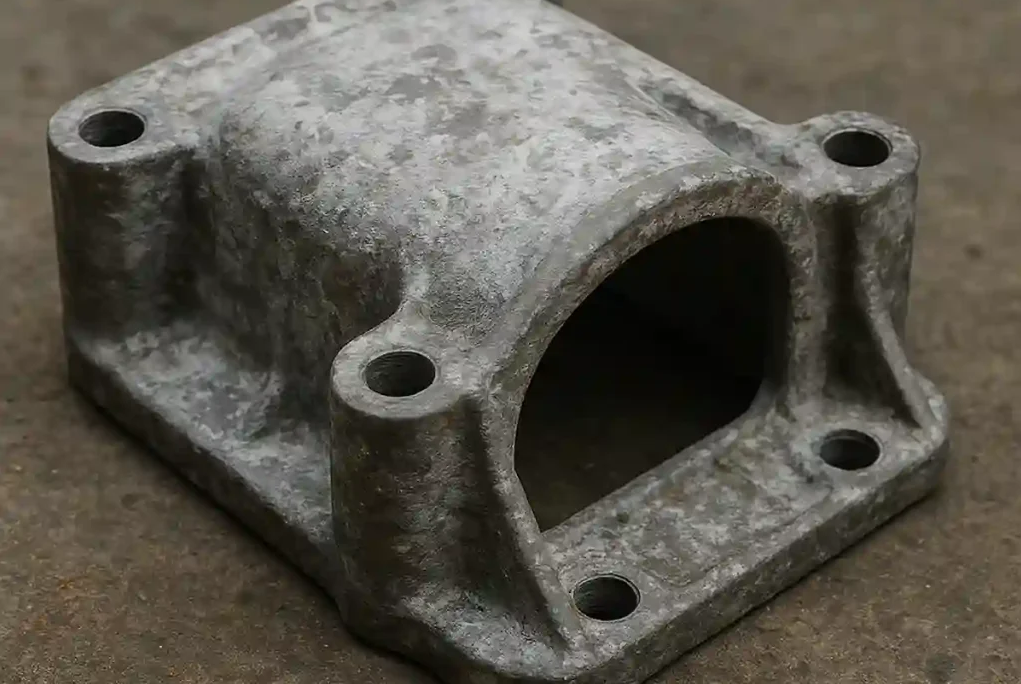
Aluminum corrosion is the deterioration of aluminum through reaction with its environment. Aluminum is actually a very reactive metal, but its surface is always covered by a thin oxide film that protects it. Corrosion only starts when that film is damaged and cannot repair itself, for example because of chloride salts, conditions that are too acidic or too alkaline, or contact with another metal.
This article covers the causes of aluminum corrosion, its main types, the effect of alloy choice, and how to prevent it. For an overview of corrosion in all metals, see our guide to the types of metal corrosion.
Does Aluminum Rust?
Aluminum corrodes, but it does not rust in the way iron does. Rust is a reddish-brown iron oxide that is porous and flakes off, so corrosion of iron keeps going. Aluminum reacts with oxygen to form aluminum oxide (Al₂O₃), which is dense, firmly attached, and only a few nanometers thick. This film seals the surface and stops further reaction. If it is scratched, a new film forms within seconds as long as oxygen is present.
That is why aluminum looks durable in open air. Its corrosion products also look different: not red rust, but grayish-white spots, stains, or powder (aluminum hydroxide and oxide). Aluminum corrosion often goes unnoticed because the color is not striking.
Causes of Aluminum Corrosion
Acidic or alkaline conditions
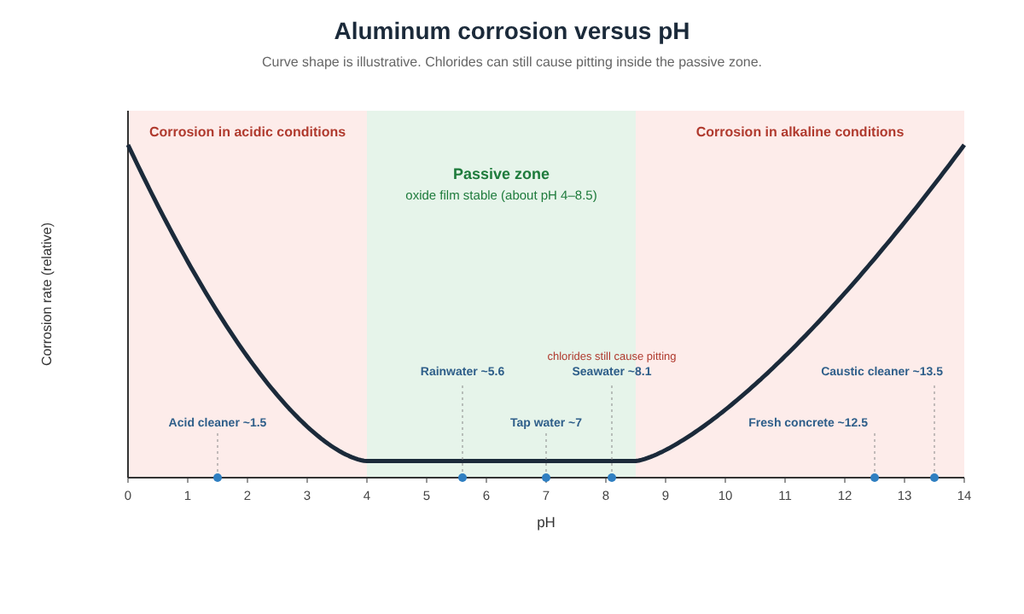
The oxide film on aluminum is stable at roughly pH 4 to 8.5. Outside that range the oxide dissolves and the metal beneath it corrodes. Aluminum is amphoteric: it is attacked by both acids and alkalis. An often overlooked source of alkali is fresh concrete and mortar (pH about 12–13), along with caustic cleaners.
Chloride ions
Chlorides from seawater, coastal air, road salt, and some industrial chemicals are aluminum’s main enemy. Chloride ions penetrate the oxide film at weak spots and start deep, localized corrosion, even when the pH is neutral.
Contact with other metals
In the galvanic series, aluminum is more active than steel, stainless steel, and copper. When aluminum touches these metals in a wet environment, aluminum becomes the anode and corrodes faster.
Copper ions in water
Water that has passed through copper pipes carries small amounts of copper ions. These deposit on aluminum, form tiny cathodic sites, and trigger pitting. For this reason, aluminum should not be installed downstream of copper plumbing.
Trapped water
Crevices, damp stacked sheets, and areas that never dry out let the local environment become acidic or starved of oxygen. The oxide film cannot repair itself there.
Types of Aluminum Corrosion
Pitting corrosion
The most common form on aluminum. Chlorides create small, deep pits, often capped with white powder. The surrounding surface looks intact, yet the pits can go right through thin sheet. The mechanism is explained in full in our article on pitting corrosion.
Galvanic corrosion
Occurs when aluminum is electrically connected to a more noble metal in a wet environment. A classic example is an aluminum plate fastened with steel bolts: the aluminum around the bolts corrodes. Damage is worst when the aluminum (anode) area is small compared with the noble metal (cathode).
Crevice corrosion
Occurs in narrow gaps, such as under washers, in lap joints, or under gaskets. Inside the crevice, oxygen is used up and the liquid turns acidic, so the oxide film cannot recover.
Intergranular corrosion
Corrosion that travels along grain boundaries. Susceptible alloys include the 2xxx series (Al-Cu), some 7xxx alloys, and 5xxx alloys with more than about 3% magnesium after long exposure to roughly 65–200°C (150–390°F). Under those conditions a phase forms at the grain boundaries that corrodes more easily than the grains.
Exfoliation corrosion
A form of intergranular corrosion in rolled or extruded products with flat, elongated grains. Swelling corrosion products push the metal layers apart, so the surface peels in layers like the pages of a book. It is common in 2xxx and 7xxx alloys in marine environments.
Stress corrosion cracking
Cracking caused by the combination of tensile stress and a corrosive environment. High-strength 7xxx alloys in the T6 temper are the most susceptible. Overaged tempers such as T73 and T76 were developed to reduce this risk, at a small cost in strength. The difference between these tempers comes from heat treatment.
Filiform corrosion
Thread-like, wandering corrosion under paint or other coatings, usually starting at a scratch or a cut edge. It appears in high humidity and is often seen on painted aluminum window frames and panels near the coast.
Water staining
Aluminum sheet or extrusions stacked while damp develop white or gray stains on the touching surfaces. The damage is usually cosmetic, but it often leads to rejected goods.
| Type | What it looks like | Main trigger |
|---|---|---|
| Pitting | Small pits with white powder | Chlorides |
| Galvanic | Corrosion around joints with other metals | Contact with steel, stainless steel, copper |
| Crevice | Corrosion under washers, gaskets, lap joints | Narrow, wet gaps |
| Intergranular | Fine cracks along grain boundaries, seen under a microscope | Susceptible alloys and certain heating |
| Exfoliation | Surface peeling in layers | Rolled or extruded 2xxx and 7xxx alloys |
| Stress corrosion cracking | Cracks with little deformation | Tensile stress and a damp environment |
| Filiform | Wandering threads under paint | High humidity and coating defects |
| Water staining | White stains on stacked material | Trapped moisture |
How Alloy Choice Affects Corrosion
Corrosion resistance depends heavily on the alloy.
| Series | Main alloying element | Corrosion resistance | Typical uses |
|---|---|---|---|
| 1xxx | Pure aluminum (≥99%) | Excellent | Electrical conductors, packaging |
| 3xxx | Manganese | Excellent | Roofing, beverage cans, heat exchangers |
| 5xxx | Magnesium | Excellent in marine environments | Boats, tanks, coastal structures |
| 6xxx | Magnesium and silicon | Good | Extrusions, window frames, frames |
| 2xxx | Copper | Low | Aircraft structures, often clad with pure aluminum |
| 7xxx | Zinc (with magnesium, copper) | Low to moderate | Aircraft structures, high-strength parts |
Among casting alloys, copper-free aluminum-silicon alloys (such as A356) resist corrosion better than copper-bearing alloys, including many die casting alloys (the processes are compared in sand vs die vs investment casting). This trade-off is also covered in our guide to choosing materials for metal casting.
How to Prevent Aluminum Corrosion
Choose the right alloy
For marine and coastal service, 5xxx and 6xxx alloys are usually the first choice. High-strength 2xxx and 7xxx alloys need protective coatings or tempers that resist stress corrosion cracking.
Anodizing
Anodizing is an electrochemical process that thickens the natural oxide film to about 5–25 micrometers (0.2–1 mil), thousands of times thicker than the natural film. Once sealed, the layer resists corrosion and wear, and it can be colored. For buildings near the coast, specify a thicker anodic coating.
Conversion coatings, paint, and powder coating
Chemical conversion coatings improve paint adhesion and add protection. Paint or powder coating applied on top then forms a barrier against water and chlorides. Poor surface preparation is the main cause of filiform corrosion.
Isolate it from other metals
When aluminum must be joined to steel, stainless steel, or copper, break the electrical contact with insulating washers and sleeves, sealant, or paint on both surfaces. Choose fasteners close to aluminum in the galvanic series, or make sure the area of the noble metal is small.
Design so water cannot collect
Add drain holes, avoid narrow crevices, seal lap joints, and store aluminum sheet in a dry place with spacers between sheets.
Avoid damaging chemicals
Clean aluminum with pH-neutral soap. Keep it away from direct contact with fresh concrete or mortar, and from acidic or caustic cleaners.
General corrosion prevention, including cathodic protection, is covered in our article on how to prevent corrosion in metals. Interestingly, because aluminum is more active than steel, special aluminum alloys are used as sacrificial anodes to protect steel in seawater.
Frequently Asked Questions
Why does aluminum get white powder on it? The white powder is aluminum corrosion product, mainly aluminum hydroxide and oxide. It usually comes from moisture, chlorides, or contact with alkaline materials.
Is aluminum resistant to seawater? 5xxx and 6xxx alloys perform well and are widely used for boats and coastal structures. Copper-bearing alloys corrode quickly in seawater unless protected.
Can aluminum be bolted with stainless steel bolts? Yes, as long as the electrical contact is broken with insulating washers and sealant, or the bolt area is much smaller than the aluminum plate and the joint does not stay wet.
How do you clean corrosion off aluminum? Light corrosion can be removed with a soft brush and a pH-neutral cleaner, then rinsed and dried. Avoid coarse abrasives and strong acid or alkaline cleaners. After cleaning, protect the surface again with paint or a coating.
Conclusion
Aluminum’s corrosion resistance comes from a thin oxide film that constantly renews itself. Corrosion begins when that film is broken down by chlorides, conditions outside roughly pH 4 to 8.5, contact with other metals, or trapped water. Choosing the right alloy, protecting the surface with anodizing or paint, isolating aluminum from other metals, and designing so water cannot collect will give aluminum parts a very long service life.


