
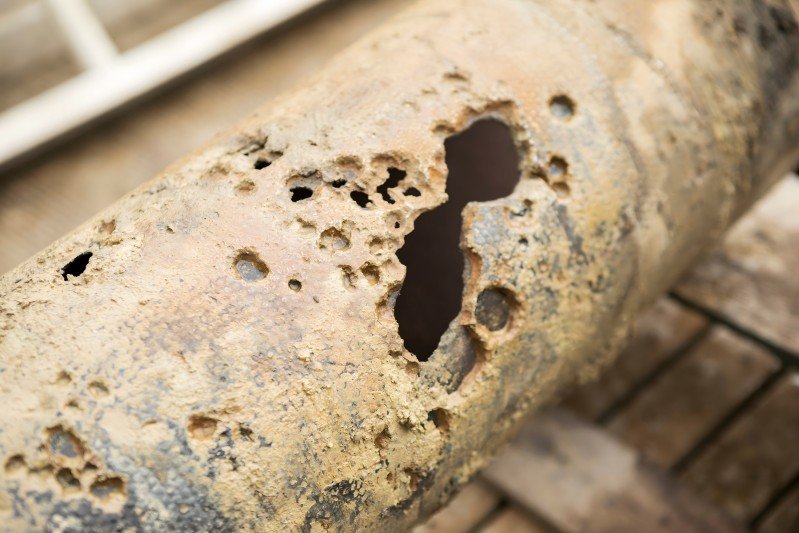
Pitting corrosion is a localized form of corrosion that attacks very small areas of a metal surface and produces narrow, deep holes called pits. It is regarded as one of the most dangerous forms of corrosion. Very little metal is lost, yet a single pit can perforate a pipe or tank wall and cause a leak while most of the surface still looks intact.
What Is Pitting Corrosion?
In uniform corrosion, the whole surface thins at a similar rate, so the damage is easy to measure and predict. Pitting works the other way. The attack is concentrated in tiny spots while the surrounding surface is barely affected.
Typical features of pitting corrosion:
- Pits are small in diameter, often less than a few millimeters, with a depth equal to or greater than the diameter.
- The pit mouth is often covered by corrosion products, which makes it hard to see during visual inspection.
- Weight loss is very small, so corrosion rates based on weight loss do not reflect the real damage.
- Pits can act as starting points for fatigue cracks or stress corrosion cracking.
Pitting is one of several common forms of corrosion in industry. For the full picture, see our overview of the types of metal corrosion.
What Causes Pitting Corrosion?
Pitting mainly affects metals protected by a passive film, a very thin oxide layer that forms on its own. Stainless steel is protected by chromium oxide, aluminum by aluminum oxide. While the film is intact, the metal hardly corrodes. Pitting begins when the film breaks down at one point and cannot heal.
Factors that trigger it:
- Chloride ions. This is the most common cause. Chlorides from seawater, coastal air, de-icing salt, or chlorine-based cleaners can penetrate and break down the passive film. Other halides such as bromide act in a similar way.
- High temperature. Each alloy has a critical pitting temperature. Above it, pits form and grow readily.
- Stagnant liquid. Standing or very slow-moving water lets chlorides and dirt settle on the surface.
- Low pH and oxidizers. Acidic conditions and oxidizing species such as ferric ions and hypochlorite speed up the attack.
- Surface defects. Scratches, weld spatter, heat tint next to welds, and embedded iron particles are weak points in the passive film.
- Inclusions in the metal. Manganese sulfide inclusions in stainless steel are the most frequently reported pit initiation sites.
- Deposits and scale. The area under a deposit is starved of oxygen, so the passive film struggles to recover.
The Mechanism of Pitting Corrosion
Pitting is usually described in three stages.
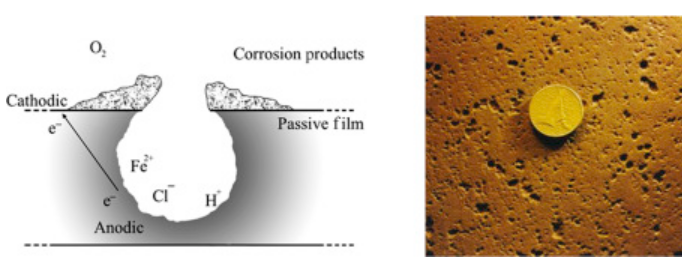
1. Initiation. Chloride ions attack a weak point in the passive film, for example at the edge of an inclusion or at the bottom of a scratch. The film breaks down locally and bare metal is exposed.
2. Propagation. The exposed spot becomes a small anode where metal dissolves into positive ions. The large surrounding passive surface becomes the cathode, where oxygen is reduced. Because the anode is tiny and the cathode is large, metal dissolves quickly inside the pit.
The process then feeds itself (it is autocatalytic). Positive metal ions building up inside the pit draw in chloride ions from outside. The resulting metal chloride reacts with water (hydrolysis) and produces hydrochloric acid, so the pH inside the pit drops sharply. This acidic, chloride-rich environment prevents the passive film from reforming, and the pit keeps growing downward.
3. Termination or repassivation. A pit can stop growing if conditions change, for instance when the solution inside is flushed out or the surface dries, allowing the film to heal. If conditions stay the same, the pit grows until it penetrates the wall.
Pit Shapes
ASTM G46 groups pit cross-sections into several types: narrow and deep, elliptical, wide and shallow, subsurface, undercutting, and shapes that follow the microstructure in either a horizontal or vertical direction.
Subsurface and undercutting pits carry the highest risk, because the cavity inside the metal is much larger than the opening visible at the surface.
Susceptible Metals and the Role of PREN
The metals most often affected are stainless steels, aluminum and its alloys, and nickel alloys. Carbon steel has no strong passive film, so it tends to corrode more uniformly, although local pits can still form under deposits or in chloride-contaminated concrete. For the basics of that material, see our article on low-carbon steel.
For stainless steels, pitting resistance is estimated with the Pitting Resistance Equivalent Number:
PREN = %Cr + 3.3 × %Mo + 16 × %N
The higher the PREN, the better the alloy resists chlorides.
| Alloy | Typical PREN | Notes |
|---|---|---|
| 304 stainless steel | about 18–20 | Fine indoors and in fresh water, vulnerable in coastal air |
| 316L stainless steel | about 23–26 | 2–3% molybdenum improves chloride resistance |
| Duplex 2205 | about 34–36 | Chemical processing, oil and gas |
| Super duplex 2507 | above 40 | Suitable for direct seawater contact |
These are general ranges. Actual values depend on the composition of each heat. As a rough guide, alloys with a PREN of 40 or more are generally considered seawater resistant at ambient temperature.
For cast components, such as the cast stainless grades CF8 and CF8M (the cast equivalents of 304 and 316), casting quality also matters. Inclusions, surface porosity, and residual molding sand can all serve as pit initiation sites, so cleaning and finishing need to be done carefully.
Examples of Pitting Corrosion
- Stainless steel railings in coastal areas. Brown spots appear, and cleaning them reveals small pits.
- Heat exchanger and condenser tubes. Chloride-bearing cooling water pits the tube wall from the inside.
- Food industry tanks and piping. Chlorine-based cleaners that are not fully rinsed off damage the passive film.
- Aluminum boat hulls and marine parts. Constant contact with seawater.
- Reinforcing steel in concrete. Chlorides that penetrate concrete in marine environments break down the passive film on the rebar and cause local pits.
- Stainless steel kitchen sinks. Salt and bleach left to dry leave pitted spots.
How to Detect and Measure Pitting
Pitting is hard to detect because the pits are small and often covered by corrosion products. Common methods:
- Visual inspection after cleaning, with a magnifier or microscope.
- Dye penetrant testing to reveal pits open to the surface.
- Ultrasonic testing to measure remaining wall thickness from the outside.
- Eddy current testing for heat exchanger tubes.
- Radiography for locations that cannot be reached.
For the general methods that apply to every form of corrosion, see how to prevent corrosion in metals.
Each method is explained in our article on non-destructive testing (NDT).
Damage is rated according to ASTM G46 by pit density, size, and depth. One measure is the pitting factor, the ratio of the deepest pit to the average penetration. To compare materials in the laboratory, common methods include ASTM G48 (ferric chloride immersion) and ASTM G61 (cyclic polarization).
How to Prevent Pitting Corrosion
- Select a material that suits the environment. For chloride service, choose an alloy with a higher PREN, such as 316L instead of 304, or duplex for harsher conditions.
- Control the environment. Lower the chloride level, keep the operating temperature down, and avoid very low pH.
- Avoid stagnant liquid. Design tanks and piping to drain completely, with no pockets or dead legs.
- Keep surfaces clean. Remove deposits, scale, and salt regularly. Rinse thoroughly after using chlorine-based cleaners.
- Look after the passive film. After welding or machining, remove heat tint and iron contamination by pickling and passivation. A smoother surface finish also resists pitting better.
- Use protective coatings on metals that are not resistant enough.
- Apply cathodic protection to submerged or buried structures.
- Add corrosion inhibitors to closed water systems.
Frequently Asked Questions
Can stainless steel suffer from pitting corrosion? Yes. Stainless steel resists rust because of its passive film, and that film is exactly what chlorides attack. Type 304 is fairly vulnerable in coastal environments, while 316L performs better thanks to its molybdenum content.
What is the difference between pitting and crevice corrosion? The mechanisms are similar. Pitting starts on an open surface, while crevice corrosion starts inside a narrow gap, such as under a gasket, bolt head, or deposit, where liquid is trapped.
Why is pitting more dangerous than uniform corrosion? Because it is hard to see, hard to predict, and can perforate a wall even though very little metal has been lost.
Can pitting corrosion be repaired? Shallow pits can be removed by grinding or polishing, followed by repassivation. Deeper pits can be weld-repaired if enough wall thickness remains, as described in our article on repair welding. When pits are numerous and deep, the component is better replaced with a more resistant material.
Conclusion
Pitting corrosion is a localized attack that occurs when a metal’s passive film breaks down at a single point, most often because of chloride ions. The pits are small, grow by a self-accelerating mechanism, and are often discovered only after a leak. Prevention rests on three things: a material with enough pitting resistance for its environment, a clean and well-passivated surface, and design and maintenance that never leave chloride-bearing liquid standing.


