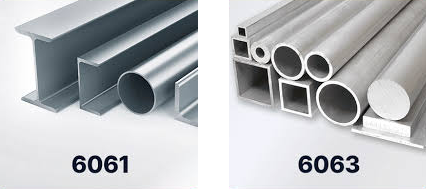
6063 aluminum is a wrought alloy from the 6xxx series, with magnesium and silicon as its main alloying elements. It is the most widely used alloy for extruded profiles: door and window frames, storefronts, curtain walls, solar panel frames, handrails, and heat sinks. If you have touched an aluminum window frame, it was very likely 6063 in the T5 or T6 temper.
The reason is simple: 6063 extrudes easily into complex shapes with a smooth surface, and it anodizes beautifully. It is weaker than 6061 aluminum, but strong enough for most architectural uses. This article covers its composition, mechanical properties by temper, 6063-T5 vs T6, 6061 vs 6063, and its uses, welding, and standards.
What Is 6063 Aluminum?
In the Aluminum Association numbering system, the 6 marks alloys with magnesium and silicon as the main elements. Together they form magnesium silicide (Mg₂Si), which lets the alloy be strengthened by age hardening. The series system is explained in aluminum alloys.
Compared with other 6xxx alloys, 6063 has lower magnesium and silicon and almost no copper. That makes it softer at extrusion temperature, so it flows easily through the die and leaves a smoother surface. In Europe it is known as EN AW-6063 or AlMg0.7Si.
6063 Aluminum Composition
| Element | 6063 aluminum (%) | 6061 aluminum (%) |
|---|---|---|
| Silicon (Si) | 0.20–0.6 | 0.40–0.8 |
| Magnesium (Mg) | 0.45–0.9 | 0.8–1.2 |
| Iron (Fe), max. | 0.35 | 0.7 |
| Copper (Cu) | 0.10 max. | 0.15–0.40 |
| Manganese (Mn), max. | 0.10 | 0.15 |
| Chromium (Cr) | 0.10 max. | 0.04–0.35 |
| Zinc (Zn), max. | 0.10 | 0.25 |
| Titanium (Ti), max. | 0.10 | 0.15 |
| Aluminum | Balance | Balance |
Low copper and iron give 6063 better corrosion resistance and more uniform color after anodizing.
Mechanical Properties by Temper
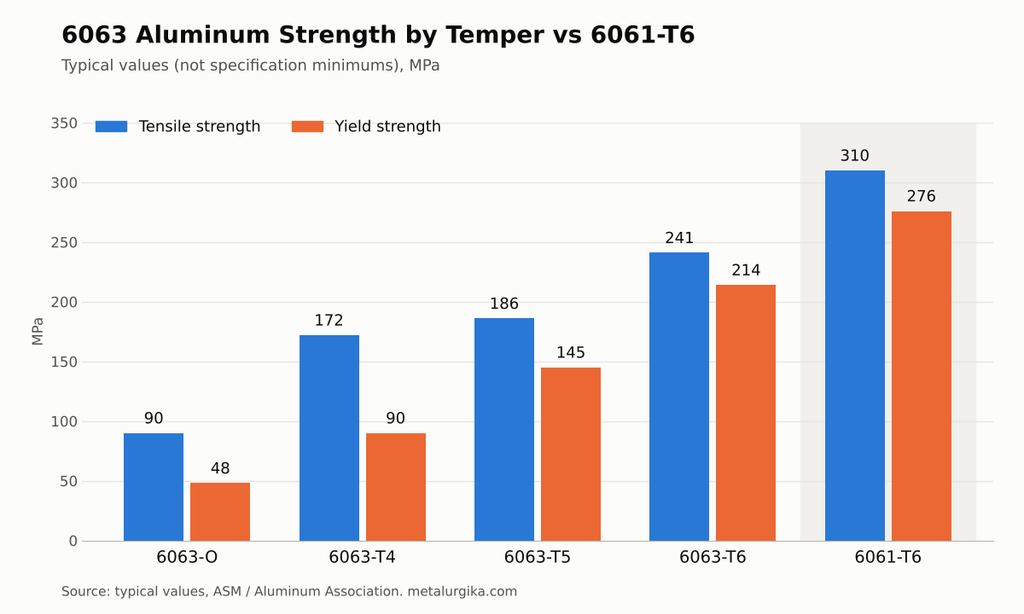
6063’s properties depend strongly on temper. The table gives typical values; guaranteed specification minimums are lower and depend on section thickness.
| Temper | Tensile strength | Yield strength | Elongation (%) | Hardness (HB) |
|---|---|---|---|---|
| 6063-O (annealed) | 90 MPa (13 ksi) | 48 MPa (7 ksi) | about 25–30 | 25 |
| 6063-T4 | 172 MPa (25 ksi) | 90 MPa (13 ksi) | 22 | 46 |
| 6063-T5 | 186 MPa (27 ksi) | 145 MPa (21 ksi) | 12 | 60 |
| 6063-T6 | 241 MPa (35 ksi) | 214 MPa (31 ksi) | 12 | 73 |
| 6061-T6 (for comparison) | 310 MPa (45 ksi) | 276 MPa (40 ksi) | 12 | 95 |
For reference, ASTM B221 sets minimums for thin 6063-T5 extrusions of about 150 MPa (22 ksi) tensile and 110 MPa (16 ksi) yield, and for 6063-T6 about 205 MPa (30 ksi) tensile and 170 MPa (25 ksi) yield.
Key physical properties: density about 2.70 g/cm³ (0.0975 lb/in³), melting range about 615–655 °C (1,140–1,210 °F), thermal conductivity about 200–210 W/m·K, and electrical conductivity about 53–55% IACS. That high thermal conductivity is why 6063 is a favorite for heat sinks.
6063-T5 vs T6
The difference between T5 and T6 lies in how the profile is cooled after it leaves the extrusion press:
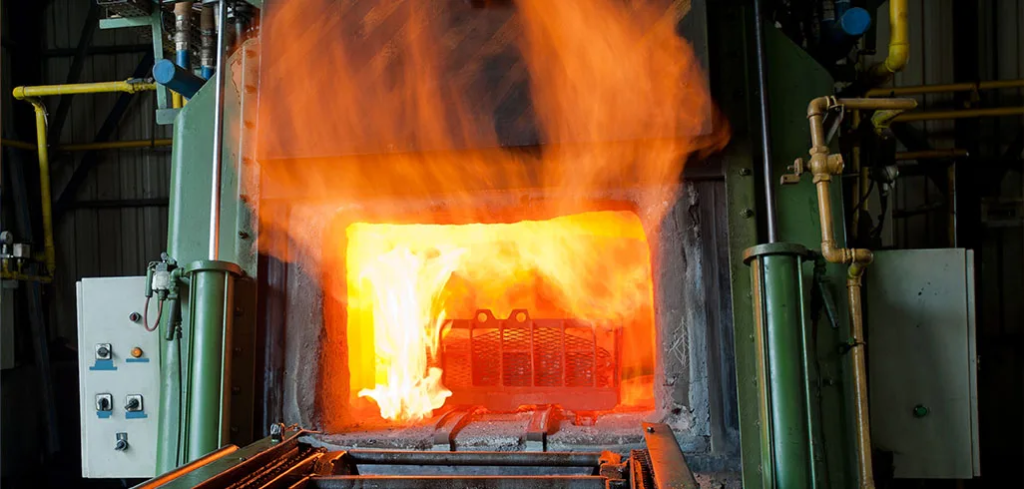
- T5: the profile is cooled straight from extrusion temperature by air or fans, then artificially aged in an oven at about 175–205 °C (350–400 °F) for a few hours. There is no separate solution treatment.
- T6: the profile is solution treated at about 520 °C (970 °F), quenched rapidly in water or spray, then aged. T6 can also be reached with a water quench directly at the press exit.
As a result, 6063-T6 is roughly 25–30% stronger than T5, but T5 is cheaper, distorts less, and is enough for windows and doors. T6 is chosen for light structural frames, low-pressure tubing, and parts that need more strength. There is also 6063-T52, stress relieved by light compression and aged at a lower temperature; it is slightly weaker than T5 but easier to bend. Aging is explained in aluminum heat treatment.
Why 6063 Extrudes So Well
In extrusion, billets are heated to about 430–500 °C (810–930 °F) and pushed through a steel die. 6063’s low alloy content gives it low flow stress, so:
- Extrusion speeds can be high.
- Thin-walled hollow profiles, such as multi-channel window frames, can be made in one pass.
- Surfaces come out smooth, with fine die lines.
- Dies last longer.
This is the main reason 6063 is the standard architectural extrusion alloy almost everywhere.
Anodizing and Decorative Finishes
6063 anodizes to a very uniform finish, whether clear, bronze, or black. The anodic layer improves corrosion and scratch resistance and can be dyed. Exterior architectural profiles usually get a thicker anodic layer than interior ones. Besides anodizing, 6063 profiles are often powder coated. The process is covered in aluminum anodizing.
6061 vs 6063 Aluminum
| Aspect | 6063 aluminum | 6061 aluminum |
|---|---|---|
| T6 strength (tensile / yield) | About 241 / 214 MPa (35 / 31 ksi) | About 310 / 276 MPa (45 / 40 ksi) |
| Extrudability | Excellent; complex shapes, thin walls | Good; simpler shapes |
| Surface and anodizing | Very smooth, uniform color | Good, color slightly less uniform |
| Corrosion resistance | Excellent | Good |
| Machinability | Fair, tends to be gummy | Good |
| Common product forms | Profiles, pipe, tube | Plate, bar, profiles, forgings |
| Typical uses | Window frames, trim, heat sinks | Structural frames, machine parts, fixtures |
The difference between 6061 and 6063 comes down to strength versus form and finish. Choose 6063 when profile shape, surface, and cost matter more than strength. Choose 6061 when the part carries significant load or needs heavy machining. Related alloys include 6060 (slightly softer, common in Europe) and 6005 and 6082, which are stronger structural extrusion alloys.
Uses of 6063 Aluminum
- Architecture: window and door frames, curtain walls, partitions, storefronts, railings, and handrails.
- Energy: solar panel frames.
- Electronics: heat sinks and enclosures.
- Furniture and interiors: cabinet frames, tables, shelving, and decorative trim.
- Transportation: vehicle trim and light truck body frames.
- Pipe and tube: irrigation tubing and non-structural tube.
Welding and Machining
6063 welds well by TIG or MIG with ER4043 or ER5356 filler. The heat-affected zone loses part of its strength because welding heat undoes the aging, so a welded joint is weaker than the base metal unless the part is re-heat-treated. Corrosion behavior is covered in aluminum corrosion.
In machining, 6063-T5 and T6 drill and cut well, but they are softer than 6061 and chips tend to stick. Sharp tools, positive rake angles, and coolant give a cleaner result.
Standards and Designations
- ASTM B221: aluminum extruded bars, rods, profiles, and tubes.
- ASTM B429: extruded structural pipe and tube.
- EN 573 and EN 755: EN AW-6063 or AlMg0.7Si for extrusions in Europe.
- JIS H4100: A6063S for extrusions in Japan.
When ordering profiles, specify alloy and temper together, such as “6063-T5”, plus the finish: mill, anodized, or powder coated.
Frequently Asked Questions
What is 6063 aluminum used for?
Mainly extruded profiles: window and door frames, curtain walls, trim, railings, solar panel frames, and heat sinks.
What is the difference between 6063-T5 and T6?
T5 is cooled straight from extrusion and then aged, while T6 is solution treated and quenched before aging. T6 is stronger; T5 is cheaper and enough for most window frames.
Which is stronger, 6061 or 6063?
6061. In the T6 temper, 6061 has a yield strength of about 276 MPa (40 ksi), versus about 214 MPa (31 ksi) for 6063.
Can 6063 aluminum be welded?
Yes, by TIG or MIG with ER4043 or ER5356 filler, though the heat-affected zone becomes softer.
Related Articles
- 6061 Aluminum: Properties, Density, Composition, and 6061 vs 7075, 6063, and 5052
- Aluminum Alloys: Series, Tempers, and Uses
- Aluminum Heat Treatment: Solution Treating, Aging, and Temper Codes (T6, T651, T73)
- Aluminum Anodizing: Process, Types (I, II, III), Thickness, Colors, and Sealing

Dagus R. Djuanda is a metallurgical engineer with more than 20 years of experience in materials engineering, specializing in magnetic materials. He holds a master’s degree in magnetic materials engineering, is a doctoral candidate in industrial engineering, and works as an engineer at the Ministry of Industry of the Republic of Indonesia. Founder of Metalurgika.