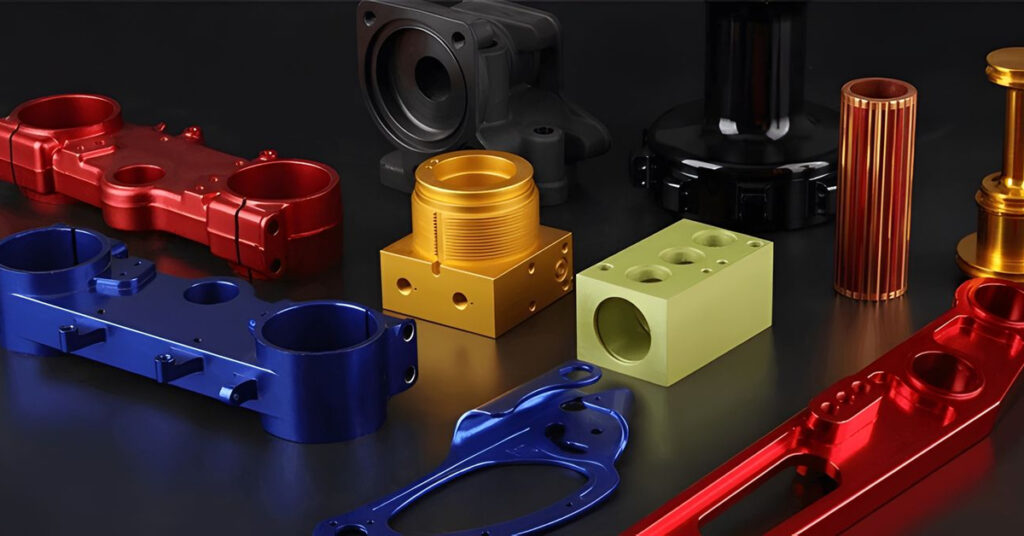
Anodizing is an electrochemical process that thickens aluminum’s natural oxide film into a much thicker, harder, and more corrosion-resistant layer of aluminum oxide. The aluminum part is made the anode in an acid electrolyte, and direct current oxidizes its surface in a controlled way. The result is not paint or a coating applied on top. It is the metal itself, converted into oxide.
The natural oxide on aluminum is only a few nanometers thick. Anodizing grows it to anywhere from a few micrometers to about 100 micrometers (about 4 mil), depending on the process. Because the layer is porous until it is sealed, anodized aluminum can also be dyed. That is why window frames, laptop housings, cookware, and machine parts often come in silver, black, bronze, or bright colors without any paint.
This guide explains what anodizing is, how it works, the process steps, Type I, II, and III, coating thickness and standards, how anodized aluminum is colored (including black anodizing), which alloys anodize well, how it compares with powder coating, and its advantages and disadvantages. Why aluminum needs protection in the first place is covered in our article on aluminum corrosion.
What Is Anodizing?
The word comes from anode: the workpiece is connected as the anode (positive electrode) of an electrolytic cell. It is also spelled anodising, and the finished material is called anodized aluminum.
Anodizing is different from ordinary coatings such as electroplating, galvanizing, or paint:
- The layer grows out of the metal. Electroplating deposits another metal (nickel, chromium, zinc) on top of the part. Anodizing converts the aluminum surface itself into aluminum oxide (Al₂O₃). The layer cannot peel off like paint.
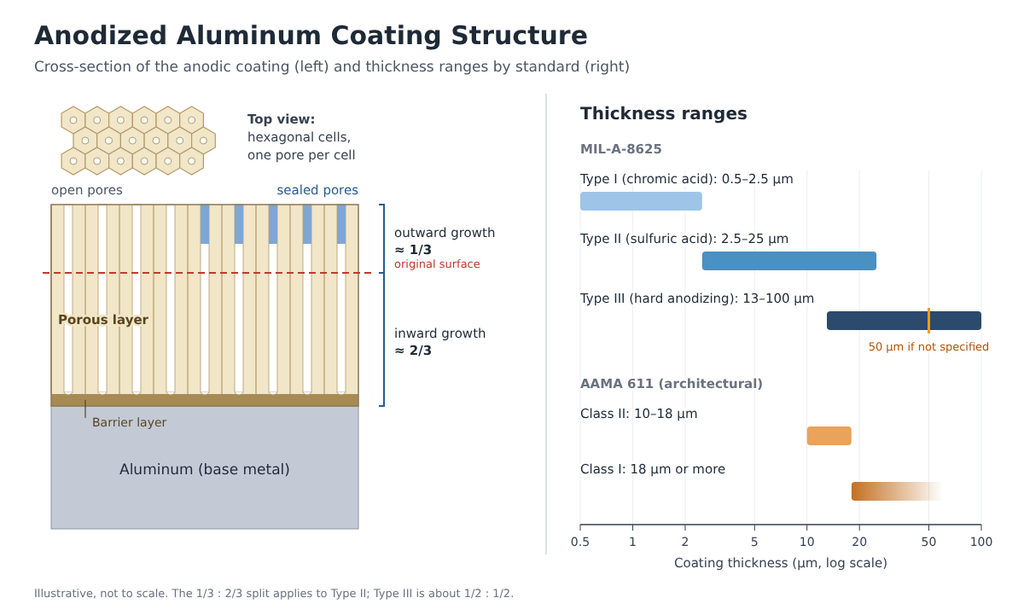
- The layer grows in two directions. Part of the oxide forms inward, replacing metal, and part grows outward from the original surface. The part’s dimensions change, but by less than the coating thickness.
- The layer is a ceramic. Aluminum oxide is hard, wear resistant, and an electrical insulator. An anodized surface no longer conducts electricity.
Anodizing was first used industrially in 1923 to protect Duralumin parts on seaplanes from corrosion. That early process used chromic acid and was known as the Bengough-Stuart process. Gower and O’Brien patented the first sulfuric acid process in 1927, and sulfuric acid remains the most widely used electrolyte today.
How Anodizing Works
Aluminum parts are hung on racks (usually titanium or aluminum) and lowered into an electrolyte bath, most often sulfuric acid. The parts are connected to the positive terminal of a rectifier, and the cathodes are lead, aluminum, or stainless steel plates. When current flows, oxygen from the electrolyte reacts with the aluminum surface to form aluminum oxide. Hydrogen gas is released at the cathode.
Two things happen at the same time:
- Oxide forms at the boundary between the metal and the coating.
- The acid dissolves some of the oxide at the base of the coating.
The balance between growth and dissolution produces the characteristic structure of an anodic coating:
- Barrier layer: a very thin, dense oxide layer directly on the metal. This is the layer the current passes through.
- Porous layer: the bulk of the coating, made of tightly packed hexagonal cells, each with one straight pore at its center. The pores are roughly 10–150 nanometers in diameter.
These pores are what allow anodized aluminum to absorb dye. After dyeing (or left clear), the pores are closed by sealing so the coating resists staining and corrosion.
Inward and outward growth
Because the oxide grows in both directions, the dimensional change is smaller than the coating thickness. Common rules of thumb:
- Type II (conventional sulfuric anodizing): about two-thirds inward and one-third outward.
- Type III (hard anodizing): about half inward and half outward.
Example: a 50 µm (2 mil) hard anodized coating adds about 25 µm (1 mil) to each surface. A shaft diameter grows by about 50 µm (two sides), and a bore diameter shrinks by about 50 µm. On precision bores and threads, that is enough to make a fit bind, so the size must be compensated at the machining stage. How dimensional changes like this affect accuracy grades is discussed in our guide to dimensional tolerance and accuracy grades.
The Anodizing Process, Step by Step
Anodizing quality depends heavily on surface preparation. Scratches, die lines, and stains on the metal remain visible after anodizing and often look worse. A typical line runs as follows:
- Mechanical preparation. Machining, grinding, polishing, or blasting is done before anodizing, because the anodic coating follows the texture beneath it. Blasting with fine grit or glass beads gives a uniform matte look (the method is similar to that described in our article on shot blasting). Heat treatment such as T6 is also done before anodizing.
- Cleaning (degreasing). A mild alkaline cleaner removes oil, cutting fluid, and dirt.
- Etching or bright dipping. A caustic soda (NaOH) etch removes a thin layer of metal and gives a matte satin finish that hides fine scratches. A bright dip in a phosphoric-nitric acid mixture does the opposite and gives a mirror-like shine.
- Desmutting. After etching, alloying elements such as copper, silicon, and iron are left behind as a dark film (smut). It is dissolved in acid, traditionally nitric acid or a substitute.
- Anodizing. The parts are immersed in the electrolyte under controlled current and temperature. For Type II, a bath of about 15% sulfuric acid runs at about 20 °C (68 °F) and roughly 10–20 V. Coating thickness grows in proportion to current density and time.
- Coloring (optional). While the pores are still open, the parts are dipped in dye or colored electrolytically (see Colors below).
- Sealing. The pores are closed so the coating resists corrosion, does not stain, and holds its color.
- Inspection. Thickness is measured with an eddy current gauge, seal quality is tested (for example with a dye stain or acid dissolution test), and salt spray testing is done where a specification requires it.
Parts are rinsed between every step, and before sealing usually in deionized water. Chlorides carried in rinse water can cause small corrosion spots.
How long does anodizing take?
A common shop formula: time (minutes) = thickness (mil) × 720 ÷ current density (A/ft²). A 1 mil (about 25 µm) coating at 20 A/ft² (about 2.2 A/dm²) takes about 36 minutes. In metric units this is roughly thickness (µm) ≈ 0.3 × current density (A/dm²) × time (minutes). It is only an estimate for Type II; efficiency varies with alloy and temperature.
Sealing anodized aluminum
An unsealed anodic coating behaves like a sponge: it picks up fingerprints and oil, and dye can bleed out. The main sealing methods:
| Sealing method | Approximate temperature | Notes |
|---|---|---|
| Hot water (deionized) | 96–100 °C (205–212 °F) | The simplest and most common. Oxide on the pore walls hydrates to boehmite, which swells and plugs the pores. Takes about 3 minutes per micrometer of coating and uses a lot of energy. |
| Nickel acetate | about 80–96 °C (176–205 °F) | Widely used for dyed parts because it reduces dye bleeding into the seal tank. |
| Mid-temperature (metal salts with additives) | about 60–80 °C (140–176 °F) | Saves energy, but the bath is harder to control. |
| Cold seal (nickel fluoride) | about 24–29 °C (75–85 °F) | Saves energy. Works by a different mechanism (fluoro-aluminate fills the pores), is not fully cured for about 24 hours, and its nickel waste must be treated. |
| Dichromate | near boiling | Gives a yellow-green tint. Used on aircraft alloys such as 2024 that need high corrosion resistance. |
Hard anodized parts are often left unsealed. Sealing reduces the hardness and wear resistance of the coating, so parts that need wear resistance are left unsealed, while parts that need corrosion resistance are sealed.
Types of Anodizing
The most widely referenced standard is the U.S. military specification MIL-A-8625 (now MIL-PRF-8625). It divides anodizing into types by electrolyte and into two classes by color: Class 1 non-dyed and Class 2 dyed.
| Type | Electrolyte and conditions | Thickness (MIL-A-8625) | Characteristics | Typical uses |
|---|---|---|---|---|
| Type I | Chromic acid | about 0.5–2.5 µm (0.00002–0.0001 in) | Very thin, almost no dimensional change, little effect on fatigue strength, rarely dyed. Uses hexavalent chromium, so it is in decline. | Aircraft parts, riveted and bonded assemblies, parts with tight crevices |
| Type IB and IC | Low-voltage chromic acid (IB); non-chromic electrolyte such as boric-sulfuric acid (IC) | Thin, similar to Type I | IB for 7xxx alloys; IC as a greener Type I replacement | Aerospace |
| Type II | About 15% sulfuric acid at about 20 °C (68 °F) | about 2.5–25 µm (0.0001–0.001 in) | The most common type. Porous, easy to dye, good corrosion resistance | Window frames, facades, electronics, furniture, consumer goods |
| Type IIB | Sulfuric acid, thin film | Thin | Non-chromate alternative to Type I | Aerospace |
| Type III (hard anodizing) | Cold sulfuric acid near 0 °C (32 °F), high current density and voltage | about 13–100 µm (0.0005–0.004 in); 50 µm (0.002 in) if not specified | Hard (roughly 400–700 HV depending on alloy), very wear resistant, natural color gray to dark bronze | Pistons, hydraulic cylinders, valves, gears, slides, firearm parts |
Two other processes are worth knowing:
- Phosphoric acid anodizing produces a thin coating with large pores that gives excellent adhesive and paint bonding. It is used to prepare aircraft parts for structural adhesive bonding.
- Oxalic acid anodizing was patented in Japan in 1923 and later widely used for architecture in Germany. Its coatings tend to be yellowish.
Hard anodizing (Type III)
Hard anodizing uses sulfuric acid chilled to around the freezing point of water and a current density roughly twice that of Type II. The cold bath slows oxide dissolution, so the coating grows thicker and denser. Because the growing coating increasingly resists current, the voltage is raised step by step to several tens of volts, sometimes above 75 V depending on the alloy.
Hard coat anodizing resists wear far better than bare aluminum and is used on sliding surfaces. Some points to keep in mind:
- The natural color is dark, from gray to deep bronze, darker on thick coatings and copper-bearing alloys. If dyed, the practical choices are black or other dark colors.
- Sharp corners are hard to coat fully, because the coating grows perpendicular to the surface and leaves a gap at the corner. Designs should give edges and corners a radius.
- Crazing (fine surface cracks) can appear if the coating is heated above about 80 °C (176 °F) or the part is bent, because the oxide expands far less than aluminum.
- Fatigue strength of the part can drop, because the hard, brittle layer becomes a site for crack initiation. This matters for parts under cyclic loading.
- PTFE impregnation can be added to lower friction.
Anodizing Thickness and Standards
Thickness is the most important parameter in an anodizing specification. A thicker coating resists corrosion and weathering better, but costs more, takes longer, and changes dimensions more.
| Standard | Class | Thickness | Use |
|---|---|---|---|
| MIL-A-8625 | Type I / II / III | about 0.5–2.5 / 2.5–25 / 13–100 µm | Engineering, military, aerospace (thickness must be called out on the drawing) |
| ISO 7599 | AA5, AA10, AA15, AA20, AA25 | The number after AA = minimum average thickness in µm | Decorative and protective; AA25 for severe exterior service such as coastal and industrial sites |
| AAMA 611 (U.S.) | Architectural Class II | 10–18 µm (0.4–0.7 mil) | Interior or light exterior use with regular cleaning |
| AAMA 611 (U.S.) | Architectural Class I | 18 µm (0.7 mil) or more | Exterior facades, windows, curtain walls, including coastal climates |
ISO 7599 does not cover hard anodizing, which has its own standard (ISO 10074), nor chromic and phosphoric acid anodizing. In practice, AA5 to AA10 is used indoors, AA15 to AA20 for normal exterior use, and AA25 in corrosive environments. Under AAMA 611, Class I coatings must pass 3,000 hours of salt spray testing, versus 1,000 hours for Class II.
For buildings in coastal or humid tropical climates, exterior frames and facades should be specified at AA20 to AA25 or AAMA Class I.
Anodized Aluminum Colors
Clear anodized aluminum, with no dye, looks silver with a slight depth, because the oxide is transparent. Other colors are made in several ways:
| Method | Principle | Colors | Weather resistance |
|---|---|---|---|
| Organic dye | Dye is absorbed into the pores and locked in by sealing | Almost any color: red, blue, gold, green, black | Some organic dyes fade under UV; best for interior use |
| Electrolytic coloring (two-step) | After anodizing, metal salts (for example tin or nickel) are deposited at the bottom of the pores by electric current | Champagne, light to dark bronze, black | Very UV stable; the standard for windows and facades |
| Integral coloring | Color forms during anodizing from special alloys or electrolytes | Bronze, gray, black | UV stable; uncommon because it uses a lot of energy |
| Interference coloring | Metal deposition is controlled so that light interferes | Certain blues, greens, golds | UV stable; complex process |
That is why architectural anodized colors are usually limited to clear, champagne, bronze (including dark bronze), and black, the colors that can be produced electrolytically and survive sunlight. Bright colors such as red or blue are usually organic dyes and better suited to indoor products.
One frequent disappointment: anodized color depends strongly on the alloy and surface treatment. Two pieces from different alloys or lots can come out slightly different even in the same tank. For large projects, use the same alloy and supplier throughout.
Black anodized aluminum
Black is one of the most requested anodized colors, and there are two main ways to make it:
- Organic black dye on Type II. It gives a deep, even black, suited to machine parts, electronics, and accessories. Outdoors, some black dyes shift toward purple or brown after long sun exposure.
- Electrolytic black, the darkest step of electrolytic coloring. It is more UV stable and the choice for black windows and facades.
The look depends on surface preparation:
- Matte black anodized aluminum: the surface is etched or blasted before anodizing.
- Glossy black: the surface is polished or bright dipped first.
Black hard anodizing (Type III, Class 2) builds on the coating’s naturally dark color and adds black dye. The result is hard and wear resistant, and is common on firearm parts, optics, and tools.
Which Alloys Anodize Well?
Not every aluminum anodizes the same way. Alloying elements that do not become clear oxide, such as copper, silicon, and iron, make the coating darker, softer, or less uniform. Each alloy series is described in our guide to aluminum alloys.
| Alloy | Anodizing result |
|---|---|
| 1xxx series (pure aluminum) | Very clear and bright; good for decorative work and reflectors |
| 5xxx series (e.g., 5005, 5052) | Good; anodizing-quality 5005 is widely used for architectural panels |
| 6xxx series (6063, 6061) | The most common. 6063 is the window-frame extrusion alloy and anodizes very well; 6061 is good for machined parts and hard anodizing |
| 7xxx series (e.g., 7075) | Can be anodized, including hard anodizing, but the color is slightly yellowish or less clear |
| 2xxx series (e.g., 2024) | The most difficult; the coating is thinner and softer because of copper, and is often dichromate sealed for corrosion resistance |
| Sand and permanent mold castings (e.g., A356) | Possible, but the color is dull gray and less uniform because of about 7% silicon |
| Die castings (e.g., A380, ADC12) | Poor: blotchy dark gray, spotting from porosity, and a thin coating; usually better painted or powder coated |
Can you anodize cast aluminum?
Yes, but it never looks as good as wrought aluminum. Three things cause trouble:
- Silicon. Casting alloys contain a lot of silicon (A356 about 7%, ADC12 about 10–12%). Silicon particles do not oxidize into clear oxide, so the surface turns dark gray and uneven.
- Porosity. Gas and shrinkage pores at the surface trap acid, which later seeps out and stains. The causes of porosity are covered in our article on aluminum casting.
- Copper. Die casting alloys such as A380 and ADC12 contain copper, which makes the coating thinner and softer.
If a casting must be anodized, choose a low-silicon or copper-free alloy, use a casting process that keeps porosity low, and talk to the anodizer early. For decorative finishes, die castings are usually better painted, powder coated, or given a conversion coating.
Anodizing Other Metals
Anodizing is used mostly on aluminum, but the same principle works on a few other metals with stable oxides:
- Titanium anodizing forms a very thin, transparent oxide. Its colors (gold, purple, blue, green) come from light interference, not dye, and are set by the voltage used. It is common on medical implants (as color coding), jewelry, and bicycle parts. How the colors work, a voltage chart, and the process are covered in our guide to titanium anodizing.
- Magnesium is anodized for corrosion resistance and as a paint base, because magnesium is very reactive.
- Niobium, tantalum, zinc, and zirconium can also be anodized for special purposes, such as electrolytic capacitors (tantalum and niobium).
What about anodized steel? Steel cannot be anodized the way aluminum can. The iron oxide that forms is neither dense nor adherent, so it does not protect. Products sold as “anodized steel” are usually black oxide coated steel, electrochemically colored stainless steel, or aluminum-coated steel. The equivalent way to protect steel from corrosion is galvanizing; see our guide to hot dip galvanizing.
Anodized vs Powder Coated and Other Finishes
| Property | Anodizing (Type II) | Hard anodizing (Type III) | Powder coating | Liquid paint | Chemical conversion coating |
|---|---|---|---|---|---|
| How it forms | Aluminum converted to oxide | Same, thicker and denser | Polymer powder melted onto the surface | Paint sprayed onto the surface | Thin chemical reaction layer |
| Typical thickness | 5–25 µm | 25–100 µm | about 60–120 µm | about 25–75 µm | under 1 µm |
| Can it peel? | No | No | Yes, with poor preparation | Yes | No (very thin) |
| Scratch and wear resistance | Good | Excellent | Moderate | Low to moderate | Low |
| Color choice | Wide, but limited for exterior use | Dark only | Almost unlimited, including textures | Almost unlimited | Clear or yellowish |
| Metallic look | Yes, the metal’s luster shows | Dull and dark | Hidden | Hidden | Yes |
| Electrically conductive | No (insulator) | No | No | No | Partly |
| Spot repair | Difficult; must be stripped and redone | Difficult | Can be repainted | Easy | Touch-up pens available |
| Alkali resistance | Low | Low | Good | Moderate | Low |
When to choose which:
- Choose anodizing for a metallic look and a hard, scratch-resistant finish that cannot peel, such as window frames, door hardware, electronics housings, and machine parts.
- Choose hard anodizing for sliding and wearing surfaces.
- Choose powder coating for specific colors that must last in the sun, for textures, or for a thick finish on castings and die castings that anodize poorly. Powder coating is also easier to repair.
- Choose a chemical conversion coating as a paint base, or where the surface must stay conductive, for example at grounding points.
Corrosion protection options in general, including for metals other than aluminum, are covered in our article on how to prevent corrosion in metals.
Advantages and Disadvantages of Anodizing
Advantages:
- The coating is part of the metal, so it does not peel, blister, or flake like paint.
- Hard and scratch resistant. Hard anodizing is one of the most wear-resistant surfaces that can be made on aluminum.
- Improves corrosion resistance, especially when properly sealed.
- Keeps the metallic luster, and can be colored.
- Adds no organic layer, so it tolerates fairly high temperatures and does not give off fumes like paint.
- Anodized aluminum remains recyclable.
- Unsealed anodizing is an excellent base for adhesives and paint.
Disadvantages:
- Limited to aluminum and a few other metals. It does not work on steel.
- Results depend on the alloy. Castings, die castings, and copper-bearing alloys come out dull and uneven.
- Color varies between lots and alloys.
- Some colors fade in sunlight when organic dyes are used.
- Poor alkali resistance. Wet cement, mortar, and caustic cleaners dissolve the oxide.
- Brittle coating. It can craze if the part is bent after anodizing or heated above about 80 °C (176 °F).
- Changes dimensions, especially hard anodizing, so precision bores and threads need masking or compensation.
- Reduces fatigue strength, especially thick, hard coatings.
- Electrical insulator. Electrical contact points must be masked or stripped.
- Hard to spot repair. Deep scratches cannot be patched; the part must be stripped and re-anodized, and stripping removes a little metal.
- Chemical waste. Acid, chromate, and nickel baths need proper waste treatment.
Common Anodizing Problems
| Problem | Likely cause | Prevention |
|---|---|---|
| Burning: scorched spots or a damaged coating at one point | Locally excessive current density, poor rack contact, poor bath circulation | Firm rack contact, gradual voltage ramp, agitated and cooled bath |
| Soft or powdery coating | Bath too warm, high dissolved aluminum in the bath, excessive time | Control bath temperature, replace or regenerate the electrolyte |
| Uneven color | Different alloys or lots, uneven etching, leftover smut, poor rinsing | Uniform alloy and lot, complete desmutting |
| Dye bleeding or fading | Incomplete sealing, dye not UV stable | Proper sealing, electrolytic color for exterior use |
| Sealing smut (white powder after sealing) | Contaminated seal water or wrong pH | Deionized water, anti-smut additive, pH control |
| Rack marks | Contact points are not anodized | Place contact points on hidden areas |
| Spots and stains on castings | Porosity traps acid that later seeps out | Suitable alloy and casting process, thorough rinsing and drying |
| Bores or threads too tight | Coating growth not compensated | Compensate at machining, mask, or re-tap |
| Crazing | Part bent or heated after anodizing | Form and heat treat before anodizing |
| Small corrosion spots | Chlorides from rinse water or the environment | Good rinse water quality, complete sealing |
When the anodized part is a casting, the sequence of final operations such as fettling, blasting, and machining is covered in our article on finishing metal castings.
Caring for Anodized Aluminum
- Clean with pH-neutral soap and water, then rinse and dry. Avoid strong alkaline and strong acid cleaners, because both dissolve the oxide.
- Do not use abrasive pads or sandpaper. The anodic layer is thin; once scratched through to the metal, it does not heal.
- Protect it from wet cement and mortar during construction. Cover frames with protective film and clean off splashes right away.
- Clean regularly in coastal and industrial areas, because salt and pollutant deposits trigger pitting. The mechanism is explained in our article on pitting corrosion.
- Painting anodized aluminum is possible, but a sealed surface is smooth and paint struggles to grip it. Scuff it lightly and use a suitable primer. If a part is meant to be painted from the start, unsealed anodizing or a conversion coating is a better base.
Applications of Anodizing
- Architecture: window and door frames, curtain walls, facade panels, handrails.
- Electronics: laptop, phone, and camera housings, heat sinks.
- Consumer goods: hard anodized cookware, furniture, lighting.
- Automotive and cycling: trim, rims, suspension parts, brake pistons, bicycle frames.
- Machinery and hydraulics: cylinders, pistons, valves, gears, slides, pneumatic components (hard anodizing).
- Aerospace and defense: structural parts (chromic acid or non-chromate anodizing), firearm components (black hard anodizing).
- Nameplates and signs: printed or laser-engraved anodized aluminum. The laser removes dye from the coating, so the marking shows white or silver on a colored background.
Frequently Asked Questions
Does anodizing wear off or peel? Anodizing does not peel like paint because it grows out of the metal itself. What can happen is that the color fades (with organic dyes in sunlight), the coating wears away under friction, or it is dissolved by alkalis and strong acids.
Can you anodize cast aluminum? Yes, but the result is dull gray and less uniform because of silicon and porosity. Die casting alloys such as A380 and ADC12 give the poorest results and are usually better painted or powder coated.
Can anodized aluminum be painted? Yes, after light scuffing and a suitable primer, because a sealed surface is smooth. Unsealed anodizing is actually an excellent base for paint and adhesives.
Can steel be anodized? Not the way aluminum is. Iron oxide does not form a dense, protective layer. “Anodized steel” products are usually black oxide, colored stainless steel, or aluminum-coated steel. To protect steel, use galvanizing or paint.
Can you anodize aluminum at home? Small-scale anodizing can be done with dilute sulfuric acid, a cathode, and a DC power supply, but sulfuric acid is corrosive and the process gives off flammable hydrogen gas. Results are also hard to make uniform without control of temperature, current density, and sealing. For important parts, use an anodizing shop with proper equipment and waste treatment.
Conclusion
Anodizing grows an aluminum oxide layer out of the aluminum itself, so the result is hard, corrosion resistant, impossible to peel, and can be colored. Type II is the most common decorative and protective anodizing, Type III hard anodizing is used for wear resistance, and Type I chromic acid anodizing serves aircraft parts. Quality depends on the alloy, surface preparation, a thickness matched to the environment, and proper sealing. Its main drawbacks are the limited choice of metals and alloys, color variation between lots, poor resistance to alkalis, and the difficulty of spot repair.
Related Articles
- Aluminum Corrosion: Causes, Types, and Prevention
- Aluminum Alloys: Series, Tempers, and Uses
- Aluminum Casting: Processes, Alloys, and Common Defects
- Hot Dip Galvanizing: Process, Coating Thickness, Standards, and Galvanized vs Galvalume
- How to Prevent Corrosion in Metals

Dagus R. Djuanda is a metallurgical engineer with more than 20 years of experience in materials engineering, specializing in magnetic materials. He holds a master’s degree in magnetic materials engineering, is a doctoral candidate in industrial engineering, and works as an engineer at the Ministry of Industry of the Republic of Indonesia. Founder of Metalurgika.