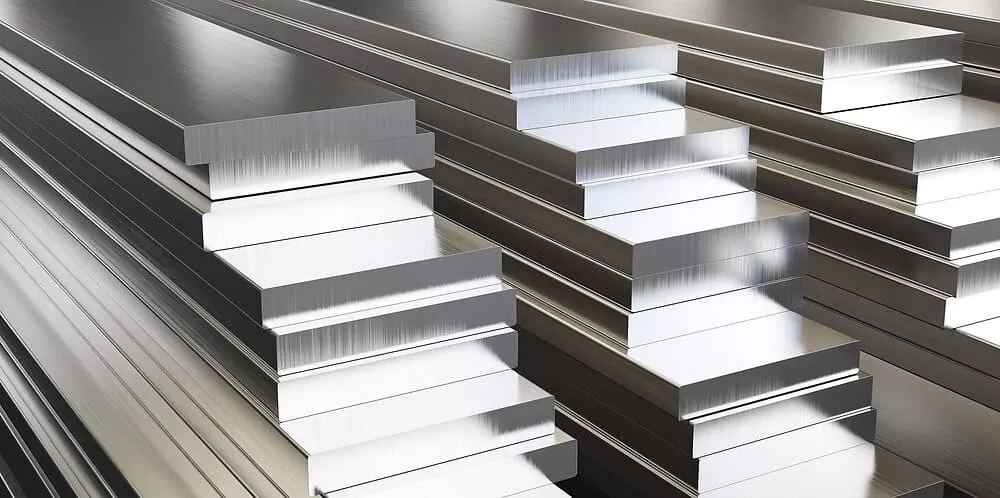
Walk into any metal supplier and ask for aluminum sheet to bend, weld, and leave outdoors, and you will most likely be handed 5052 aluminum, usually as 5052-H32. It is the standard choice for fuel tanks, truck bodies, boat parts, enclosures, and panels. Unlike 6061 aluminum and 6063 aluminum, it does not get its strength from heat treatment but from cold work. Here are answers to the questions people ask most.
1. What is 5052 aluminum?
5052 is a wrought aluminum alloy from the 5xxx series, with about 2.5% magnesium as its main alloying element and a small amount of chromium. In Europe it is EN AW-5052 or AlMg2.5, and in Japan A5052. The 5xxx series is often called the “marine” series because of its good resistance to saltwater. Where it fits among other alloys is covered in aluminum alloys.
2. What is its chemical composition?
| Element | Content (%) |
|---|---|
| Magnesium (Mg) | 2.2–2.8 |
| Chromium (Cr) | 0.15–0.35 |
| Silicon + iron (Si + Fe), max. | 0.45 |
| Copper (Cu), max. | 0.10 |
| Manganese (Mn), max. | 0.10 |
| Zinc (Zn), max. | 0.10 |
| Aluminum | Balance |
Magnesium strengthens the metal by dissolving in the aluminum. Chromium helps resist stress corrosion and controls grain size. The very low copper content makes 5052 far more corrosion resistant than 2xxx and 7xxx alloys.
3. Why can’t 5052 aluminum be heat treated for strength?
Because 5052 has no elements that form strengthening precipitates, like Mg₂Si in 6xxx alloys or MgZn₂ in 7xxx alloys. Its magnesium stays dissolved, so aging adds no strength. The only way to strengthen it is cold work, such as rolling, which makes it harder but less ductile. The only heat treatments used on 5052 are annealing (to soften it) and stabilizing. Heat-treatable alloys are explained in aluminum heat treatment.
4. What do H32, H34, and H38 mean?
H tempers mark alloys strengthened by cold work. The first digit describes the process; the second, the degree of hardness.
- H3x: strain hardened, then stabilized by low-temperature heating so properties do not drift over time. This matters for magnesium alloys like 5052.
- Second digit: 2 = quarter hard, 4 = half hard, 6 = three-quarter hard, 8 = full hard.
- O: annealed, the softest and most formable condition.
So 5052-H32 is sheet that has been strain hardened, stabilized, and brought to quarter hard. It is the most common temper on the market because it balances strength and formability.
| Temper | Tensile strength | Yield strength | Elongation (%) | Hardness (HB) |
|---|---|---|---|---|
| 5052-O | 193 MPa (28 ksi) | 90 MPa (13 ksi) | 25 | 47 |
| 5052-H32 | 228 MPa (33 ksi) | 193 MPa (28 ksi) | 12 | 60 |
| 5052-H34 | 262 MPa (38 ksi) | 214 MPa (31 ksi) | 10 | 68 |
| 5052-H38 | 290 MPa (42 ksi) | 255 MPa (37 ksi) | 7 | 77 |
These are typical values for thin sheet. ASTM B209 minimums are lower and depend on thickness.
5. How strong is 5052 compared with other alloys?
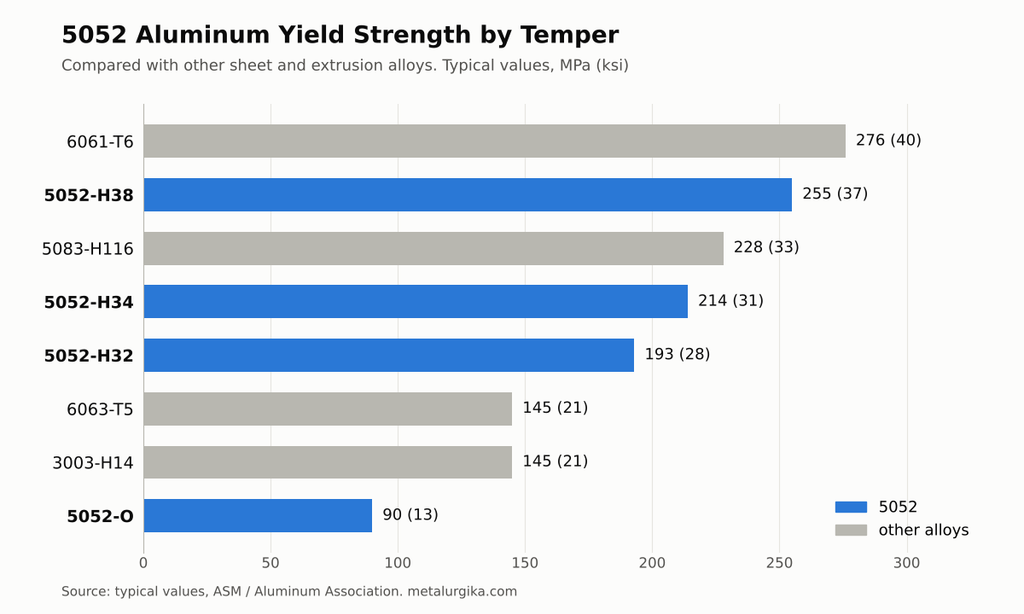
In the H32 temper, 5052 has a yield strength of about 193 MPa (28 ksi). That is higher than common 3003 sheet and 6063-T5 extrusions, but lower than 5083 and 6061-T6. A strength of 5052 that is rarely mentioned is fatigue resistance: the endurance limit of 5052-H32 is about 117 MPa (17 ksi), higher than about 97 MPa (14 ksi) for 6061-T6. That makes 5052 a good fit for parts that vibrate constantly, such as tanks and vehicle panels.
Physical properties: density about 2.68 g/cm³ (0.097 lb/in³), melting range 607–650 °C (1,125–1,200 °F), thermal conductivity about 138 W/m·K, and electrical conductivity about 35% IACS.
6. What is the difference between 5052 and 6061 aluminum?
| Aspect | 5052-H32 | 6061-T6 |
|---|---|---|
| Main alloying element | Magnesium | Magnesium + silicon |
| How it is strengthened | Cold work | Heat treatment (aging) |
| Yield strength | About 193 MPa (28 ksi) | About 276 MPa (40 ksi) |
| Formability | Excellent | Fair; cracks at tight radii |
| Seawater resistance | Excellent | Good |
| Weldability | Excellent; joints keep more strength | Good, but the weld zone softens significantly |
| Machinability | Fair; gummy | Good |
| Common forms | Sheet and plate | Plate, bar, extrusions |
The rule of thumb in 5052 vs 6061: choose 5052 for parts made from bent and welded sheet, especially if they see water. Choose 6061 for parts machined from bar or thick plate, or frames that must be strong.
7. Is 5052 aluminum sheet easy to bend?
Yes, this is its main advantage. Thin 5052-H32 sheet can usually be bent 90° to an inside radius of about 0–1.5 times its thickness without cracking, while 6061-T6 typically needs about 1.5–3 times thickness and is more prone to cracking on the outside of the bend. A few tips:
- Bend across the rolling direction when possible; bends parallel to it crack more easily.
- For very tight bends or deep forming, use O or H32, not H38.
- Plate thicker than about 6 mm (1/4 in) needs a larger radius.
8. Is 5052 aluminum good in saltwater?
Very good. Magnesium and very low copper make 5052 resistant to seawater, coastal air, and industrial atmospheres. It is widely used for small boats, pontoons, deck hardware, and tanks. For larger, structural hulls, 5083 aluminum is usually chosen because it is stronger. Keep 5052 isolated from steel and copper in seawater to avoid galvanic corrosion; the mechanism is covered in aluminum corrosion.
9. Can 5052 aluminum be welded?
Yes, and it welds well. TIG and MIG with ER5356 filler are the most common choice for strength and color match. ER4043 also works but is less suited to joints that will be anodized or exposed to seawater. Because 5052 is not heat-treat strengthened, the weld zone only drops to the annealed (O) strength of about 90 MPa (13 ksi) yield, a smaller loss than 6xxx alloys suffer when welding heat undoes their aging. Clean off the oxide layer with a stainless steel brush before welding.
10. Can 5052 aluminum be anodized?
Yes. Anodizing gives 5052 a good protective layer against corrosion and scratches. For decorative work, though, the finish is slightly yellowish and less clear than on 6063, which is why architectural profiles still use 6063. Anodized 5052 is common for panels and enclosures. Processes and types are covered in aluminum anodizing.
11. Is 5052 aluminum easy to machine?
Not especially. In the O temper it is soft and chips stick to the tool. H32 and H34 machine better but still trail 6061-T6. Sharp carbide tools, positive rake, high speeds, and coolant help. For heavily machined parts, 6061 or free-machining alloys such as 6262 and 2011 are better choices.
12. What is 5052 aluminum used for?
- Transportation: fuel tanks, truck bodies and boxes, trailer panels, bus flooring.
- Marine: small boats, pontoons, deck hardware, water tanks.
- Electronics and electrical: enclosures, panels, server racks, and chassis.
- Building and household: roofing, gutters, road signs, cookware, and appliance panels.
- Industrial: low-pressure vessels, ducting, and machine guards.
Bonus: Which standards and designations should buyers know?
- ASTM B209: aluminum sheet and plate, including 5052.
- EN 485 and EN 573: EN AW-5052 (AlMg2.5) in Europe.
- JIS H4000: A5052P for plate in Japan.
Specify alloy, temper, thickness, and size together, such as “5052-H32 sheet, 0.125 in (3.2 mm), 48 × 96 in”, and ask for a mill certificate to confirm alloy and temper.
In Short
- 5052 is an Al-Mg alloy strengthened by cold work, most often supplied as H32.
- Its strengths: easy bending, easy welding, seawater resistance, and fatigue resistance.
- Choose 6061 for higher strength or heavy machining, and 5083 for heavier marine structures.
Further Reading
- 6061 Aluminum: Properties, Density, Composition, and 6061 vs 7075, 6063, and 5052
- 6063 Aluminum: Composition, Properties, T5 vs T6, and 6063 vs 6061
- Aluminum Corrosion: Causes, Types, and Prevention

Dagus R. Djuanda is a metallurgical engineer with more than 20 years of experience in materials engineering, specializing in magnetic materials. He holds a master’s degree in magnetic materials engineering, is a doctoral candidate in industrial engineering, and works as an engineer at the Ministry of Industry of the Republic of Indonesia. Founder of Metalurgika.