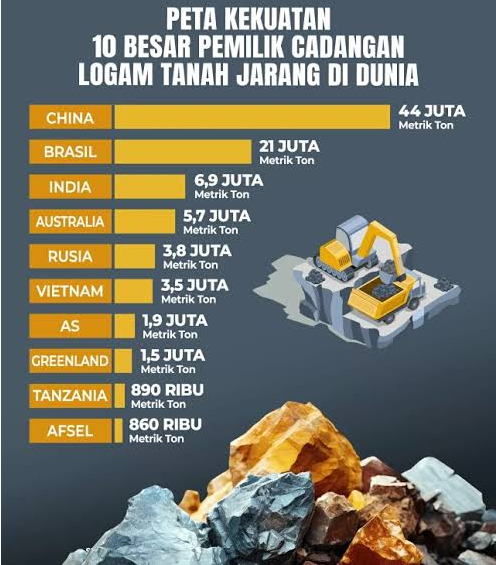
When discussing rare earth supply chain geopolitics, it’s important to first understand the underlying map: who actually controls global rare earth reserves and production? The answer reveals an imbalance far more extreme than most other strategic mineral commodities.
Highly Concentrated Production Dominance
Unlike commodities such as copper or nickel, whose production is spread across dozens of countries each holding a significant share, global rare earth production is heavily concentrated in just a handful of countries. One country has historically dominated the majority share of global REE mine production — a position built over the past several decades through a combination of long-term industrial policy, refining infrastructure investment, and mastery of complex element separation technology.
Why this dominance has persisted: it isn’t merely about geological reserve ownership, but control over refining capacity — a stage far more complex and expensive than raw ore mining alone, as discussed in Rare Earth Extraction and Refining. Even countries with significant REE reserves often remain dependent on refining facilities in that dominant country, having not yet developed adequate domestic refining infrastructure.
Reserve Distribution: More Balanced Than Production
Interestingly, the distribution of geologically identified REE reserves is actually far more balanced than the distribution of actual production. Several other countries hold significant REE reserves that remain largely untapped, including nations across the Americas, Africa, and Southeast Asia — indicating that current production dominance reflects historical investment decisions and policy choices more than geological limitations.
Factors hindering production diversification:
- The very long timeline for new mine development, from exploration to commercial production, often taking a decade or more
- Significant environmental challenges, given that REE refining generates low-level radioactive waste requiring strict management
- The need for massive capital investment to build technologically competitive refining facilities
Ongoing Diversification Efforts
Awareness of supply concentration risk is driving various countries to develop alternative REE projects:
Mining projects outside the dominant producer continue to be developed across several regions, supported by government policy incentives that view REEs as strategic minerals critical to long-term economic and defense security.
Investment in alternative refining facilities has become a particular focus, given that refining capacity — not mining alone — is the true critical bottleneck in the global REE supply chain.
Cross-border strategic partnerships are increasingly common, where countries holding reserves partner with countries holding refining technology or investment capital to accelerate project development that would be impossible to pursue independently.
Indonesia’s Position on the Global Map
Indonesia is not yet a major player in the current global REE production landscape, but holds potential that is beginning to draw serious attention — particularly from byproduct minerals found in tin and nickel mining tailings that have been operating for decades, as discussed in Indonesia’s Rare Earth Downstream Push.
Indonesia’s potential advantage: unlike countries that must build REE mines from scratch, Indonesia could potentially leverage existing tin and nickel mining infrastructure, where rare earth minerals have long been discarded as an economically unexploited byproduct in tailings.
Remaining challenges: extraction technology for byproduct minerals from tailings requires its own investment and technical expertise, along with the challenge of classifying and separating the LREE-HREE composition from tailing sources, which differs in character from primary REE deposits found in other countries.
Why This Power Map Keeps Shifting
The dynamics of REE reserve and production control are not a static condition — new investments, refining technology breakthroughs, and policy shifts can reshape this map over the medium term. For industry players and policymakers dependent on REEs as a strategic raw material, monitoring the evolving global production and reserve landscape is an important part of long-term supply chain planning — just as it remains highly relevant to REE price and market analysis, which is heavily shaped by these supply control dynamics.