In Rare Earth Elements 101, we briefly noted that global rare earth production remains heavily concentrated in a handful of countries — and that concentration has created a geopolitical problem all its own.
We’ve also covered extraction and refining and Indonesia’s downstream potential in this cluster. Now let’s tackle the one piece we haven’t fully unpacked yet: how rare earths went from a mining commodity to one of the world’s most contested diplomatic bargaining chips — and what that means for the global technology supply chain.
China’s Dominance and Why It Matters
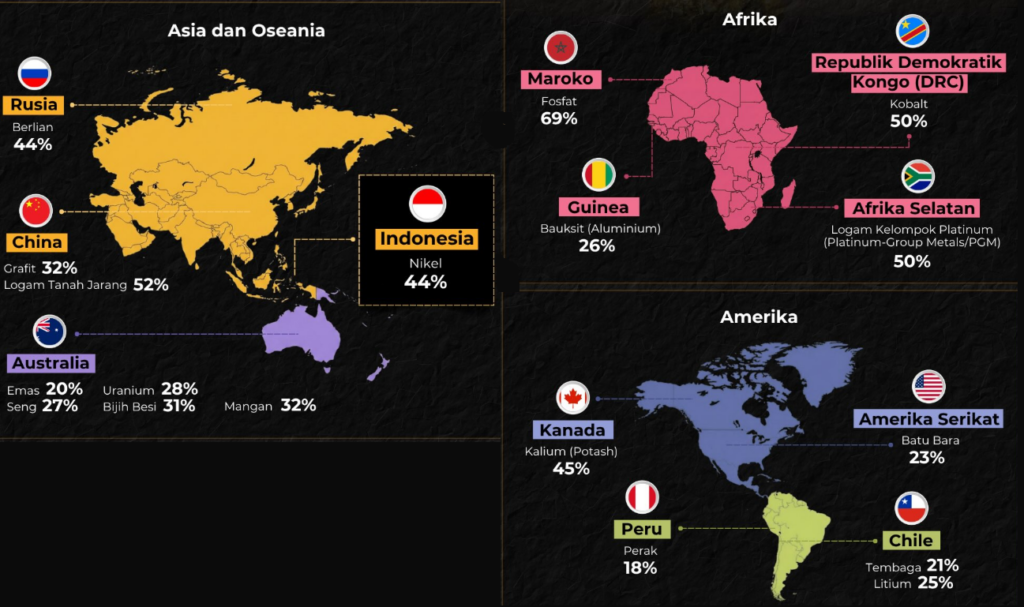
China currently controls the majority of the world’s rare earth processing and refining capacity. That position isn’t accidental — it’s the result of decades of long-term investment in the complex element-separation technology we described in our extraction article. As a result, even though REE reserves are scattered across many countries, nearly everyone — from EV makers to semiconductor producers to defense industries — still depends on a supply chain that passes through China at some point.
That dependency is exactly why China’s export policy carries a much bigger ripple effect than a typical mining commodity would.
Timeline: The Export Tightening That Shook Global Markets
Since early 2025, Beijing has progressively tightened rare earth export controls:
- April 2025 — China imposed its first export controls on several heavy rare earth types, amid an escalating tariff war with the United States.
- June 2025 — The US and China reached a framework agreement in London to resume rare earth shipments more quickly, as part of broader trade negotiations.
- October 2025 — China’s Ministry of Commerce announced stricter export restrictions, requiring foreign entities to obtain special licenses to export products containing more than 0.1% Chinese-origin rare earth material or made using Chinese technology. The rule took effect gradually starting November 8, 2025, and fully by December 1, 2025.
- January 2026 — Restrictions tightened further, followed by two more rounds of tightening in subsequent months, this time specifically targeting several major Japanese conglomerates.
- June 2026 — China completely halted shipments of gallium, dysprosium, terbium, and yttrium to Japan, following diplomatic tension after Japanese Prime Minister Sanae Takaichi’s remarks on Taiwan in November 2025.
Interestingly, over the same period, China’s overall rare-earth-based magnet exports to the global market actually increased — a sign that these restrictions are highly targeted geopolitically, rather than a blanket supply tightening.
How Major Powers Have Responded
The United States felt the most immediate impact. After the April 2025 export controls disrupted supply chains badly enough to force several auto plants into temporary shutdowns, Washington and Beijing pursued trade negotiations that led to a 32% month-over-month surge in Chinese REE exports by June 2025. Tensions haven’t fully eased, though — restrictions on materials with both civilian and military applications were extended through late November 2026, reflecting that this issue remains part of a much larger trade negotiation between the two countries.
The European Union has chosen to build domestic capacity instead. Through its Critical Raw Materials Act, the European Commission is targeting 7,000 tonnes of domestic rare-earth-based magnet production by 2030, backed by several mining, refining, and recycling projects. A major processing facility is already operating in Estonia, with another in southwestern France scheduled to start operations in 2026. EU trade officials have publicly stated that China’s restrictions have significantly disrupted Europe’s automotive and manufacturing sectors.
Japan has faced the most personal pressure due to diplomatic friction, with supplies of several critical elements for its automotive and electronics sectors completely cut off in recent months.
India, despite holding the world’s fifth-largest rare earth reserves, still accounts for less than 1% of global supply — a reminder that large reserves in the ground don’t automatically make a country a major player unless processing capacity is built up. This echoes a point from our extraction article: processing technology, not raw reserves alone, is the real key to rare earth supply chain power.
Where Does Indonesia Stand?
Amid this dynamic, Indonesia has taken its own policy path. In August 2026, the government, through the Presidential Chief of Staff, announced that exporting rare earth elements as a primary product is now officially banned — though commodities containing REEs as a byproduct, such as those from tin or nickel mining, can still be exported as long as they meet applicable regulations. This policy serves as a transition guideline for exporters, surveyors, and customs authorities while the government drafts more detailed rules on REE content limits in export products.
This policy direction aligns with the downstream strategy we’ve already discussed: rather than remaining a raw material exporter, Indonesia is trying to position itself higher up the value chain — something that, if successful, could give it greater bargaining power amid global geopolitical competition over this strategic mineral group.
Conclusion
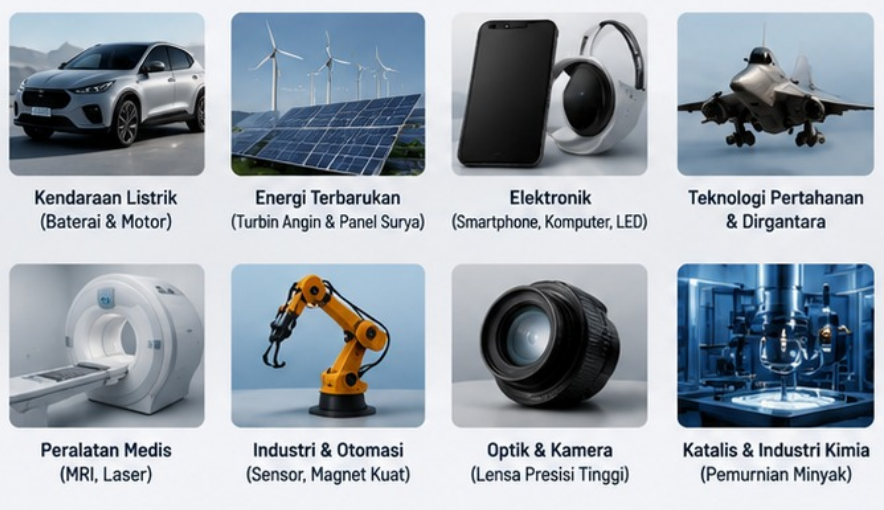
The rare earth supply chain is no longer just a matter of mines and factories — it’s a new battlefield in geopolitical competition among major powers. Every export policy decision made in Beijing sends ripple effects through the automotive, electronics, renewable energy, and defense industries worldwide, while other countries race to build domestic capacity, seek alternative sources, or negotiate access through diplomacy and trade.
For Indonesia, understanding this dynamic matters not just as an observer, but as one of the resource holders shaping its own policy direction amid this global supply chain contest.