Amid concerns over supply dependence and the volatility of rare earth prices, a natural question arises: is there a viable magnet alternative that doesn’t rely on neodymium or other rare earth elements? The answer is yes, though each alternative comes with its own trade-offs that need to be understood before being treated as an ideal solution.
Why the Search for Alternatives Matters
As discussed in the LREE vs HREE analysis, dependence on specific rare earth elements — particularly neodymium and dysprosium for high-performance permanent magnets — creates significant supply chain risk for the automotive and renewable energy industries. Alternative material research is one mitigation strategy, alongside others such as REE recycling and supply source diversification.
Ferrite Magnets: The Most Mature and Affordable Alternative
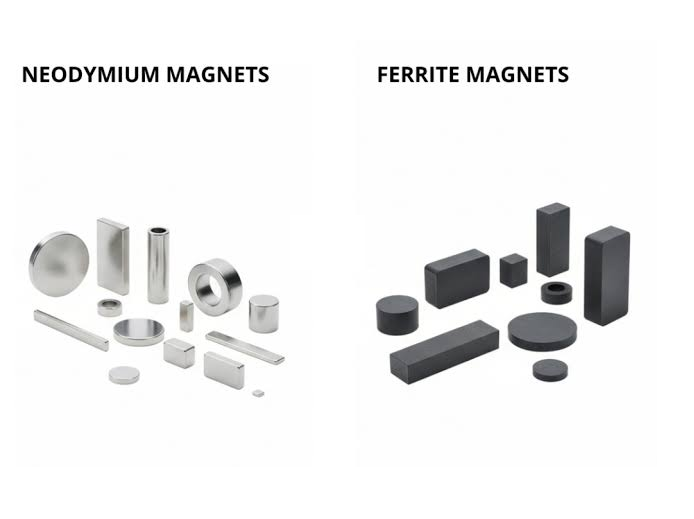
Ferrite magnets (also known as ceramic magnets) are made from a mixture of iron oxide with barium or strontium — containing no rare earth elements at all.
Key advantages:
- Production cost is far lower than neodymium magnets, since raw materials are abundant and not dependent on concentrated supply sources
- Excellent corrosion resistance without additional coating, unlike neodymium magnets, which are prone to corrosion and typically require a protective nickel coating
- Stable across a wide operating temperature range for certain applications
A critical limitation: ferrite’s magnetic field strength is far lower than neodymium’s — typically requiring several times the volume of ferrite magnet to produce an equivalent magnetic field strength. This makes ferrite less suitable for applications that prioritize light weight and compact size, such as high-performance EV motors.
Applications where it still fits: large household speakers, simple electric motors for home appliances, and other applications that aren’t particularly sensitive to weight and size.
Induction Motors: Avoiding the Need for Permanent Magnets Altogether
Instead of searching for an alternative magnet material, some EV manufacturers take a different approach: using induction motors that require no permanent magnet at all, relying instead on electromagnetically induced magnetic fields in the rotor.
Advantage: completely eliminates dependence on rare earth elements, with raw material costs that are more stable and not exposed to REE price volatility.
Trade-off: induction motors generally have somewhat lower efficiency and power density compared to permanent magnet motors of the same size, meaning the motor needs to be larger or heavier to achieve equivalent performance — a trade-off EV manufacturers must weigh against target driving range and energy efficiency goals.
Permanent Magnet Motors with Reduced HREE Content
Another growing approach is to continue using neodymium magnets, but with formulations that significantly reduce or eliminate dysprosium and terbium content — the two most expensive and scarcest HREEs typically added to improve a magnet’s resistance to demagnetization at high temperatures.
How this is achieved: through motor design innovations that reduce magnet exposure to extreme operating temperatures (thereby reducing the need for dysprosium for thermal stability), as well as the development of more efficient magnet microstructures that achieve equivalent thermal resistance using minimal HREE content.
Other Experimental Magnet Materials
Academic and industrial research continues to explore new candidate magnet materials that could further reduce REE dependence, though most remain in the research stage and are not yet commercially mature:
- Iron-nitrogen-based magnets — explored for their potential magnetic field strength approaching that of neodymium without any REE content
- Manganese-bismuth-based magnets — another candidate being researched for high-temperature applications
- Computational material research (AI-driven material discovery) that accelerates the identification of new magnet formulation candidates without the need for lengthy laboratory trial-and-error
Reality Check: Full Substitution Remains Far Off
While these various alternatives are promising, it’s important to understand that in the near term, neodymium-based magnets will continue to dominate applications demanding the highest power density and efficiency, such as premium EV motors and offshore wind turbines — as discussed in the broader REE market dynamics. Alternatives like ferrite and induction motors are better viewed as technology diversification suited to specific application segments, rather than a universal replacement that will eliminate REE demand entirely anytime soon.