
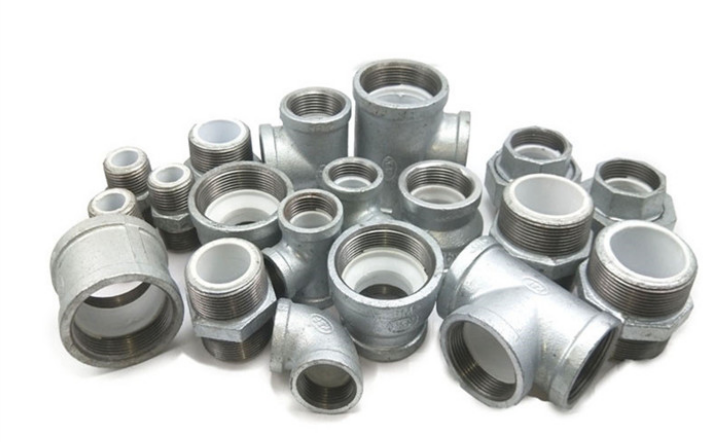
Malleable cast iron is a cast iron made in two steps: the metal is first cast as hard, brittle white iron, and then annealed for a long time until its iron carbide breaks down into irregular clusters of graphite. The result is a cast iron that is ductile, easy to machine, and resistant to impact. It is often simply called malleable iron.
This article expands on the short section in our guide to what cast iron is, with a focus on how malleable cast iron is made, its types, its properties, and where it is used.
What Is Malleable Cast Iron?
The properties of cast iron depend on the form of its carbon. In gray iron, the carbon is present as sharp graphite flakes, which make the material brittle. In white iron, the carbon is locked up as cementite (iron carbide), which is extremely hard. Malleable cast iron starts as white iron and then converts that cementite into irregular graphite clusters called temper carbon.
Temper carbon clusters have no sharp tips like graphite flakes, so the surrounding metal can carry load and deform a little before it breaks. The idea is similar to ductile iron, but the route is different: the spherical graphite in ductile iron forms during solidification thanks to magnesium, while the temper carbon in malleable iron forms after casting, through heat treatment.
Can malleable iron be forged? Not in the usual sense. “Malleable” here means the metal can be bent or hammered slightly without shattering. It is not hot forged like steel.
How Malleable Cast Iron Is Made
Step 1: Casting white iron
The entire cross section must solidify as white iron, with no graphite at all. If some graphite forms during casting (a condition called mottling), it takes the shape of flakes and the anneal cannot fix it. For this reason, carbon and silicon are kept lower than in gray iron.
| Element | Typical range | Why |
|---|---|---|
| Carbon (C) | 2.2–2.9% | Enough to form graphite during the anneal, not so high that the iron solidifies gray |
| Silicon (Si) | 0.9–1.9% | Promotes graphitization during the anneal, but too much causes flake graphite on solidification |
| Manganese (Mn) | 0.2–0.6% (higher for pearlitic grades) | Ties up sulfur; excess slows the anneal |
| Sulfur (S) | up to about 0.2% | Balanced by manganese |
| Phosphorus (P) | up to about 0.15% | High phosphorus causes brittleness |
These are typical ranges. The exact composition depends on section size and the type of malleable iron being made. The iron is usually melted in an induction furnace or cupola (see our article on melting furnaces for metal casting) and poured into a sand mold.
The need to solidify white limits section thickness. Malleable iron castings are usually thin to medium walled, roughly under 25–40 mm (1–1.5 in). Thicker sections cool too slowly and tend to form flake graphite.
Step 2: Annealing (malleablizing)
The white iron castings are then annealed in a furnace. This is called malleablizing. For ferritic blackheart malleable iron, the cycle has several stages:
- Slow heating to about 900–960°C (1650–1760°F).
- First stage graphitization. The castings are held at that temperature for several to more than ten hours. The cementite breaks down into austenite and temper carbon.
- Relatively fast cooling to about 760°C (1400°F).
- Second stage graphitization. The castings are cooled very slowly from about 760°C to 690°C (1400°F to 1275°F), at roughly 3–10°C (5–18°F) per hour, or held just below the transformation temperature. Carbon in the austenite moves to the existing graphite clusters, leaving a ferrite matrix.
- Air cooling to room temperature.
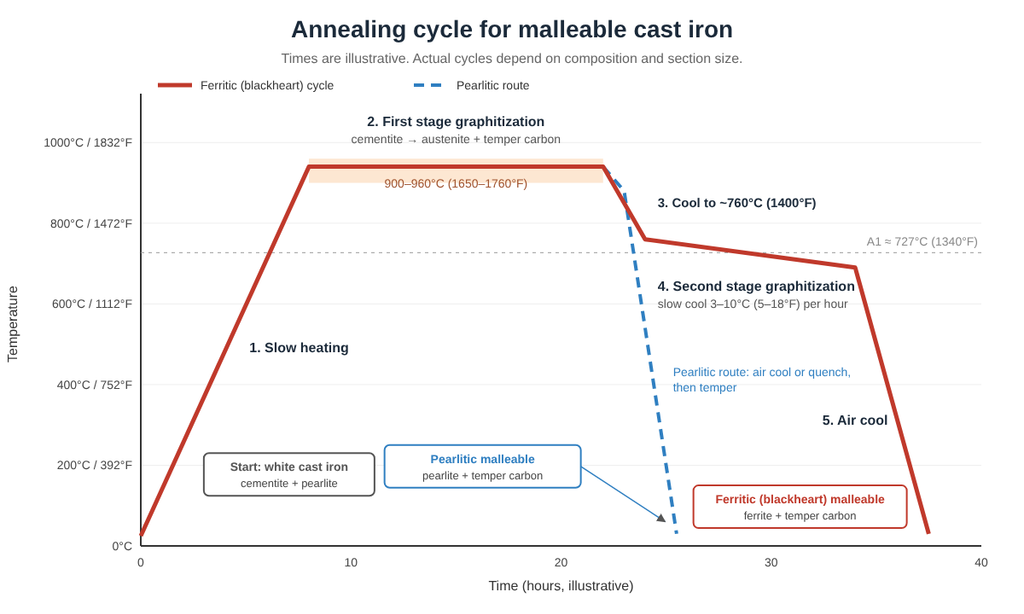
The cycle once took several days. Modern furnaces with controlled atmospheres have shortened it to roughly 20–40 hours, depending on composition and section size. The basic pattern is the same as annealing in other metals, heating, holding, and slow cooling, but the purpose is different: not recrystallization, but changing the form of the carbon.
Types of Malleable Cast Iron
There are three main types, distinguished by the annealing atmosphere and the cooling route.
Blackheart (ferritic) malleable iron
Annealed in a neutral atmosphere so the carbon stays inside the casting as graphite clusters. The matrix is ferrite. The fracture surface is dark, which gives the type its name. It is the most ductile and most machinable type, and the most widely produced, especially in North America and Japan.
Pearlitic malleable iron
Processed like blackheart iron through first stage graphitization. The castings are then cooled faster, in air or by quenching followed by tempering, so the second stage is skipped and the matrix becomes pearlite or tempered martensite. The result is stronger and harder, with lower ductility. The principles of quenching and tempering are covered in our article on heat treatment of metals.
Whiteheart malleable iron
Annealed in an oxidizing atmosphere at a higher temperature, about 950–1,050°C (1740–1920°F), for tens of hours. Carbon at the surface reacts with the atmosphere and leaves the casting (decarburization). In thin sections, almost the whole cross section becomes ferrite with little graphite, and the fracture looks bright. In thicker sections the core still contains graphite and pearlite. This type is more common in Europe and suits thin parts. Some low-carbon grades can even be welded.
| Type | Annealing atmosphere | Matrix | Typical tensile strength | Typical elongation |
|---|---|---|---|---|
| Blackheart (ferritic) | Neutral | Ferrite | 300–370 MPa (44–54 ksi) | 6–18% |
| Pearlitic | Neutral, then faster cooling | Pearlite or tempered martensite | 450–800 MPa (65–116 ksi) | 1–8% |
| Whiteheart | Oxidizing | Ferrite at the surface, ferrite and pearlite in the core | 350–450 MPa (51–65 ksi) | 4–12% |
The values are ranges of minimums across common standard grades. For design, use the values in the standard and grade you specify.
Properties of Malleable Cast Iron
- Ductile and impact resistant. Far more ductile than gray or white iron. Parts can bend somewhat before they break, which makes them safer under impact.
- Easy to machine. Ferritic grades are among the most machinable cast irons. The graphite clusters help break chips and lubricate the tool.
- Uniform in thin sections. Because the casting first solidifies white, the structure is uniform even in thin walls. This is an advantage over ductile iron, which tends to form hard carbides in very thin sections.
- Tough at low temperature. Ferritic grades keep reasonable toughness below freezing.
- Corrosion resistance similar to other cast irons. It is usually protected by hot-dip galvanizing or paint. The protection options are the same as for other iron-based metals, as explained in how to prevent corrosion in metals.
- Hard to weld, except some whiteheart grades. Welding heat can form hard carbides again around the weld. Repairs follow special procedures, as described in our article on repair welding for metal castings.
- Limited to thin and medium sections, because the whole cross section must solidify white first.
Standards and Grades
| Standard | Scope | Example grades |
|---|---|---|
| ASTM A47 | Ferritic blackheart | Grade 32510, 35018 (first three digits: minimum yield strength in hundreds of psi, so 325 = 32,500 psi or about 224 MPa; last two: minimum elongation %) |
| ASTM A220 | Pearlitic | Grade 40010 to 90001 |
| EN 1562 | Blackheart and pearlitic (GJMB), whiteheart (GJMW) | EN-GJMB-350-10, EN-GJMB-550-4, EN-GJMW-400-5 |
| JIS G5705 | All three types | Codes FCMB (blackheart), FCMP (pearlitic), FCMW (whiteheart) |
In EN designations, the first number is the minimum tensile strength in MPa and the second is the minimum elongation in percent. EN-GJMB-350-10, for example, is a blackheart grade with a minimum tensile strength of 350 MPa and a minimum elongation of 10%.
Uses of Malleable Cast Iron
- Pipe fittings: threaded elbows, tees, couplings, and unions for water and gas lines, usually galvanized. This is the best known use.
- Electrical and utility hardware: clamps, brackets, and line hardware.
- Automotive and heavy vehicle parts: differential carriers, brackets, levers, and brake components on older vehicles. Pearlitic grades are used for stronger parts such as levers and small gear housings.
- Agricultural and railway equipment: chain links, hooks, brackets, and small parts that take impact.
- Hand tools and hardware: wrenches, hinges, clamps, and vise parts.
Since about the 1950s, many of these uses have gradually moved to ductile iron, which needs no long anneal. Malleable cast iron remains mainly in small, thin-walled parts made in high volume, such as pipe fittings.
Malleable Iron vs Ductile Iron
| Aspect | Malleable cast iron | Ductile iron |
|---|---|---|
| Graphite shape | Irregular clusters (temper carbon) | Spheres (nodules) |
| How graphite forms | Annealing after casting | During solidification, thanks to magnesium |
| Heat treatment | Required, long cycle | Optional |
| Section size | Thin to medium | Thin to very heavy |
| Very thin sections | Uniform and carbide free | Prone to hard carbides |
| Energy cost | Higher because of the anneal | Lower |
| Strength and ductility | Good | Equal or higher |
For thick or large parts, ductile iron almost always makes more sense. For small, thin-walled parts that must be ductile and easy to machine, malleable iron is still competitive. How to choose between cast iron, cast steel, and other alloys is covered in our guide to choosing materials for metal casting.
Common Problems
- Mottling: flake graphite forms during casting because carbon or silicon is too high, or a section is too thick. Annealing cannot fix it.
- Incomplete anneal: the temperature is too low or the time too short, so residual cementite leaves the casting hard and brittle.
- Wrong matrix: second stage cooling is too fast in ferritic grades, leaving pearlite and reducing ductility.
- Embrittlement after galvanizing: under some conditions, malleable iron can become brittle after hot-dip galvanizing. Composition and cooling after the anneal are controlled to prevent it.
- Distortion: thin castings can sag during the long hold at high temperature, so they need support in the furnace and sometimes straightening.
- Unwanted scale and decarburization in blackheart iron when the furnace atmosphere is not controlled.
Frequently Asked Questions
What is the difference between malleable iron and white iron? White iron is the starting material. It is very hard and brittle because its carbon is present as cementite. After annealing, the cementite breaks down into graphite clusters and the material becomes ductile.
Is malleable iron the same as wrought iron? No. Wrought iron is a very low-carbon iron shaped by forging. Malleable iron is a high-carbon cast iron shaped by casting.
Why are galvanized pipe fittings often made of malleable iron? Fittings are thin-walled and complex in shape, must survive impact while being installed and tightened, and need threads that are easy to cut. Malleable iron meets all of these needs.
How long does it take to anneal malleable iron? In modern furnaces, about 20–40 hours for blackheart grades. Whiteheart grades usually take longer.
Conclusion
Malleable cast iron is white iron annealed until its cementite turns into graphite clusters. There are three types: blackheart, the most ductile; pearlitic, the strongest; and whiteheart, suited to thin parts. The long anneal and the limit on section size have moved many of its uses to ductile iron, but for small, thin-walled parts such as pipe fittings, it remains a reliable choice.
Related Articles
- What Is Cast Iron? Definition, Types, Properties, and Uses
- Ductile Iron: Nodularization and Inoculation
- Annealing: Types, Process, and Temperatures for Steel and Other Metals
- Heat Treatment: Process, Types, and Effects on Metal Properties
- Choosing Materials for Metal Casting: Cast Iron, Cast Steel, and Aluminum Alloys


