
Carburizing is a heat treatment process that adds carbon to the surface of low-carbon steel at high temperature, then quenches it so the outer layer becomes very hard and wear-resistant while the core stays ductile. The result is a part whose surface can withstand friction and high contact stress without breaking easily. That is why carburizing is the main hardening method for transmission gears, pinions, and many automotive components.
Carburizing is one of the surface hardening methods, and the one most people mean when they say case hardening. This guide covers it in detail: why carbon makes steel hardenable, the process steps, the link between time and case depth, the types of carburizing, suitable steels, and common problems.
Why Does Carbon Make Steel Hardenable?
Steel is hardened by heating it into the austenite range and cooling it quickly so it transforms into martensite. The hardness of martensite depends almost entirely on its carbon content. A steel with about 0.2% carbon reaches only moderate hardness after quenching, while one with about 0.8% carbon can exceed 60 HRC.
The problem is that steel with high carbon throughout is brittle. Carburizing solves this dilemma: only the surface is raised to about 0.7 to 0.9% carbon, while the core stays low in carbon. After quenching, the surface becomes very hard high-carbon martensite and the core becomes a tough low-carbon structure.
The Carburizing Process, Step by Step
1. Preparation and Masking
Parts are cleaned of oil, grease, and scale, because contamination blocks carbon uptake and causes soft spots. Areas that must stay soft, such as threads or holes to be machined later, are covered with anti-carburizing paste or copper plating.
2. Heating and Carbon Diffusion
Parts are heated to about 850 to 950 °C (1,560 to 1,740 °F), above the transformation range, so the structure becomes austenite, which can dissolve a lot of carbon. In a carbon-rich environment, carbon is absorbed at the surface and diffuses inward.
In industry, this stage is often split into two phases:
- Boost: the atmosphere’s carbon potential is set high so carbon enters quickly.
- Diffuse: the carbon potential is lowered so carbon spreads deeper and surface carbon falls to the target, usually 0.7 to 0.9%.
3. Quenching
Once the required depth is reached, parts are quenched, usually in oil. There are several approaches:
- Direct quench: parts are cooled slightly from the carburizing temperature and quenched straight away. It is the most economical and most common route for fine-grained steels.
- Single reheat: parts are cooled slowly, then reheated to about 800 to 850 °C (1,470 to 1,560 °F) before quenching. This gives a finer grain but uses extra energy.
- High-pressure gas quench: used with vacuum carburizing to reduce distortion.
4. Tempering
As-quenched martensite is very brittle, so parts are tempered right away at a low temperature, about 150 to 200 °C (300 to 390 °F), for one to two hours. Surface hardness drops slightly, but toughness rises a great deal. The principle is the same as in our article on quenching and tempering.
For precision parts, a sub-zero treatment (cooling below 0 °C, or 32 °F) is sometimes added before tempering to transform retained austenite into martensite, and shot peening is often applied afterward to add compressive residual stress.
Carburizing Time and Case Depth
Because carbon enters by diffusion, case depth grows with the square root of time, not with time itself. A rule of thumb often used for carburizing at about 925 °C (1,700 °F) is:
Total case depth (mm) ≈ 0.635 × √(time in hours), or about 0.025 × √(time in hours) in inches
| Time at about 925 °C (1,700 °F) | Approximate total case depth |
|---|---|
| 1 hour | about 0.6 mm (0.025 in) |
| 4 hours | about 1.3 mm (0.05 in) |
| 9 hours | about 1.9 mm (0.075 in) |
| 16 hours | about 2.5 mm (0.1 in) |
In other words, doubling the case depth takes four times as long. That is why the very deep cases on large gears can take more than a day. Higher temperatures speed up diffusion, but they also coarsen the grain and increase distortion.
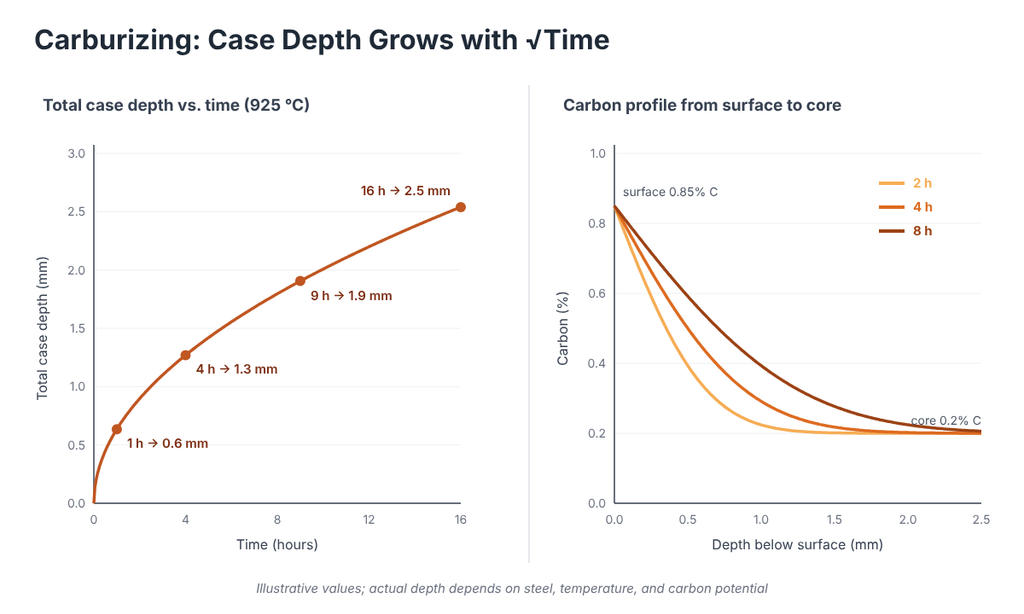
Note that these figures are total case depth, the depth at which carbon content is almost back to core level. Effective case depth, the depth to a hardness of 550 HV, is usually thinner, roughly two-thirds of the total. When ordering carburizing, state clearly which depth you mean. Measurement is covered in our guide to surface hardening.
Types of Carburizing
Pack Carburizing
Pack carburizing is the simplest method and is still used in small shops and teaching labs. The steps are:
- Parts are placed in a heat-resistant steel box, surrounded by a solid carburizing compound.
- The compound is charcoal mixed with about 10 to 20% of an energizer such as barium carbonate (BaCO₃) or sodium carbonate.
- The box is sealed, for example with clay, to keep air out.
- The box is heated in a furnace at about 900 to 950 °C (1,650 to 1,740 °F) for several hours.
- Parts are removed and quenched, or cooled first and then reheated and quenched.
Inside the box, the remaining oxygen reacts with the charcoal to form carbon monoxide (CO), and the CO releases carbon at the steel surface. The energizer speeds up CO formation.
Pros: cheap equipment and no special atmosphere furnace. Cons: slow because the whole box must heat up, surface carbon is hard to control, results vary, and it is poorly suited to high volumes.
Gas Carburizing
Gas carburizing is the most widely used industrial method. Parts are heated in a furnace filled with a carrier atmosphere, usually endothermic gas (a mixture of CO, H₂, and N₂) or a nitrogen-methanol blend, enriched with natural gas or propane.
Its main advantage is that the atmosphere’s carbon potential can be measured and controlled, for example with an oxygen probe inside the furnace, so surface carbon can be held right on target. Gas carburizing suits high-volume production in both batch and continuous furnaces.
The drawback is that oxygen in the atmosphere causes intergranular oxidation (IGO): elements such as manganese, chromium, and silicon oxidize along grain boundaries to a depth of a few micrometers. This layer slightly reduces fatigue strength.
Vacuum Carburizing (Low Pressure Carburizing)
Vacuum carburizing, or low pressure carburizing (LPC), is carried out in a vacuum furnace with a hydrocarbon gas, usually acetylene, at very low pressure. The gas is introduced in pulses: carburizing boosts alternate with diffusion steps.
Its advantages:
- no oxygen, so no intergranular oxidation
- clean surfaces that need no washing
- carbon can reach narrow holes and deep grooves
- parts are usually quenched in high-pressure gas, which reduces distortion
The main drawback is high equipment cost. LPC is increasingly used for transmission gears and fuel injector parts.
Salt Bath and Plasma Carburizing
- Salt bath (liquid) carburizing: parts are dipped into molten cyanide-based salt. It is fast and uniform, but the salt is highly toxic and its waste is hard to treat, so the method is now rarely used.
- Plasma carburizing: uses a glow discharge in a low-pressure carbon-bearing gas. It is clean and easy to control, but the equipment is expensive and its use is limited.
Steels Suitable for Carburizing
Carburizing is meant for steels with low carbon, about 0.1 to 0.25%, so the core stays ductile.
| Group | Example grades | Notes |
|---|---|---|
| Plain low-carbon steel | 1018, 1020, mild steel | Inexpensive; low core hardness; suits light to moderately loaded parts |
| Cr-Mn low-alloy steel | 20MnCr5, 16MnCr5 | Popular for automotive gears in Europe and Asia |
| Ni-Cr-Mo low-alloy steel | 8620, 4320, 9310 | Higher core hardenability; 9310 for very highly loaded gears |
| Cr-Mo low-alloy steel (JIS) | SCM415, SCM420 | Widely used in Japanese and Asian component manufacturing |
These steels are discussed further in our article on low carbon steel.
What about structural steels such as A36? A36 can be carburized and is often used in experiments, but its chemistry is not controlled as tightly as that of dedicated carburizing grades, so results are less consistent. For critical parts, choose a steel designed for carburizing.
What about 4140? 4140 already contains about 0.4% carbon, so it can be hardened directly by quenching and tempering or by induction hardening. Carburizing 4140 is rarely done because it produces a case with very high carbon that is prone to cracking. To raise the surface hardness of 4140, nitriding is usually the better choice.
What about stainless steel? Conventional carburizing actually damages the corrosion resistance of stainless steel, because chromium gets tied up as carbides. Special low-temperature carburizing processes (below about 500 °C, or 930 °F) exist for austenitic stainless steel that harden the surface without forming carbides, but they require dedicated equipment and know-how.
Properties of Carburized Steel
- Surface hardness: about 58 to 64 HRC after quenching and tempering.
- Core hardness: depends on the steel and section size; low for plain carbon steel, and about 30 to 45 HRC for alloy steels such as 8620 or 20MnCr5.
- Compressive residual stress at the surface: the high-carbon case expands more as it transforms to martensite, so the core holds it in compression. This compressive stress greatly improves bending fatigue strength and resistance to contact pitting.
- Wear resistance is very high thanks to the high-carbon martensite.
Carburizing vs. Other Methods
| Aspect | Carburizing | Nitriding | Induction hardening |
|---|---|---|---|
| Process temperature | 850 – 950 °C (1,560 – 1,740 °F), then quench | 500 – 550 °C (930 – 1,020 °F), no quench | Rapid local heating, then quench |
| Suitable steels | Low carbon (0.1 – 0.25% C) | Alloy steels with Cr, Mo, Al | Medium carbon (0.35 – 0.55% C) |
| Typical case depth | 0.5 – 2 mm | 0.1 – 0.6 mm | 0.5 – 6 mm |
| Distortion | Medium to high | Very low | Low to medium |
| Typical use | Highly loaded gears | Precision parts, dies | Shafts, pins, high-volume parts |
A full comparison of all methods is in our guide to surface hardening.
Common Carburizing Problems
- Distortion: high temperature and quenching make parts bend or change size. It is usually handled by leaving grinding stock, using fixtures during quenching, or switching to vacuum carburizing with gas quenching.
- Excess retained austenite: occurs when surface carbon is too high or quenching is too slow. Hardness drops and dimensions can change in service. A commonly accepted limit is about 10 to 20%.
- Excess or networked carbides: form when surface carbon is well above target, especially at sharp corners, making the case brittle.
- Intergranular oxidation: typical of gas carburizing; slightly lowers fatigue strength and can be ground off or avoided with vacuum carburizing.
- Decarburization: the surface loses carbon because the atmosphere is out of control or air enters during transfer, leaving low hardness.
- Soft spots: caused by dirty surfaces, leaking masks, or uneven quenching.
- Case depth off target: caused by wrong temperature or time, or by an overpacked furnace load that keeps the atmosphere from reaching every surface.
Fine cracks after carburizing and quenching often show up only with non-destructive testing (NDT) such as magnetic particle inspection.
Applications of Carburizing
- transmission, differential, and industrial gearbox gears
- pinions, gear shafts, and sprockets
- camshafts and tappets
- bearing rings and rollers (for example in 8620 steel)
- piston pins, kingpins, and chain pins
- heavy equipment and agricultural machinery parts
Frequently Asked Questions
What is carburizing? Carburizing is a process that adds carbon to the surface of low-carbon steel at about 850 to 950 °C (1,560 to 1,740 °F), followed by quenching and tempering. The result is a hard, wear-resistant surface with a core that stays ductile.
How long does carburizing take? It depends on the required case depth. At about 925 °C (1,700 °F), a total case of about 0.6 mm takes roughly 1 hour, 1.3 mm about 4 hours, and 1.9 mm about 9 hours, not counting heating and quenching. Depth grows with the square root of time.
What is the difference between pack carburizing and gas carburizing? Pack carburizing uses a solid compound of charcoal and energizer in a sealed box; the equipment is cheap but results are hard to control. Gas carburizing uses a gas atmosphere in a dedicated furnace, so surface carbon can be set precisely, making it suitable for high-volume production.
Which steels are best for carburizing? Low-carbon and low-alloy steels with about 0.1 to 0.25% carbon, such as 1018, 8620, 20MnCr5, 16MnCr5, SCM415, and SCM420. Mild and structural steels such as A36 can also be carburized, but results are less consistent.
What is the difference between carburizing and nitriding? Carburizing adds carbon at high temperature and requires quenching, so the case is deeper but distortion is greater. Nitriding adds nitrogen at about 500 to 550 °C (930 to 1,020 °F) without quenching, so the case is thinner and harder with very little distortion.


