
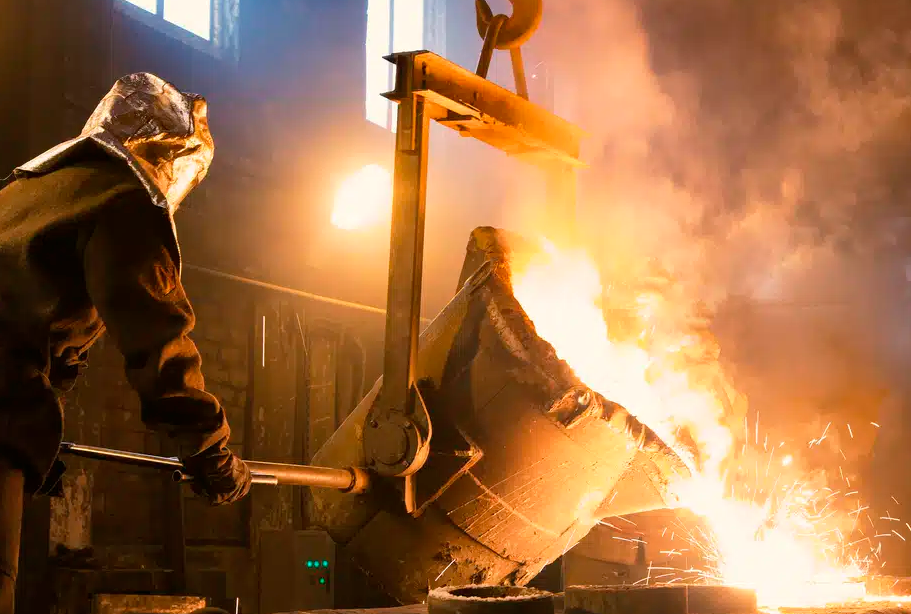
Metal casting is one of the oldest and most important manufacturing processes in human history. From simple tools in the distant past to high-precision components in today’s automotive and aerospace industries, almost every metal object we use every day goes through casting at some stage of its production.
If you are new to metallurgy, this article covers the basics of metal casting: what it is, how the process works, the most common methods, and where casting is used in everyday life.
What Is Metal Casting?
Metal casting is a way of shaping metal by melting solid metal into a liquid, then pouring it into a mold shaped to the desired product design. Once the molten metal cools and solidifies in the mold, the casting is removed and is ready for finishing such as cutting, surface smoothing, or further machining.
It is the method of choice for producing components with complex shapes that are hard to achieve by conventional machining, and it is efficient for large production volumes.
The General Stages of the Casting Process
Broadly speaking, metal casting goes through the following stages:
- Pattern making: creating a replica of the product to be cast, usually from wood, metal, or plastic.
- Mold making: using the pattern to form the mold cavity from sand, ceramic, or metal, depending on the method.
- Melting: heating raw metal in a furnace until it reaches its melting point and turns liquid.
- Pouring: pouring the molten metal into the prepared mold cavity.
- Cooling and solidification: letting the molten metal cool in the mold until it solidifies into the shape of the mold.
- Shakeout: removing the casting from the mold.
- Finishing: final steps such as cutting off the leftover gating system, smoothing the surface, and quality inspection.
Types of Metal Casting Methods
Several casting methods are common in industry, each with its own advantages and applications. A more detailed comparison of the first three is covered in sand casting vs die casting vs investment casting.
Sand casting. The oldest and most widely used method, because it is relatively inexpensive and flexible across a wide range of product sizes. The mold is made from a sand mixture packed around the product pattern.
Die casting. Molten metal is injected under high pressure into a permanent metal mold (usually steel). This method suits mass production with tight dimensional tolerances and is often used for automotive and electronic components.
Investment casting (lost-wax casting). A wax pattern is coated in ceramic, then the wax is melted out before molten metal is poured in. This method produces parts with fine detail and high precision, often used for turbine components and jewelry.
Centrifugal casting. Molten metal is poured into a rotating mold, using centrifugal force to distribute the metal evenly. It is commonly used to produce pipes and cylindrical components. This and other methods are covered in other metal casting methods.
Applications of Metal Casting in Industry
Metal casting is found in almost every industrial sector, including:
- Automotive: engine blocks, pistons, wheels, and many other vehicle components.
- Construction: pipe fittings, structural components, and building hardware.
- Aerospace: turbine components and aircraft parts that require high precision.
- Household appliances: pots, pans, and a wide range of metal utensils.
- Energy: power plant turbine components and heavy industrial equipment.
Conclusion
Metal casting is not just about melting and molding metal. Behind it lies careful technical calculation, from material selection and mold design to precise temperature control, all aimed at producing quality products. Understanding these basics is an important foundation before moving on to more specific topics, such as choosing alloys, casting defects and how to fix them, or modern casting technologies such as 3D sand printing.
In upcoming articles, METALURGIKA.COM will take a closer look at each of these casting methods one by one, complete with case studies of how they are used in industry. Stay tuned for the latest insights into the world of metallurgy.


