
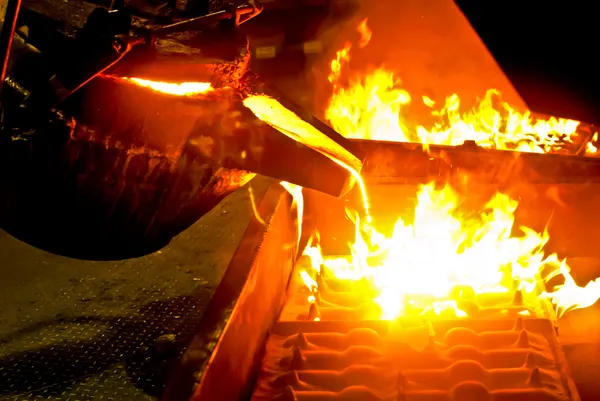
Gray iron and ductile iron can start from almost the same raw materials, yet their mechanical properties are very different. Gray iron is brittle, while ductile iron can bend and withstand impact loads. The difference comes down to one thing: the shape of the graphite inside the metal. This article explains how foundries turn graphite flakes into small spheres (nodules), and what must be controlled for the process to succeed.
Why Graphite Shape Matters So Much
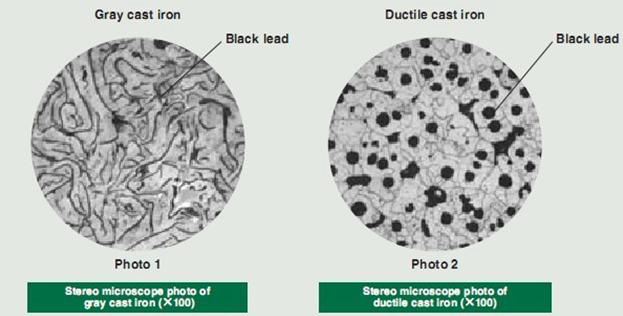
In gray iron, graphite grows as flat flakes. The sharp tips of these flakes act like tiny cracks inside the metal, concentrating stress and causing the material to fracture with little deformation.
In ductile iron, the graphite is spherical. Spheres do not create sharp stress concentrations, so the surrounding metal matrix can carry load and deform before it fractures. The result is a material with tensile strength and elongation approaching cast steel, while keeping the advantages of cast iron: a lower melting point, good fluidity, and lower production cost. Ductile iron is also known as spheroidal graphite (SG) iron, and in Japan and Indonesia it is commonly called FCD, following JIS designations.
Step 1: Preparing the Base Iron
Nodularization only works if the base iron meets certain requirements.
Low sulfur content. Sulfur reacts with magnesium, consuming the magnesium that should form nodules. Base iron for ductile iron is therefore melted with low sulfur or desulfurized first. The choice of melting furnace matters too, since induction furnaces make low-sulfur iron easier to achieve than cupolas.
Correct carbon equivalent. Carbon and silicon are balanced so the iron flows well and graphite can form without producing hard carbides.
Limiting tramp elements. Even small amounts of residual elements such as lead, bismuth, titanium, and antimony can degrade nodule shape. This is why scrap selection for ductile iron is stricter than for gray iron.
Step 2: Nodularization with Magnesium
Magnesium is the key element that makes graphite grow as spheres. The challenge is that magnesium boils at a temperature far below that of molten iron, so adding it can trigger a violent reaction with flare and white smoke. It is therefore usually added as an alloy, most commonly ferrosilicon-magnesium, using one of several methods:
Sandwich method. The nodulizing alloy sits in a pocket at the bottom of the ladle, covered by a layer such as steel punchings, and molten iron is poured on top. It is simple and the most widely used.
Tundish cover method. The ladle is fitted with a lid that has a pouring hole, which contains the reaction, reduces smoke, and improves magnesium recovery.
Wire feeding. A magnesium-cored wire is fed into the ladle by machine, allowing precise control and easy automation.
Many nodulizers also contain a small amount of cerium or other rare earth elements, which help neutralize tramp elements and stabilize nodule shape.
Fading: an effect that wears off. The effect of magnesium does not last. Magnesium keeps evaporating and oxidizing, so treated iron must be poured within a limited time window. If pouring is delayed, graphite reverts to compacted (vermicular) or flake form, and the whole part may be rejected.
Step 3: Inoculation
After nodularization, the iron is inoculated, usually with ferrosilicon containing small amounts of calcium, barium, or aluminum. The inoculant provides many nucleation sites where graphite can start growing. More nucleation sites mean more, smaller nodules, and a lower risk of hard carbides (chill) forming in thin sections.
Inoculation can be done in the ladle, in the metal stream during pouring (stream inoculation), or in the mold using an inoculant insert in the gating system. Inoculating as close as possible to solidification is usually most effective, because the inoculant effect also fades.
Grades and the Role of the Matrix
The final properties of ductile iron depend on the metal matrix around the nodules:
Ferritic matrix. Softer and more ductile, with high elongation. Examples include EN-GJS-400-15 (FCD400), used for parts that must absorb impact, such as pipe fittings and suspension components.
Pearlitic matrix. Stronger and harder, but with lower elongation. Examples include EN-GJS-700-2 (FCD700), used for crankshafts and gears.
Mixed ferrite-pearlite matrix. A compromise between the two, such as EN-GJS-500-7, which is very common in the automotive industry.
ADI (Austempered Ductile Iron). Through austempering heat treatment, ductile iron can reach strength levels that rival forged steel, making it suitable for gears and wear-resistant parts.
The matrix can be adjusted through composition (for example, copper or tin to promote pearlite), cooling rate, or post-casting heat treatment.
Typical Ductile Iron Defects
Low nodularity. Usually caused by high sulfur, insufficient magnesium, or fading. It is checked by metallography or, more quickly, by ultrasonic velocity testing.
Dross. Magnesium oxide and sulfide films trapped in the casting, similar to inclusion defects in general. It is controlled by skimming the ladle and using filters in the gating system.
Shrinkage. Ductile iron has unusual shrinkage behavior because graphite expands as it forms. If the mold is not rigid enough, this expansion pushes the mold walls outward and creates internal shrinkage cavities. Gating and riser design for ductile iron therefore differs from that for cast steel.
Chunky graphite. Irregular graphite in very thick sections that solidify slowly, reducing strength and elongation.
Why Ductile Iron Is a First Choice for So Many Industries
Ductile iron combines the ease of producing cast iron with mechanical properties close to steel. This combination makes it widely used, from automotive components and water pipes to wind turbine hubs. But its success depends heavily on process discipline at every step: clean base iron, correct nodularisation, effective inoculation, and controlled pouring time. Foundries that manage these four factors consistently gain a major advantage in the structural components market.


