
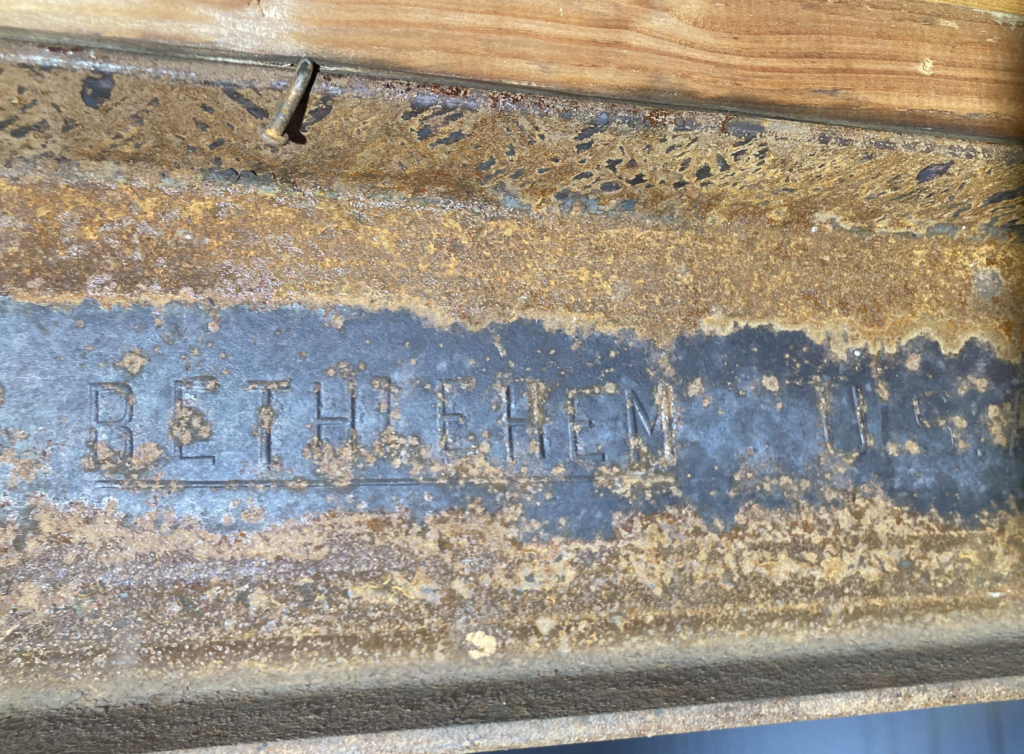
Corrosion cannot be switched off. A refined metal is always trying to return to the oxide it was mined as, and given water, oxygen, and time, it will. Knowing how to prevent corrosion therefore means knowing how to slow it down, to a rate so low that the part outlives its purpose. This article walks through eight methods used in industry and at home, and then looks closely at the most familiar case of all: rust on iron and steel.
If you want to know what kind of attack you are dealing with first, start with our overview of the types of metal corrosion. This article picks up where that one ends and focuses on the remedies.
Why Metals Corrode, in One Minute
Most corrosion is electrochemical. Four things have to be present at the same time:
- an anode, the spot where metal dissolves,
- a cathode, where oxygen (or another species) picks up the electrons,
- an electrolyte, usually water with something dissolved in it,
- a metallic path joining anode and cathode.
Take away any one of the four and the corrosion cell stops working. Every method below does exactly that. Paint keeps the electrolyte off the surface. Cathodic protection turns the whole structure into a cathode. A plastic washer between two different metals breaks the metallic path.
Corrosion Prevention Methods at a Glance
| Method | How it protects | Typical use | Main limitation |
|---|---|---|---|
| Material selection | The metal itself resists the environment | Process piping, marine hardware, food equipment | Higher material cost |
| Design | Water and dirt have nowhere to collect | Tanks, structures, castings | Must be decided before fabrication |
| Paint and organic coatings | Barrier between metal and environment | Structural steel, machinery, vehicles | Fails where the film is damaged or poorly prepared |
| Galvanizing and metallic coatings | Barrier plus sacrificial zinc | Poles, guardrails, fasteners, roofing | Zinc is consumed over time |
| Cathodic protection | Makes the structure a cathode | Pipelines, ship hulls, jetties, buried tanks | Works only where the metal is buried or submerged |
| Environmental control and inhibitors | Makes the surroundings less aggressive | Cooling water, boilers, storage, packaging | Needs monitoring and dosing |
| Passivation and anodizing | Strengthens the natural oxide film | Stainless steel, aluminum | Film can still break down in chlorides |
| Inspection and maintenance | Finds damage while it is still cheap to repair | Every asset | Depends on discipline |
1. Choose a Material That Suits the Environment
The cheapest time to prevent corrosion is before anything is built. Stainless steel resists rust because it contains at least about 10.5% chromium, which forms a thin, self-healing oxide film. Aluminum, titanium, and copper alloys protect themselves in a similar way.
“Resistant” always means resistant to something specific. Type 304 stainless is fine in a kitchen and stains within months near the sea, where 316 or a duplex grade is the better choice. That weakness to chlorides is explained in our article on pitting corrosion.
When a resistant alloy is too expensive, the usual answer is ordinary carbon steel with extra wall thickness (a corrosion allowance) and one of the protection methods below. For cast parts, the trade-offs between iron, steel, and aluminum are covered in our guide to choosing materials for metal casting.
2. Design Out the Places Where Corrosion Starts
Corrosion starts where water sits. Good design gives it no place to do so:
- Slope horizontal surfaces and add drain holes so that water runs off.
- Make tanks and pipes drain completely, with no dead legs or pockets.
- Prefer continuous welds to bolted or stitch-welded lap joints, which leave crevices.
- Round off sharp edges, because paint thins out over them.
- Keep dissimilar metals apart with insulating gaskets, sleeves, and washers. Where they must touch, make the fastener the more noble metal, never the less noble one. A small anode joined to a large cathode corrodes very quickly.
- Leave access for inspection and repainting.
3. Apply Paint and Other Protective Coatings
Coatings are the most widely used protection for steel. A typical industrial system has three layers: a zinc-rich primer that grips the steel and protects it at scratches, an epoxy intermediate coat that builds thickness, and a polyurethane topcoat that resists sunlight. Powder coating, epoxy linings, rubber linings, and wrapping tapes follow the same barrier principle.
A coating is only as good as the surface under it. Paint applied over rust, mill scale, oil, or salt will lift, and most early coating failures trace back to preparation. For structural steel and castings, the surface is normally blast cleaned to a specified grade such as Sa 2.5, then primed within a few hours, before the bare metal starts to rust again. Our article on shot blasting explains the cleanliness grades and the surface profile that helps paint adhere.
4. Use Galvanizing and Other Metallic Coatings
In hot-dip galvanizing, clean steel is dipped into molten zinc at about 450 °C (840 °F). The zinc bonds to the steel and protects it in two ways. It is a barrier, and it is also more active than iron, so at a scratch or cut edge the zinc corrodes in place of the steel. This is why galvanized guardrails and poles can last for decades without paint.
Other metallic coatings include:
- Electroplated zinc, thinner than hot-dip, common on fasteners and small parts.
- Thermal spray zinc or aluminum, for structures too large for a galvanizing bath.
- Tin, nickel, and chromium plating, which are barriers only. They are more noble than steel, so a pinhole in the plating concentrates the attack on the steel underneath.
For long life in harsh atmospheres, galvanized steel is often painted as well. This combination is called a duplex system.
5. Install Cathodic Protection
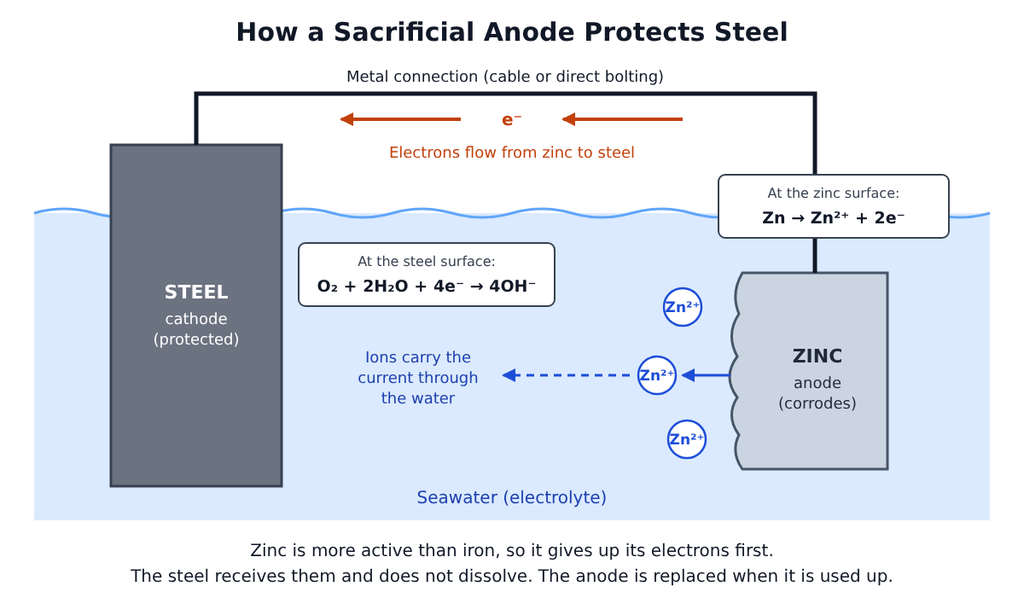
Cathodic protection supplies electrons to the structure so that the whole surface behaves as a cathode and stops dissolving. There are two ways to do it.
Sacrificial anodes. Blocks of zinc, aluminum, or magnesium are connected to the steel. They corrode first and are replaced when they are used up. Zinc and aluminum anodes are standard in seawater, while magnesium is used in soil and fresh water, where a higher driving voltage is needed.
Impressed current (ICCP). A rectifier pushes current from long-lasting anodes, such as mixed metal oxide or high-silicon cast iron, to the structure. It suits long pipelines, large hulls, and jetties, where sacrificial anodes alone would be impractical.
Cathodic protection needs a continuous electrolyte to carry the current, so it works on buried and submerged steel and does nothing for a structure standing in open air. It is almost always combined with a coating. The coating does most of the work, and the cathodic protection covers the flaws in it.
6. Control the Environment and Use Inhibitors
Sometimes it is easier to change the surroundings than the metal.
- Keep it dry. Steel rusts slowly in dry air, and the rate climbs sharply once relative humidity passes roughly 60%. Ventilation, dehumidifiers, and desiccant bags all help in storage.
- Remove salts and dirt. Washing down equipment in coastal or industrial areas removes the deposits that hold moisture against the surface.
- Treat the water. Closed cooling loops and boilers are dosed with corrosion inhibitors and oxygen scavengers, and their pH is kept in a safe range.
- Protect parts in storage and shipping. Oils, greases, waxes, and vapor corrosion inhibitor (VCI) paper or film keep machined surfaces bright until they are put into service.
7. Strengthen the Passive Film: Passivation and Anodizing
Stainless steel and aluminum depend on their oxide films, and those films can be improved.
Passivation of stainless steel uses nitric or citric acid to remove free iron left on the surface by cutting tools, grinding, or handling. Welds are first pickled to remove heat tint. Without this step, a stainless part can show rust spots that actually come from contamination and not from the alloy.
Anodizing thickens the oxide film on aluminum electrochemically. The resulting layer is hard, can be dyed, and is sealed to close its pores.
Stress also matters. Residual stress from welding or forming can combine with a corrosive environment to produce stress corrosion cracking, and stress relief such as post-weld heat treatment lowers that risk.
8. Inspect and Maintain
No protection system lasts forever. Coatings chalk and chip, anodes are consumed, and inhibitors run low. A simple routine catches these early: look for rust bleeding at joints and edges, touch up damaged paint before the rust spreads under the film, measure remaining wall thickness on pipes and tanks, and check anode condition and protection potentials. The thickness and crack-detection techniques used for this are described in our article on non-destructive testing (NDT).
How to Prevent Iron from Rusting
Rust is the corrosion product of iron and its alloys. Other metals corrode, but only iron rusts.
What rust is and why it keeps going
When iron meets water and oxygen, it forms hydrated iron(III) oxide, the familiar red-brown rust. Two properties make rust a poor shield. It is porous, so water and oxygen pass straight through it, and it takes up more volume than the iron it came from, so it flakes off and exposes fresh metal. Compare this with aluminum, whose oxide film is thin, tight, and protective. Iron left alone simply keeps rusting.
The process speeds up with:
- Salt, which makes water far more conductive. This is why steel near the sea rusts so much faster.
- Acidic pollution and acid rain.
- Constant wetting and drying, as in splash zones and on parts stored outdoors.
- Contact with a more noble metal, such as copper or stainless steel, while wet.
- Dirt and old rust, which hold moisture against the surface.
Practical ways to stop iron and steel from rusting
- Keep it dry and clean. Store tools and stock indoors, off the floor, and wipe them down after use. This is the simplest rust prevention there is.
- Paint it. Use a rust-inhibiting primer followed by a topcoat, on a surface that has been cleaned to bare metal.
- Oil, grease, or wax it. A thin oil film protects tools, machine beds, and machined parts that cannot be painted.
- Galvanize it. For outdoor steel such as fences, poles, roofing, and fasteners, zinc gives the longest maintenance-free life.
- Use conversion coatings. Phosphating and black oxide (bluing) create a thin layer that holds oil well. They are common on fasteners, firearms, and tools.
- Season cast iron cookware. Oil baked onto a cast iron pan polymerizes into a hard film that keeps water away from the metal.
- Change the alloy. Stainless steel resists rust through its chromium content. Weathering steel forms a dense, adherent rust layer that slows further attack, although it needs wet and dry cycles and is unsuitable for salty or permanently damp locations.
- Protect steel in concrete. Enough concrete cover, dense low-permeability concrete, and, in marine structures, epoxy-coated or galvanized bars or cathodic protection keep chlorides away from the reinforcement.
What to do when rust has already started
Remove loose rust by wire brushing, grinding, or blasting until the metal is sound, then coat it the same day. Where full cleaning is impossible, a rust converter based on tannic or phosphoric acid turns the remaining thin rust into a more stable dark layer that can be primed. A converter is a compromise. It does not replace proper cleaning on heavily rusted or load-bearing steel.
Carbon steel and cast iron
Plain low-carbon steel has no protective alloying and depends entirely on the measures above. Cast iron also rusts on the surface, though thick-walled castings such as pipes and machine bases often last a long time because the attack is slow relative to the section. Freshly blasted castings are especially vulnerable. In humid air they can show a film of flash rust within hours, so they should be primed or oiled soon after cleaning.
Which Method for Which Situation?
| Situation | Usual approach |
|---|---|
| Structural steel outdoors | Blast clean, then a three-coat paint system or hot-dip galvanizing |
| Steel in coastal air | Galvanizing plus paint (duplex system), regular washing |
| Buried pipeline or tank | Coating or wrapping plus cathodic protection |
| Ship hull, jetty piles | Marine coating plus sacrificial anodes or ICCP |
| Closed cooling water system | Water treatment with inhibitors and pH control |
| Chemical or food processing | Stainless steel of a suitable grade, pickled and passivated |
| Machined parts in storage | Oil or wax film, VCI packaging, dry storage |
| Hand tools and workshop machines | Keep dry, wipe with oil |
| Aluminum exposed to weather | Anodizing or powder coating, isolate from steel and copper |
Common Mistakes
- Painting over rust or mill scale. The film looks fine for a while, then blisters and peels.
- Mixing metals without insulation. Ordinary steel screws in a stainless or copper assembly corrode very quickly once wet.
- Assuming stainless steel never rusts. It does in chlorides, in crevices, and when contaminated with iron.
- Relying on cathodic protection above the waterline. It protects only the wetted or buried part.
- Ignoring small damage. A chip in a coating becomes a patch of under-film rust that costs far more to repair later.
Frequently Asked Questions
Can corrosion be stopped completely? Not in practice. The aim is to slow it to a rate that is acceptable over the life of the part, and to choose methods whose cost matches the value of what is being protected.
What is the difference between rust and corrosion? Corrosion is the general term for the deterioration of a metal by reaction with its environment. Rust is the specific product of iron and steel corroding. Aluminum, copper, and zinc corrode without rusting.
Is galvanized steel rustproof? No, but it is very durable. The zinc is slowly consumed, faster in coastal and industrial air. Red rust appears once the zinc is gone, which can take decades in a mild climate.
Does painting over rust stop it? Only if the rust is thin, tight, and treated first. Loose rust must be removed. Paint applied over flaking rust comes off with it.
What is the most effective way to prevent corrosion? There is no single best method. The most reliable results come from combining two or more: a suitable material, a design that sheds water, a coating, and, for buried or submerged steel, cathodic protection.
Conclusion
Every method of corrosion prevention removes one of the four things a corrosion cell needs. Material selection and design do this from the start, coatings and galvanizing keep the environment away from the metal, cathodic protection changes the electrochemistry, and environmental control makes the surroundings less aggressive. For iron and steel, the practical rule is simple: keep water and oxygen off the surface, repair damage early, and never coat over rust.


