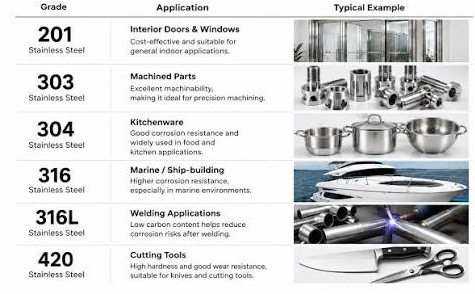
A 304 water bottle, a 316 boat cleat, and a 201 shelf bracket all look equally bright on the store shelf. The difference shows up months later, when the 201 bracket in a bathroom starts to spot with rust while a 316 railing at the beach stays clean. In the 304 vs 316 stainless steel comparison, the difference is molybdenum. Grade 201 differs from both because most of its nickel is replaced with manganese and nitrogen.
This guide compares the three grades in detail: composition, corrosion resistance, strength, magnetism, food safety, cost, how to tell them apart, and how to choose. Stainless steel families and other common grades are covered in our main guide to the types of stainless steel.
Quick Comparison: 201 vs 304 vs 316
All three are austenitic stainless steels, so they share the same basic character: ductile, easy to form and weld, and non-magnetic in the annealed condition. What separates them is the alloy recipe.
| Property | 201 | 304 | 316 |
|---|---|---|---|
| Chromium (Cr) | 16–18% | 18–20% | 16–18% |
| Nickel (Ni) | 3.5–5.5% | 8–10.5% | 10–14% |
| Manganese (Mn) | 5.5–7.5% | 2% max. | 2% max. |
| Molybdenum (Mo) | none | none | 2–3% |
| Nitrogen (N) | 0.25% max. | 0.10% max. | 0.10% max. |
| Carbon (C) | 0.15% max. | 0.08% max. | 0.08% max. |
| Other names | UNS S20100, SUS 201 | UNS S30400, SUS 304, 18-8, A2 (fasteners) | UNS S31600, SUS 316, marine grade, A4 (fasteners) |
| Corrosion resistance | Moderate | Good | Best of the three |
| Strength (annealed) | Highest | Medium | Medium |
| Magnetic after forming | Most likely | Slightly | Least likely |
| Cost | Lowest | Medium | Highest |
Composition follows AISI/SAE ranges in weight percent. Product standards such as ASTM A240 (plate, sheet, and strip) use slightly different limits.
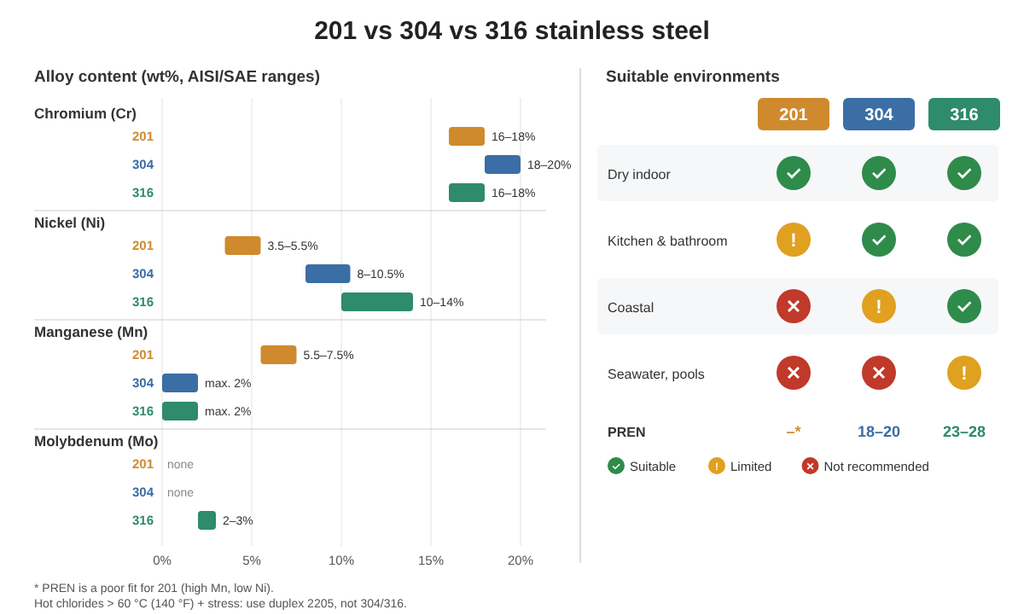
Composition and What Each Element Does
All three grades start from the same base: iron with about 16 to 20% chromium. Chromium forms the passive film, an oxide layer a few nanometers thick that protects the surface. The difference lies in the supporting elements.
304: The 18-8 Baseline
Type 304 contains about 18% chromium and 8% nickel, which is why it is known as 18-8 stainless. Nickel stabilizes the austenite structure, making the steel ductile, non-magnetic, easy to deep draw into sinks and pots, and easy to weld. 304 is the most widely produced stainless steel in the world and the benchmark other grades are measured against.
316: 304 Plus Molybdenum
Type 316 adds 2 to 3% molybdenum and raises nickel to 10 to 14%. The extra nickel keeps the structure austenitic, since molybdenum tends to promote ferrite. Its chromium is actually slightly lower than 304’s. Molybdenum strengthens the passive film against chlorides: the ions in table salt, seawater, sweat, and bleach. That is why 316 is called marine grade.
201: Nickel Replaced by Manganese and Nitrogen
Type 201 was developed to save nickel, an expensive metal with a volatile price. It contains only 3.5 to 5.5% nickel and makes up the difference with 5.5 to 7.5% manganese and up to 0.25% nitrogen, both of which also stabilize austenite. Its chromium is 16 to 18%, lower than 304. The result is a cheaper and stronger steel that rusts more easily.
Other 200-series grades, such as 202 and various very-low-nickel proprietary grades, are also sold, especially in Asian markets. Their compositions vary, so they should not be assumed to behave like standard 201.
Corrosion Resistance: The Biggest Difference
Chlorides Are the Deciding Factor
In dry indoor air, all three grades hold up well. The difference appears when chlorides are present: coastal air, seawater, chlorinated pool water, bleach, salty foods, or road deicing salt. Chlorides break through the passive film at weak points and create small, deep holes known as pitting corrosion. The mechanism is explained in our article on pitting corrosion.
Pitting resistance is often estimated with the PREN (pitting resistance equivalent number):
PREN = %Cr + 3.3 × %Mo + 16 × %N
Calculated from the composition ranges, 304 has a PREN of about 18 to 20 and 316 about 23 to 28. Nearly all of that gap comes from molybdenum. The higher the PREN, the higher the chloride level and temperature a grade can tolerate before pitting starts.
The PREN formula is a poor fit for 201. Its nitrogen can push the calculated number close to 304’s, but the formula ignores its lower chromium, its low nickel, and its high manganese, which tends to form manganese sulfide inclusions where pits start. In real service, 201 spots with rust sooner than 304.
What It Looks Like in Service
| Environment | 201 | 304 | 316 |
|---|---|---|---|
| Dry indoor use (shelving, furniture, decor) | Adequate | Good | Good |
| Kitchens and bathrooms (humidity, soap, cleaners) | Prone to rust spots | Good | Good |
| Outdoors, inland urban | Stains easily | Good with cleaning | Good |
| Coastal areas (within a few miles of the sea) | Not recommended | Tea staining, occasional pitting | Good; still needs rinsing |
| Direct seawater or pool water contact | Not recommended | Not recommended | Fair; for severe service choose duplex |
| Chloride chemicals, pharmaceutical processing | Not recommended | Limited | Usually specified |
Tea staining is a thin brown discoloration on outdoor stainless steel, especially near the coast. It is usually cosmetic, but it signals that the grade or surface finish is not quite right for the environment.
Stress Corrosion Cracking: 316 Is Not Much Better
A common misconception: molybdenum makes 316 more resistant to pitting, but it does not make it much more resistant to chloride stress corrosion cracking (SCC). In chloride environments above about 60 °C (140 °F) with tensile stress present, 304 and 316 are both at risk. For those conditions, duplex 2205 or nickel alloys are the usual answer. See our article on stress corrosion cracking for details.
Corrosion at Welds: 304L and 316L
When 304 or 316 is held in the range of roughly 425 to 815 °C (800 to 1,500 °F), as happens next to a weld, it can become sensitized: carbon combines with chromium to form carbides at the grain boundaries, and the adjacent metal corrodes easily. For welded construction in corrosive service, choose the low-carbon versions 304L and 316L (0.03% carbon max.). These forms of corrosion are summarized in our guide to the types of metal corrosion.
Strength, Fabrication, and Magnetism
Strength
Manganese and nitrogen make 201 stronger than 304 in the annealed condition. Typical supplier data for 201 show a tensile strength of about 685 MPa (99 ksi) and a yield strength of about 290 MPa (42 ksi), while the ASTM A240 minimums for 304 and 316 are 515 MPa (75 ksi) tensile and 205 MPa (30 ksi) yield. 304 and 316 are nearly equal in strength. The higher strength of 201 allows slightly thinner gauges, another reason it costs less per part.
Forming and Machining
- 304 is the easiest to form and deep draw, with a lower work-hardening rate than 201.
- 201 work hardens faster, so it is harder to bend, shear, and drill, and it wears tools faster.
- 316 forms much like 304 but is slightly stiffer to work and more expensive to process.
None of the three can be hardened by heat treatment. Hardness rises only through cold work.
Is 304 or 316 Stainless Steel Magnetic?
All three are non-magnetic when annealed. Bending, rolling, or drawing can transform some of the austenite into martensite, which makes the worked area slightly magnetic. 201’s austenite transforms most easily, 304’s somewhat, and 316’s least, thanks to its higher nickel. That is why the corner of a 304 pot or a forged spoon tip can attract a magnet weakly even though the material is genuine 304. A magnet cannot tell 201, 304, and 316 apart.
304 vs 316: When Do You Really Need 316?
316 costs more because it carries more nickel plus molybdenum. Paying extra makes sense wherever chlorides are present:
- Coastal locations: railings, fasteners, and outdoor hardware close to the sea.
- Boats and marine hardware: deck fittings, hinges, bolts, and chain.
- Swimming pools: ladders, handrails, and fixtures regularly splashed with chlorinated water. For load-bearing parts above indoor pools, more resistant grades such as duplex or 6% molybdenum stainless are safer.
- Chemical, pharmaceutical, and brine processing: tanks and piping exposed to salt solutions, acids, or chloride cleaners.
- Medical devices and jewelry: 316L is common because it resists sweat and body fluids.
For home kitchens, sinks, potable water tanks, general food processing equipment, and indoor construction, 304 is usually enough. Using 316 in those places mostly adds cost.
304 or 304L, 316 or 316L? Choose the L grade for welded construction in corrosive service, such as tanks, process piping, and coastal frames. For parts that are not welded, or are welded only in thin sections, the standard grade is fine. Much of the plate and sheet on the market today is dual certified 304/304L or 316/316L, meaning it meets both sets of limits at once.
201 vs 304: When Is 201 Good Enough?
201 is not fake stainless steel. It is a recognized grade with its own standards, and it suits many products. Problems arise when 201 is used where 304’s corrosion resistance is needed, or when 201 is sold as 304.
201 works for:
- Furniture and shelving in dry indoor areas.
- Interior decor, trim, and door hardware.
- Equipment that rarely sees water or cleaning chemicals.
- Low-cost items with a short expected service life.
Choose 304 when:
- The item gets wet often, sits in a bathroom or kitchen, or is cleaned regularly with soap and bleach.
- The item is installed outdoors.
- The item touches wet, salty, or acidic food every day.
- The item is welded and then used in a humid environment.
The price gap between 201 and 304 comes mainly from nickel. When nickel prices are high, the gap widens and so does the temptation to substitute 201 for 304.
Is 304 Stainless Steel Food Safe?
Yes. 304 is the most common material for flatware, cookware, containers, dairy tanks, and food processing machinery. 316 is also food safe and is used for salty or acidic foods and in pharmaceutical plants. “Food grade” is not an official grade name; in practice it almost always means 304 or 316.
A few things are worth knowing:
- Stainless steel does release small amounts of metal. A study at Oregon State University (Kamerud et al., 2013) cooked tomato sauce with 304 and 316 stainless steel. After six hours of cooking, nickel in the sauce rose up to 26-fold and chromium up to 7-fold compared with sauce cooked without stainless steel, depending on the grade. Leaching fell sharply after the cookware had been used several times. The absolute amounts are small, but people with a nickel allergy should be aware of it.
- Acidic and salty foods increase leaching. Avoid storing tomato sauce, vinegar, or pickles in stainless containers for long periods.
- New cookware leaches the most. Washing and repeated use reduce it.
- For people with a nickel allergy, nickel-free stainless such as 430 (ferritic, often marked 18/0) is available, although it is less corrosion resistant.
What about 201? 201 is not toxic, but it rusts more easily. Rust spots and pits make utensils harder to clean, and a damaged surface releases more metal. For utensils, containers, and water bottles used every day, 304 is the safer choice. The 18/8 and 18/10 stamps on flatware give the chromium and nickel content and usually mean grade 304.
How to Tell 304, 316, and 201 Apart
The three grades are nearly impossible to tell apart by eye. Here are the methods that work:
| Method | What it can distinguish | Limitations |
|---|---|---|
| Magnet test | Austenitic grades (201, 304, 316) from ferritic and martensitic grades (430, 410) | Cannot separate 201, 304, and 316; formed areas can be slightly magnetic |
| Molybdenum spot test (e.g., Moly-Drop or Decapoli 304/316) | 316 from 304: the drop darkens within a few minutes if molybdenum is present | Does not separate 316 from 316L; some 304 heats contain enough Mo for a weak reaction, so compare against known 304 and 316 samples |
| Nickel or manganese spot test | Flags low nickel or high manganese (201) | Rough result; surface must be sanded clean |
| Grinding spark test | Gives clues to an experienced fabricator | Highly subjective; not reliable for purchasing decisions |
| Handheld XRF | Reads Cr, Ni, Mn, and Mo in seconds; clearly separates all three | Expensive; available at labs, large distributors, and scrap yards |
| Mill test certificate | Composition and mechanical properties per heat number | Only valid for traceable material; check that the heat number on the material matches the certificate |
Spot tests do not measure carbon, so 304 versus 304L, or 316 versus 316L, can only be confirmed by lab analysis or a certificate.
Warning signs when buying “304” stainless: a price far below market, a surface that stains quickly after contact with salt water, or a supplier who cannot provide a certificate for a large order. For project purchases, request mill certificates and spot check with XRF.
Cost: Why Is 316 the Most Expensive?
Stainless steel prices track nickel and molybdenum. 201 has the least nickel, so it is the cheapest. 316 has the most nickel plus molybdenum, so it is the most expensive. The price gap between them is not fixed; mills typically add an alloy surcharge that changes monthly with world metal prices.
When comparing costs, look at service life, not just purchase price. A 201 railing at the coast that must be replaced after a few years can cost far more than a 316 railing that lasts for decades.
How to Choose: 201, 304, or 316?
| Application | Choice |
|---|---|
| Furniture, shelving, and decor in dry indoor areas | 201 is adequate; 304 for longer life |
| Cookware, flatware, water bottles, food containers | 304 |
| Sinks and bathroom fixtures | 304 |
| Potable water tanks, general food processing equipment | 304 or 304L |
| Salty and acidic foods (soy sauce, brine, pickles), pharmaceuticals | 316 or 316L |
| Coastal railings, fasteners, and hardware | 316 or 316L |
| Boats, marine hardware, swimming pools | 316L; for load-bearing parts or severe service, duplex 2205 |
| Welded construction in corrosive service | 304L or 316L |
| Hot chloride environments (above about 60 °C / 140 °F) under stress | Duplex 2205 or nickel alloys, not 304 or 316 |
| Must be magnetic (induction cooktop base) | 430, not 201, 304, or 316 |
If stainless steel is too costly for large outdoor structures, zinc-coated carbon steel can be more economical. See our guide to hot dip galvanizing for a comparison.
Common Mistakes
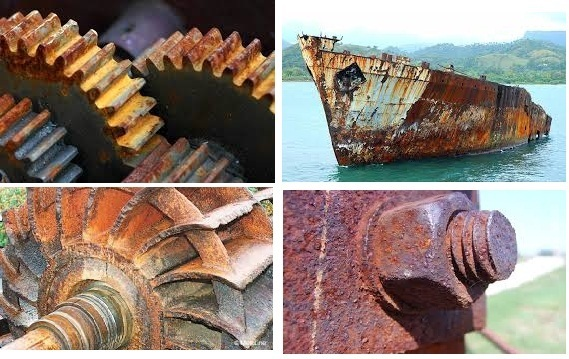
- Assuming stainless steel cannot rust. It is corrosion resistant, not corrosion proof. 201 in a bathroom and 304 at the beach can both spot with rust. Causes and cleaning are covered in our guide on how to remove rust from stainless steel.
- Using a magnet to tell 304 from 201. Both can be non-magnetic, or both slightly magnetic after forming.
- Specifying 316 to prevent SCC. Molybdenum helps against pitting, but in hot chlorides under stress, 316 is still susceptible.
- Joining stainless steel to other metals without isolation. Stainless bolts in aluminum or galvanized steel in wet conditions make the other metal corrode faster. An example is discussed in our article on aluminum corrosion.
- Using wire brushes or grinding discs previously used on carbon steel. Embedded iron particles rust and make the stainless look as if it is rusting.
- Cleaning with bleach or hydrochloric acid. Chloride cleaners damage the passive film, especially on 201 and 304. Rinse with clean water after cleaning.
- Leaving weld heat tint. The blue-brown color around welds marks damaged passive film. Remove it by pickling or passivation.
General prevention principles are summarized in our guide on how to prevent corrosion in metals.
Cast Stainless Steel: CF8 and CF8M
Cast components such as valve bodies, pumps, and impellers use cast grade names. CF8 is the cast equivalent of 304 and CF8M the cast equivalent of 316 (the M stands for molybdenum). Their low-carbon versions are CF3 and CF3M. Cast austenitic stainless steels are usually designed with a little ferrite to prevent hot cracking during solidification, so they can be slightly magnetic. Standards and processes for cast steel are covered in our article on steel casting.
Frequently Asked Questions
What is the difference between 304 and 316 stainless steel? The main difference is molybdenum. 316 contains 2 to 3% molybdenum and more nickel (10 to 14%), which makes it more resistant to chlorides from salt, seawater, and pool water. 304 has no molybdenum, costs less, and is sufficient for kitchens and indoor use.
What is the difference between 201 and 304 stainless steel? 201 contains much less nickel (3.5 to 5.5% versus 8 to 10.5%) and replaces it with manganese and nitrogen. As a result, 201 is cheaper and stronger but rusts more easily, especially in humid areas, near the sea, or when exposed to cleaning chemicals.
Is 304 stainless steel food safe? Yes. 304 is the most common material for flatware, cookware, containers, and food processing equipment. It does release small amounts of nickel and chromium, especially when new and when acidic foods are cooked for a long time, so avoid storing acidic or salty foods in it for long periods.
Is 316 better than 304? 316 resists corrosion better in chloride environments, but it is not always the better choice. For kitchens, sinks, and indoor use, 304 performs just as well at a lower cost. 316 earns its price at the coast, on boats, around pools, and in chemical processing.
How can you tell 304 from 316 stainless steel? Neither is magnetic in the annealed state, so a magnet will not help. Use a molybdenum spot test, which reacts with 316 but not with 304, a handheld XRF analyzer, or the mill test certificate.
Conclusion
The 304 vs 316 stainless steel choice comes down to molybdenum: 316 resists chlorides better and suits coastal, marine, pool, and chemical service, while 304 covers most kitchen and indoor applications. 201 saves nickel by substituting manganese and nitrogen, making it cheaper and stronger but more prone to rust, so it is best limited to dry indoor use. The three grades are hard to tell apart by eye or with a magnet, so for important purchases rely on spot tests, XRF, or mill certificates, and choose the grade by environment and service life rather than purchase price alone.
Related Articles
- Types of Stainless Steel: Austenitic, Ferritic, Martensitic, Duplex, and Common Grades
- Pitting Corrosion
- Stress Corrosion Cracking (SCC): Causes, Mechanism, Types, and Prevention
- Types of Metal Corrosion and How to Prevent Them in Industry
- How to Prevent Corrosion in Metals

Dagus R. Djuanda is a metallurgical engineer with more than 20 years of experience in materials engineering, specializing in magnetic materials. He holds a master’s degree in magnetic materials engineering, is a doctoral candidate in industrial engineering, and works as an engineer at the Ministry of Industry of the Republic of Indonesia. Founder of Metalurgika.