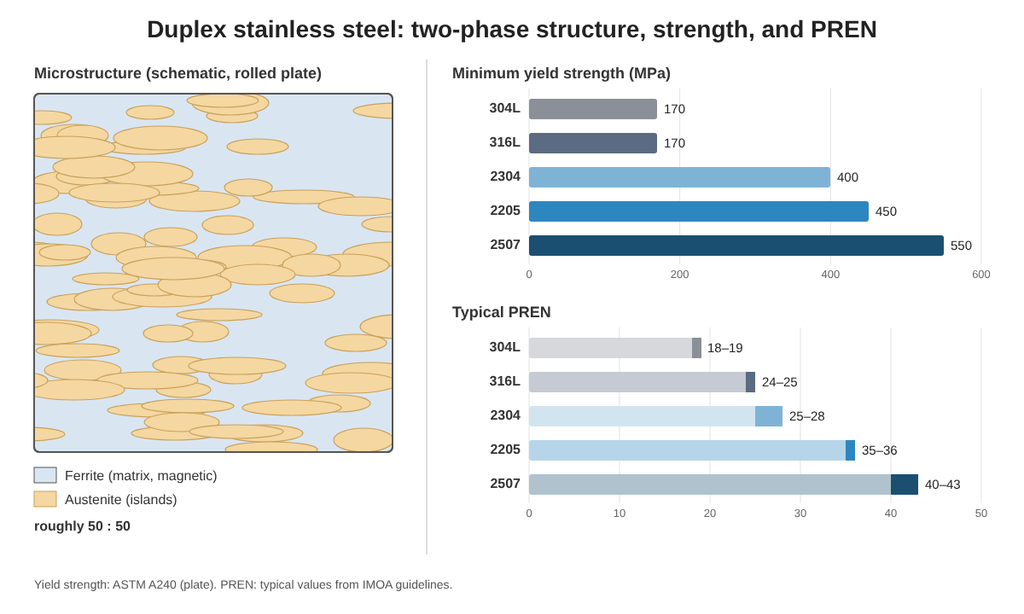
Duplex stainless steel is a stainless steel whose microstructure contains two phases, austenite and ferrite, in roughly equal amounts. That combination makes duplex about twice as strong as austenitic grades such as 304 and 316, and far more resistant to chloride stress corrosion cracking. The most widely used grade is duplex 2205, while super duplex 2507 takes over in more severe environments.
This guide explains what duplex stainless steel is, its composition, the grade families (lean, standard, super, and hyper duplex), mechanical properties and corrosion resistance, how it compares with 316, how to weld it, the danger of sigma phase, product standards, applications, and how to choose a grade. For an overview of all stainless steel families, see our guide to the types of stainless steel.
What Is Duplex Stainless Steel?
Stainless steels are grouped by crystal structure. Austenitic grades (304, 316) have a face-centered cubic structure and are ductile and non-magnetic. Ferritic grades (430) have a body-centered cubic structure, are magnetic, and resist stress corrosion cracking better, but they are less ductile and hard to weld in thick sections. Duplex combines the two: austenite grains are dispersed in a ferrite matrix in a ratio of about 50:50.
Duplex means “two-fold,” referring to the two phases. In practice, grades are usually called by number, such as “duplex 2205” or “SS 2205,” or by the generic terms “duplex steel” and “duplex material.”
The two-phase structure gives duplex the strength and SCC resistance of ferrite together with the toughness and weldability of austenite. The first wrought duplex stainless steels were produced in Sweden in 1930 for the sulfite paper industry. Modern nitrogen-alloyed grades such as 2205 became widespread in the 1970s and 1980s, once steelmaking could control nitrogen and carbon precisely.
Is Duplex Stainless Steel Magnetic?
Yes. Because about half of its structure is ferrite, duplex is clearly magnetic, unlike 304 and 316. Buyers sometimes take this as a sign that the material is “not real stainless.” In fact, the magnetism is used to check ferrite content with a ferrite meter (Feritscope).
Composition and What Each Element Does
Compared with 316, duplex has more chromium, much less nickel, and much more nitrogen. Balancing ferrite formers against austenite formers is what produces the half-and-half structure.
| Element | Typical content in 2205 | Role |
|---|---|---|
| Chromium (Cr) | 21–23% | Forms the passive film; ferrite former |
| Nickel (Ni) | 4.5–6.5% | Austenite former; kept fairly low so ferrite stays near half |
| Molybdenum (Mo) | 2.5–3.5% | Raises pitting and crevice corrosion resistance; ferrite former |
| Nitrogen (N) | 0.10–0.22% | Strong austenite former; raises strength and pitting resistance |
| Carbon (C) | 0.03% max. | Kept very low to prevent carbide formation |
Because its nickel content is low, duplex is less exposed to nickel price swings than 316. Pitting resistance is estimated with PREN = %Cr + 3.3 × %Mo + 16 × %N, which is explained in our 304 vs 316 stainless steel guide.
Duplex Grade Families: Lean, 2205, Super, and Hyper Duplex
Duplex grades are grouped by alloy content and PREN. Compositions follow EN 10088 in weight percent.
| Family | Grade | EN / UNS | Cr (%) | Ni (%) | Mo (%) | N (%) | Typical PREN |
|---|---|---|---|---|---|---|---|
| Lean duplex | 2101 | 1.4162 / S32101 | 21.0–22.0 | 1.35–1.90 | 0.10–0.80 | 0.20–0.25 | 22–27 (family) |
| Lean duplex | 2304 | 1.4362 / S32304 | 22.0–24.5 | 3.5–5.5 | 0.10–0.60 | 0.05–0.20 | 25–28 |
| Standard duplex | 2205 | 1.4462 / S31803, S32205 | 21.0–23.0 | 4.5–6.5 | 2.5–3.5 | 0.10–0.22 | 35–36 |
| Super duplex | 2507 | 1.4410 / S32750 | 24.0–26.0 | 6.0–8.0 | 3.0–4.5 | 0.24–0.35 | 40–43 |
| Hyper duplex | 2707 | 1.4658 / S32707 | 26.0–29.0 | 5.5–9.5 | 4.0–5.0 | 0.30–0.50 | above 45 |
The typical PREN values for 2304, 2205, and 2507 follow the IMOA duplex fabrication guidelines. Calculated from the lower and upper composition limits, the ranges are wider; for 2205, roughly 31 to 38.
- Lean duplex (2101, 2304) replaces 304 and 316 in structural and tank applications, with much higher strength and less nickel.
- Duplex 2205 is the all-round grade and the most widely used. It has two UNS numbers: S31803 (the original) and S32205 (with higher minimum chromium, molybdenum, and nitrogen for more consistent corrosion resistance). Much plate and pipe is now dual certified S31803/S32205.
- Super duplex 2507 (S32750) and similar grades such as S32760 (with copper and tungsten) are used for seawater and severe chloride service. Super duplex is defined by a PREN of about 40 or higher.
- Hyper duplex (2707) has a PREN above 45, for very aggressive service such as hot seawater heat exchangers.
Trade names such as SAF 2205 and SAF 2507 (Sandvik, now Alleima) are widely used as generic names. In Japan, 2205 is known as SUS 329J3L.
Mechanical Properties
The most striking advantage of duplex is strength. Its minimum yield strength is roughly two to three times that of austenitic grades.
| Grade | Minimum yield strength | Minimum tensile strength | Minimum elongation |
|---|---|---|---|
| 304L / 316L | 170 MPa (25 ksi) | 485 MPa (70 ksi) | 40% |
| 2304 (lean duplex) | 400 MPa (58 ksi) | 600 MPa (87 ksi) | 25% |
| 2205 | 450 MPa (65 ksi) | 655 MPa (95 ksi) | 25% |
| 2507 (super duplex) | 550 MPa (80 ksi) | 795 MPa (116 ksi) | 15% |
Duplex values follow ASTM A240 for plate; the 304L and 316L values are the commonly used ASTM A240 minimums.
The higher strength allows thinner walls for pipe, tanks, and pressure vessels, reducing weight and material cost even though duplex costs more per kilogram than 304.
Other properties worth knowing:
- Lower thermal expansion than austenitic grades. The expansion coefficient of 2205 is about 13 × 10⁻⁶/K (20 to 100 °C / 68 to 212 °F), close to carbon steel, compared with about 16.4 × 10⁻⁶/K for 304. That makes it easier to join to carbon steel.
- Upper temperature limit. The ASME code limits 2205 and 2304 to about 315 °C (600 °F). Above that, the ferrite starts to embrittle (see the sigma phase section).
- Lower temperature limit. Duplex stays tough to about −40 °C (−40 °F), the temperature used for the ASTM A923 toughness test. For cryogenic service, such as LNG tanks, austenitic stainless steel remains the choice.
Corrosion Resistance of Duplex Stainless Steel
Chloride Stress Corrosion Cracking
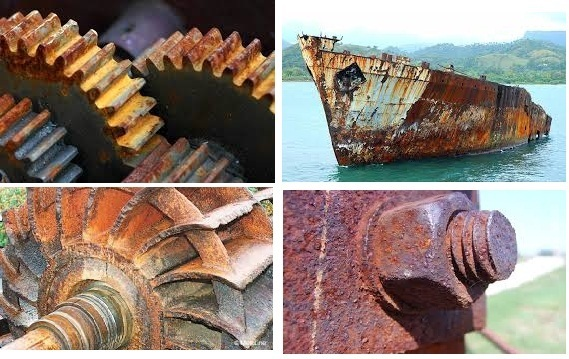
This is the main reason engineers move from 304 or 316 to duplex. Austenitic grades are susceptible to chloride stress corrosion cracking (SCC) when chlorides, tensile stress, and temperatures above about 60 °C (140 °F) occur together. The ferrite phase in duplex hinders crack growth, so duplex is far more resistant. The mechanism and real failures are covered in our article on stress corrosion cracking.
Duplex is not immune. At very high temperatures and chloride levels, or in H₂S environments (oil and gas sour service), duplex has its own limits and must be selected according to standards such as NACE MR0175/ISO 15156.
Pitting and Crevice Corrosion
With a PREN of about 35, 2205 resists pitting far better than 316L (PREN about 24 to 25). Super duplex, with a PREN above 40, is resistant enough for seawater at ambient temperature. This resistance is often expressed as the critical pitting temperature (CPT), the temperature above which pitting starts in a standard test solution; the higher the CPT, the better. The critical crevice temperature (CCT) is typically 15 to 20 °C (27 to 36 °F) lower than the CPT. Pitting is explained in our article on pitting corrosion.
General Corrosion and Erosion
Duplex also resists many organic acids and caustic solutions, and its strength gives it better erosion and abrasion resistance than austenitic grades. That suits it to pumps, impellers, and piping carrying solids-laden fluids. Other forms of corrosion are summarized in our guide to the types of metal corrosion.
Duplex vs 316 Stainless Steel
| Aspect | 316L | Duplex 2205 |
|---|---|---|
| Structure | Austenite | Austenite + ferrite (about 50:50) |
| Minimum yield strength | 170 MPa (25 ksi) | 450 MPa (65 ksi) |
| Typical PREN | 24–25 | 35–36 |
| Chloride SCC resistance | Susceptible above about 60 °C (140 °F) | Far more resistant |
| Magnetic | No | Yes |
| Service temperature range | High temperatures and cryogenic | About −40 to 315 °C (−40 to 600 °F) |
| Welding | Easy and forgiving | Needs a controlled procedure (ferrite balance) |
| Cold forming | Easy | Harder because of high strength |
| Price per kg | Lower | Higher, but walls can be thinner |
In short, choose duplex when chlorides are present above about 60 °C (140 °F), when high loads or pressures would make 316 walls thick, or when erosion is a factor. Stay with 316L above about 300 °C (570 °F), for cryogenic service, for deep-drawn parts, and when a controlled welding procedure is not available. The 304 versus 316 comparison itself is covered in our 304 vs 316 stainless steel guide.
Welding Duplex Stainless Steel
Duplex can be welded with the usual arc processes (SMAW, GTAW/TIG, GMAW/MIG, SAW), but it needs tighter control than 316. The goals are to keep the ferrite-austenite balance in the weld metal and heat-affected zone (HAZ), and to prevent sigma phase.
The Main Problems
- Cooling too fast (too little heat input, thick plate) leaves too much ferrite. Toughness drops, and chromium nitrides can form and lower corrosion resistance.
- Cooling too slowly (too much heat input, interpass temperature too high) gives sigma and other intermetallic phases time to form. These phases are brittle and tie up chromium and molybdenum.
General Guidelines
| Item | Guideline |
|---|---|
| Filler for 2205 | ER2209 / E2209, over-alloyed with about 1.5 to 3% extra nickel so the weld metal has enough austenite |
| Filler for super duplex 2507 | ER2594 / E2594 |
| Joining duplex to carbon steel | ER309L or ER309LMo (2209 is also used) |
| Preheat | Not required; light warming only to remove moisture |
| Maximum interpass temperature | About 150 °C (300 °F) for lean duplex and 2205; about 100 °C (210 °F) for super duplex |
| Heat input | Moderate, typically about 0.5 to 2.5 kJ/mm for 2205; narrower for super duplex |
| Shielding and backing gas | Argon with a small nitrogen addition helps form austenite; nitrogen or argon backing gas |
| Weld metal ferrite | Generally accepted at 25 to 75% (about 30 to 90 FN) if toughness and corrosion tests pass |
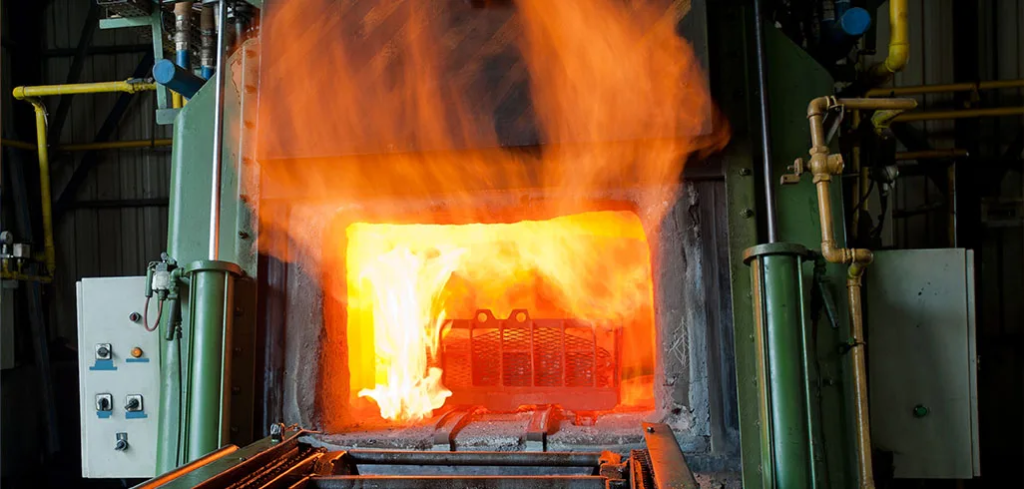
| Post-weld heat treatment | Usually not needed; if required, a full solution anneal, not a stress relief |
| Cleaning | Remove heat tint by pickling or passivation |
Never stress relieve duplex in the range of about 300 to 1,000 °C (575 to 1,830 °F). That range triggers 475 °C embrittlement and sigma phase. If heat treatment is needed, solution anneal above the minimum temperature and water quench.
A ferrite meter gives a quick check, but it does not replace metallography and ASTM A923 testing for critical work. Non-destructive testing methods for welds are covered in our article on NDT methods.
Sigma Phase and 475 °C Embrittlement
Duplex has two temperature “danger zones” to avoid during fabrication and service.
- 475 °C (885 °F) embrittlement (alpha prime). At about 300 to 525 °C (575 to 980 °F), the ferrite forms fine chromium-rich precipitates called alpha prime. Toughness drops even as strength rises. The process is slow, so it rarely occurs during fabrication, but it is the reason for the service limit of about 315 °C (600 °F).
- Sigma phase. At about 700 to 950 °C (1,300 to 1,740 °F) for 2205, and 700 to 1,000 °C (1,300 to 1,830 °F) for 2507, a hard, brittle intermetallic rich in chromium and molybdenum forms. In super duplex it can form within minutes, for example from slow cooling after annealing, welding with excessive heat input, or prolonged thermal cutting.
Because sigma phase is non-magnetic, unusually low ferrite readings can signal its presence. ASTM A923 detects detrimental intermetallic phases in 2205 and 2507 with three methods: A (metallographic screening for acceptance), B (Charpy impact test at −40 °C / −40 °F, with 54 J / 40 ft-lb as the minimum), and C (corrosion test in ferric chloride solution). Lean duplex grades are covered by ASTM A1084.
A proper solution anneal (2205 at a minimum of about 1,040 °C / 1,900 °F, 2507 at about 1,025 to 1,125 °C / 1,880 to 2,060 °F) followed by water quenching dissolves these phases again. Annealing principles are explained in our article on annealing.
Standards and Product Forms
| Product form | Common ASTM standard | Notes |
|---|---|---|
| Plate, sheet, strip | ASTM A240 | S32101, S32304, S31803/S32205, S32750, S32760 |
| Pipe and tube | ASTM A790 (pipe), A789 (tube), A928 (welded pipe) | Widely used in oil and gas, chemicals, and desalination |
| Bar and shapes | ASTM A276, A479 | Pump shafts, bolts, machine parts |
| Forgings, flanges, fittings | ASTM A182 (F51 = S31803, F60 = S32205, F53 = S32750, F55 = S32760), A815 | Pipe flanges and fittings |
| Castings | ASTM A890 and A995 (e.g., CD4MCuN, CD3MN, CE3MN) | Pump casings, valves, impellers |
| Filler metal | AWS A5.9 (ER2209, ER2594), A5.4 (E2209, E2594) | Wire and electrodes |
In Europe, the main standard is EN 10088, with material numbers such as 1.4462 (2205) and 1.4410 (2507). For cast duplex components, casting and heat treatment principles are the same as for other cast steels, covered in our article on steel casting.
Applications of Duplex Stainless Steel
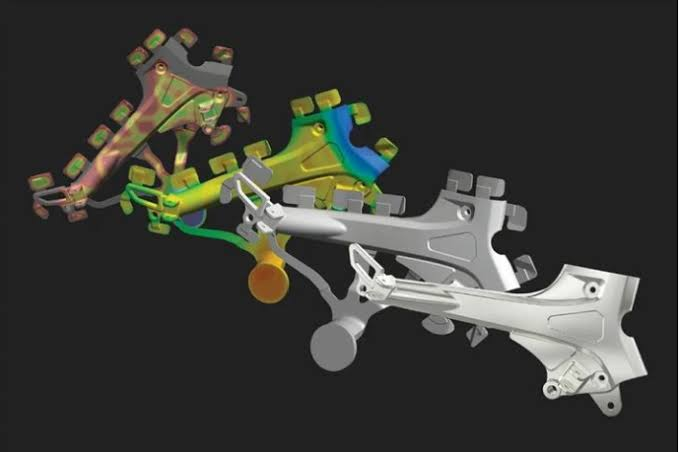
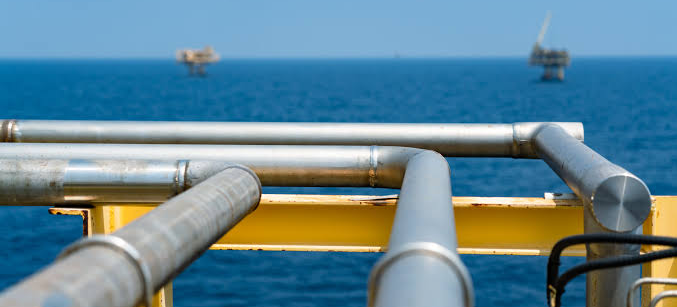
- Oil and gas: flowlines, manifolds, risers, separators, pumps, and valves on offshore platforms.
- Desalination and seawater: piping, evaporator vessels, and heat exchangers.
- Chemical and fertilizer plants: pressure vessels, tanks, and heat exchangers exposed to chlorides or acids.
- Chemical tankers: cargo tank walls, one of the largest long-standing uses of duplex.
- Pulp and paper: digesters and bleaching vessels, where duplex was first used.
- Construction and infrastructure: bridges, tunnels, and reinforcing bar in coastal concrete, especially lean duplex.
- Transport: tank trucks and rail vehicle frames.
How to Choose a Duplex Grade
| Requirement | Common choice |
|---|---|
| Stronger replacement for 304/316 in structures, tanks, and vessels | Lean duplex 2101 or 2304 |
| Chloride environments with SCC risk, up to about 300 °C (570 °F) | Duplex 2205 |
| Seawater, concentrated chlorides, or high temperature and pressure | Super duplex 2507 or S32760 |
| Hot seawater heat exchangers, very aggressive service | Hyper duplex or nickel alloys |
| Above about 300 °C (570 °F) or cryogenic | Not duplex; choose a suitable austenitic grade |
| Cast components (pumps, valves) | Cast duplex such as CD3MN (2205 equivalent) or CE3MN (2507 equivalent) |
Common Mistakes
- Assuming duplex is fake because it attracts a magnet. Duplex is magnetic because of its ferrite.
- Welding duplex like 316. Uncontrolled heat input and interpass temperature produce excess ferrite or sigma phase.
- Using 2205 filler on 2205. Use nickel over-alloyed 2209 so the weld metal has enough austenite.
- Stress relieving at intermediate temperatures. The range of about 300 to 1,000 °C (575 to 1,830 °F) creates brittle phases; either solution anneal fully or skip heat treatment.
- Using duplex above about 315 °C (600 °F). Toughness drops because of 475 °C embrittlement.
- Leaving weld heat tint. The oxide layer reduces corrosion resistance around the weld.
General prevention principles are summarized in our guide on how to prevent corrosion in metals.
Frequently Asked Questions
What is duplex stainless steel? Duplex stainless steel is a stainless steel with a mixed structure of austenite and ferrite in roughly equal amounts. That structure makes it about twice as strong as 304 and 316 and far more resistant to chloride stress corrosion cracking.
Is duplex stainless steel magnetic? Yes. About half of its structure is ferrite, so duplex attracts a magnet. This is not a sign of low quality.
What is the difference between duplex 2205 and 316? 2205 has a minimum yield strength of about 450 MPa (65 ksi), far above 316L at 170 MPa (25 ksi), a higher PREN (about 35 versus 24 to 25), and much better chloride SCC resistance. 316 is easier to weld and form and can be used at high and cryogenic temperatures.
What is super duplex stainless steel? Super duplex is the family of duplex grades with a PREN of about 40 or higher, such as 2507 (S32750) and S32760. Higher chromium, molybdenum, and nitrogen make it suitable for seawater and severe chloride service.
How do you weld 2205 duplex stainless steel? Use ER2209 wire or E2209 electrodes, no preheat, moderate heat input, and a maximum interpass temperature of about 150 °C (300 °F). Shielding gas with a small nitrogen addition helps keep the ferrite-austenite balance. Remove heat tint afterward.
Conclusion
Duplex stainless steel combines austenite and ferrite in one material, giving roughly twice the strength of austenitic grades and much better resistance to chloride stress corrosion cracking. Grade 2205 is the all-rounder, lean duplex replaces 304 and 316 in structures, and super duplex 2507 handles seawater and severe service. Success depends on fabrication: keep the ferrite balance when welding, avoid the temperature ranges that form sigma phase and 475 °C embrittlement, and limit service temperature to about 315 °C (600 °F).
Related Articles
- Types of Stainless Steel: Austenitic, Ferritic, Martensitic, Duplex, and Common Grades
- 304 vs 316 Stainless Steel (and 201): Composition, Corrosion Resistance, Cost, and How to Choose
- Stress Corrosion Cracking (SCC): Causes, Mechanism, Types, and Prevention
- Pitting Corrosion
- Steel Casting: Types, Grades, Process, and Cast Steel vs Cast Iron vs Forged Steel

Dagus R. Djuanda is a metallurgical engineer with more than 20 years of experience in materials engineering, specializing in magnetic materials. He holds a master’s degree in magnetic materials engineering, is a doctoral candidate in industrial engineering, and works as an engineer at the Ministry of Industry of the Republic of Indonesia. Founder of Metalurgika.