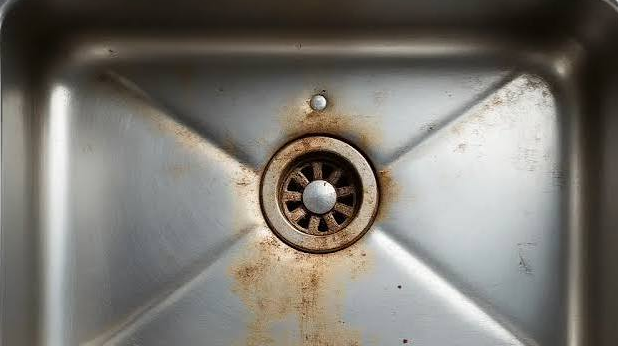
Many people are surprised when a stainless sink, pan, or railing starts to show brown spots. Isn’t stainless supposed to be rustproof? The answer is that stainless steel is corrosion resistant, not corrosion proof. Under certain conditions it can rust. The good news is that most “rust” on stainless is only a surface stain, and it is easy to remove rust from stainless steel with the right products and tools.
This guide explains why stainless steel rusts, how to tell surface staining from real corrosion, the common causes, how to remove rust from light to heavy, what never to use, specific advice for sinks, cookware, appliances, railings, and industrial equipment, and how to prevent rust from coming back. Stainless steel families and grades are covered in our guide to the types of stainless steel.
Why Does Stainless Steel Rust?
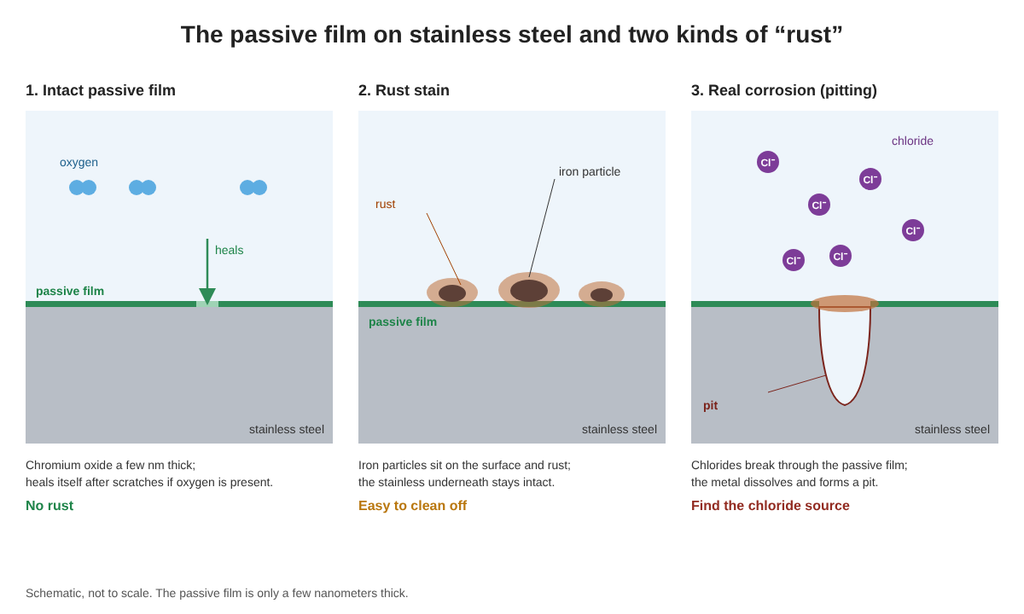
Stainless steel contains at least about 10.5% chromium. Chromium reacts with oxygen to form a passive film, a chromium oxide layer only a few nanometers thick but dense enough to protect the metal underneath. When scratched, it reforms on its own as long as oxygen is present.
Stainless rusts when the passive film is damaged faster than it can heal, or when other iron is sitting on its surface. These two situations produce two very different kinds of “rust.”
Rust Stain or Real Corrosion?
Before cleaning, identify which one you have, because the treatment and the consequences differ.
Rust Stains (Iron Contamination)
This is the most common case. Particles of iron or carbon steel from steel wool, wire brushes, grinding, chipped dish racks, or shop dust land on the stainless surface. Those particles rust, not the stainless steel itself. Signs:
- Reddish-brown spots or streaks, often following the direction of scrubbing or where something was resting.
- They come off easily with a mild cleaner, leaving a smooth surface underneath.
- Left wet for a long time, they can start real corrosion underneath.
Real Corrosion
The passive film breaks down and the stainless steel itself corrodes. The most common forms:
- Pitting corrosion. Chlorides from salt, seawater, sweat, or bleach break through the passive film at weak spots and create small, deep holes. After cleaning, the surface feels rough or shows tiny pits. See our article on pitting corrosion.
- Crevice corrosion. Occurs under washers, bolts, gaskets, or deposits, where oxygen cannot reach and the passive film cannot heal.
- Rust around welds. Heat tint left after welding, or sensitization next to the weld.
A simple test: clean the rust spot with a mild cleaner. If the surface is smooth again, it was a stain. If you still see small pits or roughness, it is pitting corrosion, and you need to find the chloride source.
In industry, free iron contamination can be detected with a chemical test such as the ferroxyl test, which turns blue where free iron is present. It is described in ASTM A380 and is not recommended for food-contact surfaces.
Common Causes of Rust on Stainless Steel
| Cause | Typical example | Sign |
|---|---|---|
| Iron contamination | Scrubbed with steel wool, cut with a disc used on carbon steel, stored near steel, rusty dish rack | Brown spots or streaks that wipe off easily |
| Chlorides | Table salt, seawater, coastal air, swimming pools, bleach, chlorinated floor cleaners | Spots that keep coming back, small pits |
| Wrong grade | 201 or 430 used in bathrooms, wet kitchens, or outdoors | Rust across the whole surface |
| Weld heat tint left in place | Welded railings, tanks, or pipe | Rust along the weld |
| Crevices and deposits | Under bolts, in pipe joints, in corners that never get rinsed | Rust in hidden places |
| Tea staining | Railings and canopies near the coast or in dusty areas | A thin, even brown film |
| Salty or acidic food left too long | Sauces, vinegar, pickles, or brine stored in stainless containers | Spots on the bottom of the container |
| Contact with other metals | Debris from galvanized or carbon steel on stainless | Rust transferred from the other metal |
Grade makes a big difference. 201 and 430 spot with rust far more easily than 304 in damp, chloride-bearing places, while 316 performs best near the coast. The differences are explained in our 304 vs 316 stainless steel guide.
How to Remove Rust from Stainless Steel
Start with the gentlest method. Always rub in the direction of the grain (the fine lines on brushed stainless) so you don’t leave scratches. After cleaning, rinse with clean water and dry.
1. Baking Soda Paste (Light Rust)
Mix two parts baking soda with one part water into a paste. Apply it to the rust spot, rub gently with a soft cloth or non-scratch sponge, rinse, and dry. Good for small spots on pans, cutlery, and sinks.
2. White Vinegar or Lemon Juice (Light to Moderate Rust)
Soak a cloth in white vinegar or lemon juice, lay it on the stain for about 15 to 30 minutes, then rub, rinse, and dry. The mild acid dissolves iron rust without harming the stainless. Don’t leave it on too long or let it dry on the surface, and always rinse afterward.
3. Oxalic Acid Cleaners (Moderate Rust)
Powder or liquid cleaners containing oxalic acid, such as Bar Keepers Friend, are very effective on rust stains and are widely sold for sinks and cookware. Follow the label, rub lightly, and rinse thoroughly. Wear gloves.
4. Stainless Steel and Tea-Stain Cleaners (Moderate Rust, Large Areas)
For railings, canopies, and outdoor panels, mild phosphoric acid cleaners work well on tea staining and rust spots. Apply to a washed surface, leave for about 30 minutes without letting it dry, rub gently, then rinse with plenty of clean water. On vertical surfaces, use a gel or paste. Test first on an inconspicuous area. The passive film re-forms on its own within a few hours after rinsing.
5. Pickling or Electrochemical Cleaning (Heavy Rust, Welds, Industrial Equipment)
Rust around welds, widespread iron contamination, or heavy corrosion calls for pickling paste (a nitric-hydrofluoric acid mix) or an electrochemical weld cleaning machine. Pickling paste is highly hazardous and can dull the surface, so it is usually handled by trained staff with full protective equipment. See the cleaning section of our guide to welding stainless steel.
6. Passivation (After the Rust Is Gone)
Passivation is a nitric or citric acid treatment that removes free iron from the surface and helps the passive film form fully. It does not remove rust or heat tint; it is done after the surface is clean. For industrial equipment, passivation follows standards such as ASTM A967 and greatly helps keep rust from returning. For household items, rinsing and drying after cleaning is usually enough. The full process is explained in our guide to passivation of stainless steel.
What Not to Use on Stainless Steel
- Ordinary steel wool. Its particles embed in the surface and become a new source of rust. Use a non-scratch sponge or stainless-safe pad.
- Carbon steel wire brushes and discs used on steel. Same problem.
- Chlorine bleach and chloride cleaners. Chlorides damage the passive film and cause pitting.
- Cleaners containing hydrochloric acid (muriatic acid), such as some tile and porcelain cleaners. Hydrochloric acid attacks stainless quickly.
- Harsh abrasive cleaners on polished or brushed finishes, which leave scratches where dirt and chlorides collect.
- Letting acid cleaners dry on the surface without rinsing.
Advice for Specific Items
| Item | Recommended method | Notes |
|---|---|---|
| Sinks | Baking soda or an oxalic acid cleaner, rubbed with the grain | Don’t leave cast iron pans or wet cans in the sink; rinse away bleach residue |
| Pots, pans, cutlery | Baking soda, vinegar, or an oxalic acid cleaner | Don’t store salty or acidic food too long; dry after washing |
| Water bottles and tumblers | Soak in warm water with baking soda or dilute vinegar; use a non-metal bottle brush | Dry with the lid off |
| Refrigerators and appliances | Stainless cleaner or baking soda, microfiber cloth with the grain | Many appliance panels are coated; follow the manufacturer’s instructions |
| Railings, handrails, canopies | Regular washing, phosphoric acid cleaner for tea staining, rinse well | Wash more often near the coast; consider grade 316 |
| Bolts and nuts | Clean, then check whether rust comes from a crevice or from a plain steel bolt | Replace bolts that turn out not to be stainless |
| Tanks, piping, industrial equipment | Pickling or electrochemical cleaning, then passivation | Find and remove the source of contamination or chlorides |
How to Prevent Stainless Steel from Rusting
- Choose the right grade. 304 for kitchens and indoors; 316 for coastal sites, pools, and chemicals; duplex for severe chloride service, as explained in our guide to duplex stainless steel.
- Rinse and dry. Especially after contact with salt, salty food, or cleaners.
- Avoid bleach and chloride cleaners. If you must use them, rinse thoroughly.
- Keep tools separate. Brushes, grinding discs, work tables, and lifting gear for stainless and carbon steel should be separate, especially in fabrication shops.
- Choose a smooth finish outdoors. Rough surfaces stain more easily; ASSDA cites about 0.5 µm Ra as a common target for tea-staining resistance near the coast.
- Design for rain washing. Avoid crevices, enclosed corners, and flat surfaces where water and dirt collect.
- Clean regularly. A practical rule for outdoor stainless: clean it whenever you wash nearby windows. Near the coast, some building managers wash stainless every three to four months.
- Clean welds and passivate fabricated parts.
General corrosion prevention principles are summarized in our guide on how to prevent corrosion in metals, and other forms of corrosion in our guide to the types of metal corrosion.
Frequently Asked Questions
Does stainless steel rust? Yes. Stainless steel is corrosion resistant, not corrosion proof. Rust appears when its passive film is damaged by chlorides, starved of oxygen in crevices, or when iron particles sit on its surface.
How do you remove rust from stainless steel? For light rust, use baking soda paste or white vinegar, rub with the grain using a non-scratch sponge, then rinse and dry. For stubborn rust, use an oxalic acid cleaner or a stainless steel cleaner. Heavy rust on industrial equipment is removed by pickling or electrochemical cleaning, followed by passivation.
Why does stainless steel rust? The most common causes are iron contamination from steel wool or tools used on carbon steel, chlorides from salt and bleach, the wrong grade (such as 201 in wet areas), weld heat tint left in place, and deposits in crevices.
Can you use steel wool on stainless steel? No. Steel wool leaves particles that embed in the surface and rust. Use a non-scratch sponge, nylon pad, or stainless-safe scrubber instead.
What is passivation of stainless steel? Passivation is a chemical treatment with nitric or citric acid that removes free iron from the surface so the passive film can form fully. It is done after rust or weld discoloration is removed and helps prevent rust from returning.
Conclusion
Stainless steel can rust, but most visible rust is just staining from iron particles sitting on the surface. To remove rust from stainless steel, start gently with baking soda or vinegar, move to an oxalic acid or stainless steel cleaner if needed, always rub with the grain, and rinse. Avoid steel wool, bleach, and hydrochloric acid. If rust keeps coming back, look for the cause, whether chlorides, the wrong grade, crevices, or weld discoloration, and fix it at the source.
Related Articles
- Types of Stainless Steel: Austenitic, Ferritic, Martensitic, Duplex, and Common Grades
- 304 vs 316 Stainless Steel (and 201): Composition, Corrosion Resistance, Cost, and How to Choose
- Pitting Corrosion
- Welding Stainless Steel: Filler Selection, TIG, MIG, and Stick, Sensitization, and Passivation
- How to Prevent Corrosion in Metals
Dagus R. Djuanda is a metallurgical engineer with more than 20 years of experience in materials engineering, specializing in magnetic materials. He holds a master’s degree in magnetic materials engineering, is a doctoral candidate in industrial engineering, and works as an engineer at the Ministry of Industry of the Republic of Indonesia. Founder of Metalurgika.