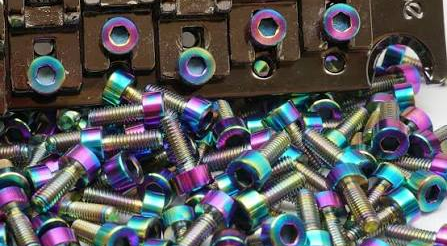
Titanium anodizing turns titanium blue, purple, gold, or green with no paint and no dye at all. The color comes from a thin oxide layer grown on the metal surface, and the thickness of that layer is set by the voltage. That is why the same piece of titanium can be given a different color simply by changing the voltage.
This guide explains how titanium anodizing differs from aluminum anodizing, how the colors form, a voltage color chart, the process step by step, small-scale anodizing at home, AMS 2488 Type 2, how alloy and surface finish affect the result, how durable the color is, and how anodizing differs from the colored coatings used on titanium jewelry. For anodizing in general, see our guide to aluminum anodizing.
What Is Titanium Anodizing?
Titanium anodizing is an electrochemical process that grows a layer of titanium dioxide (TiO₂) on the surface of titanium. The titanium part is connected as the anode (positive terminal) in an electrolyte, and direct current is applied. Oxygen from the electrolyte reacts with the titanium surface and builds an oxide layer that is integral with the metal.
Titanium already carries a very thin natural oxide film, which is what makes it so corrosion resistant. Anodizing simply thickens that film in a controlled way. It is different from passivation of stainless steel, which uses acid with no current and does not grow a new layer; it removes free iron from the surface.
How it differs from aluminum anodizing
The name is the same, but the result is very different:
| Aspect | Aluminum anodizing | Titanium color anodizing |
|---|---|---|
| Coating thickness | About 2.5–25 µm (Type II), up to 100 µm (hard anodizing) | Tens to a few hundred nanometers |
| Structure | Porous, then sealed | Dense, no sealing needed |
| Source of color | Dye absorbed into the pores | Light interference in the oxide layer |
| What controls color | Dye type and concentration | Voltage |
| Black possible | Yes | No |
On aluminum, anodizing is mainly used to protect the metal from aluminum corrosion and wear. Titanium is already highly corrosion resistant, so it is anodized mostly for color and identification.
A color-anodized oxide on titanium is roughly a thousand times thinner than a typical aluminum anodic coating. It adds almost nothing to part dimensions, but it is also easier to scratch through.
How the Colors Form: Thin-Film Interference
The TiO₂ layer itself is clear. Its color appears the same way the rainbow colors on a soap bubble or an oil slick do.
Some light reflects off the outer surface of the oxide, and some passes through the oxide and reflects off the metal underneath. The two reflections recombine. At certain wavelengths they reinforce each other; at others they cancel. The color you see is the reinforced wavelength.
Which wavelength is reinforced depends on the thickness of the layer. The higher the voltage, the thicker the oxide grows, and the color shifts. Xometry gives an oxide thickness of roughly 10–300 nm for color anodizing.
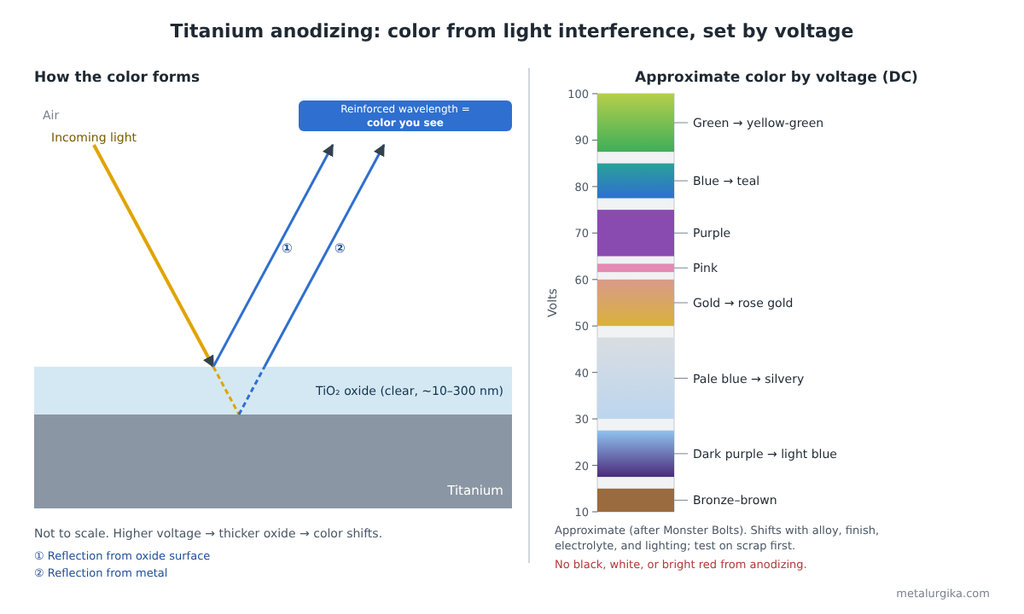
Two practical consequences follow:
- There is no dye to fade in sunlight. Anodized titanium colors are UV stable.
- Anything on top of the oxide shifts the color. Skin oil from fingerprints, for example, changes the optical path, so the color looks slightly off until it is cleaned.
Titanium Anodizing Voltage Chart
No voltage chart holds exactly for every situation. Results shift with the alloy, surface finish, electrolyte, temperature, part geometry, and even the lighting the part is viewed under. Different sources give different voltages for the same color, and a change of just 2–3 V can be visible.
The chart below is an approximate color sequence based on the chart published by titanium bolt seller Monster Bolts. Use it as a starting point, then test on a scrap piece of the same material.
| Voltage (DC, approximate) | Color |
|---|---|
| 10–15 V | Bronze to brown |
| 17.5–27.5 V | Dark purple to light blue |
| 30–47.5 V | Pale blue to silvery |
| 50–60 V | Yellow-gold to rose gold |
| About 62.5 V | Pink |
| 65–75 V | Purple |
| 77.5–85 V | Blue and teal |
| 87.5–100 V | Green to yellow-green |
A few things to know:
- The sequence repeats. Purple and blue appear twice, at low and high voltage. Second-order colors are usually softer and more pastel.
- There is no black, white, or true bright red. Thin-film interference in the oxide cannot produce those colors. Jet-black titanium almost always gets its color from another coating, not anodizing.
- You can only go up. A gold part can be taken to a higher-voltage color, but it cannot be brought back down to a lower-voltage color without removing the oxide first.
The Titanium Anodizing Process, Step by Step
The principle is simple. An even, repeatable result comes from surface preparation and voltage control.
- Surface preparation. Anodized color shows the surface honestly: scratches, machining marks, and texture all stay visible. Xometry recommends a finish of about Ra 0.8 µm (32 µin) or smoother for even color. For a matte look, the surface can be bead blasted first with fine media, on the same principle as shot blasting.
- Degreasing. Wash with soap or detergent, wipe with a solvent such as acetone or isopropyl alcohol, and rinse in distilled water. From here on, do not touch the surface with bare hands.
- Etching (industrial). Anodizing shops usually etch titanium in a nitric-hydrofluoric acid mix to remove the old oxide and contamination. Hydrofluoric acid is extremely dangerous even in small amounts, so this step is not for a home setup.
- Electrolyte. Many electrolytes are used for color anodizing, including dilute sulfuric acid, phosphate solutions, and trisodium phosphate (TSP). For small-scale work, Xometry suggests about 1–2 teaspoons of TSP per liter of distilled water, with borax as a milder alternative.
- Circuit. The titanium part goes on the positive terminal (anode). The negative terminal (cathode) is a stainless steel, titanium, or graphite plate. The anode and cathode must not touch.
- Set the voltage. Bring the voltage up to the target. Current spikes briefly, then falls quickly because the growing oxide is an insulator. Once the current drops, the oxide stops thickening at that voltage, so color is set by voltage rather than time in the bath.
- Rinse and dry. Rinse in distilled water and dry. Titanium oxide is not porous, so unlike aluminum anodizing it does not need sealing.
Brush and sponge anodizing
Instead of dipping, titanium can be colored locally with a brush or sponge soaked in electrolyte and connected to the cathode. This technique is used for logos, lettering, color gradients, and touch-ups. Areas that should stay uncolored are masked with tape or a maskant.
Anodizing Titanium at Home: Safety First
Titanium anodizing is popular with knife, flashlight, EDC, and jewelry makers because the equipment is fairly simple: an adjustable DC power supply up to about 100 V, a non-metallic container, electrolyte, and a cathode.
Keep these points in mind:
- Up to 100 V DC is dangerous. Use a power supply designed for the job, insulated leads and clips, and never touch the part or the electrolyte while the power is on. Do not improvise a supply from mains power.
- Wear gloves and eye protection. TSP is alkaline and irritates skin and eyes.
- Do not use hydrofluoric acid at home. Clean mechanically and with solvents only.
- Work in a ventilated area. Electrolysis releases hydrogen gas at the cathode.
Type 2 Titanium Anodizing (AMS 2488)
In aerospace, titanium anodizing is governed by SAE AMS 2488. The two types you will hear about most:
- Type 2. Functional rather than decorative anodizing. It uses a strongly alkaline electrolyte (pH about 13 or higher) and produces a dull gray coating. Its purpose is to reduce galling, where mating titanium surfaces seize and tear as they slide, a classic problem on titanium threads, and to serve as a base for dry film lubricants. According to discussion on finishing.com, the specification calls for no measurable dimensional change when measured to 0.0001 in (about 2.5 µm).
- Type 3. Color anodizing as described above. It is used mainly for identification (for example, color coding sizes) and appearance.
For titanium surfaces that truly need to be hard and wear resistant, anodizing is not the only option. Titanium can also be nitrided at high temperature, about 700–900 °C (1,290–1,650 °F), to form a much harder titanium nitride layer.
Bath details for Type 2 (concentration, temperature, voltage) are rarely published and are treated as trade secrets by individual shops. If a drawing calls for “anodize per AMS 2488 Type 2”, confirm that the gray anti-galling coating is what is wanted, not a color anodize.
Alloy and Surface Finish Effects
- Commercially pure titanium (such as Grade 2) generally gives the brightest, most even colors.
- Ti-6Al-4V (Grade 5), the most widely used titanium alloy, also anodizes, but colors tend to be slightly duller and can be less uniform than on CP titanium.
- Welds and heat-affected areas carry a different existing oxide and can color differently from the rest of the part. Clean and blend welded titanium first.
- Polished surfaces give glossy, saturated colors; blasted surfaces give softer matte colors.
How Durable Is Anodized Titanium?
- UV stable and corrosion resistant. There is no dye to fade, and titanium oxide is very stable. Titanium’s own corrosion resistance is excellent; for a comparison with other ways of protecting metals, see how to prevent corrosion in metals.
- Easy to wear through. A coating a few hundred nanometers thick shows bare metal when scratched or abraded, for example on bolt threads that are removed often or on a watch clasp.
- Can look different with oil or dirt. Fingerprints and oil films shift the color. Clean with mild soap and water; avoid strong alkaline cleaners and abrasives.
- Can be re-anodized. A damaged part can be recolored at the same or a higher voltage, or stripped back to bare metal first if a lower-voltage color is wanted.
Uses of Anodized Titanium
- Medical implants and instruments. Color codes sizes, for example on bone screws and plates, so surgeons can tell sizes apart at a glance.
- Aerospace. Titanium fasteners and components, with Type 2 for anti-galling or color for identification.
- Bicycles, motorcycles, and automotive. Colored titanium bolts for weight savings and looks.
- Jewelry. Earrings, body jewelry, and rings, because titanium is light and rarely causes allergic reactions.
- EDC gear, knives, and flashlights. Colored titanium clips, handles, and bodies.
Anodized Titanium Jewelry vs PVD Color
Titanium rings and jewelry are sold in gold, black, rose gold, and rainbow colors. Not all of these are anodized.
- Rainbow, blue, purple, and teal colors are almost always anodized.
- Gold can come from anodizing (around 50–60 V), but on jewelry it often comes from a PVD coating (physical vapor deposition) such as titanium nitride, also sold as IP (ion plating).
- Jet black cannot be produced by anodizing. Black titanium rings are usually PVD coated or made from another material such as ceramic or tungsten carbide.
This is why colored titanium jewelry can change color over time: whether anodized or PVD, the color layer wears first where it rubs most, revealing the silver-gray titanium underneath. Anodized jewelry can often be re-anodized; PVD-coated pieces need to be recoated by the maker.
Common Mistakes
| Mistake | Result | What to do instead |
|---|---|---|
| Touching the surface after cleaning | Blotchy, uneven color | Handle with gloves or tongs |
| Treating a voltage chart as exact | Color misses the target | Test on scrap of the same material |
| Trying to lower the color with a lower voltage | Color does not change | Strip the oxide first, then re-anodize |
| Using hydrofluoric acid without proper facilities | Risk of serious chemical burns | Clean mechanically and with solvents |
| Expecting black from anodizing | Not achievable | Use PVD or another coating |
| Using color anodize on load-bearing threads that are often reassembled | Color wears quickly, threads may gall | Use Type 2 or an anti-seize lubricant |
Frequently Asked Questions
Does titanium anodizing use paint or dye? No. The color comes from light interference in a clear oxide layer whose thickness is set by voltage. That is why the color does not fade in sunlight.
What voltage gives blue or gold on titanium? As a rough guide, dark to light blue appears around 20–30 V and gold around 50–60 V. Exact values shift with alloy, finish, and electrolyte, so always test on a scrap piece first.
How do you anodize titanium at home? Clean and degrease the part, connect it to the positive terminal of an adjustable DC power supply, use a stainless steel or titanium cathode in an electrolyte such as a TSP solution, and raise the voltage to the color you want. Use proper electrical safety, and do not use hydrofluoric acid.
What is Type 2 titanium anodizing? Functional anodizing under AMS 2488 that uses a strongly alkaline electrolyte and produces a gray coating. It reduces galling on threads and provides a base for dry film lubricants rather than adding color.
Does anodized titanium wear off? The color does not fade with light, but it can wear through with rubbing and scratches because the layer is so thin. Worn areas can be re-anodized.
Conclusion
Titanium anodizing creates color without dye: a clear oxide layer tens to hundreds of nanometers thick makes light interfere, and the voltage decides the color. The color is UV stable and needs no sealing, but it wears with friction. For consistent results, prepare the surface carefully, test voltages on scrap of the same material, and keep color anodizing (Type 3) separate from functional gray anodizing (Type 2) for threads and sliding parts.
Related Articles
- Aluminum Anodizing: Process, Types (I, II, III), Thickness, Colors, and Sealing
- Aluminum Corrosion: Causes, Types, and Prevention
- Nitriding: Process Steps, Types, Suitable Steels, and the White Layer
- Passivation of Stainless Steel: Pickling vs Passivation, Nitric vs Citric Acid, ASTM A967, and Testing
- How to Prevent Corrosion in Metals

Dagus R. Djuanda is a metallurgical engineer with more than 20 years of experience in materials engineering, specializing in magnetic materials. He holds a master’s degree in magnetic materials engineering, is a doctoral candidate in industrial engineering, and works as an engineer at the Ministry of Industry of the Republic of Indonesia. Founder of Metalurgika.