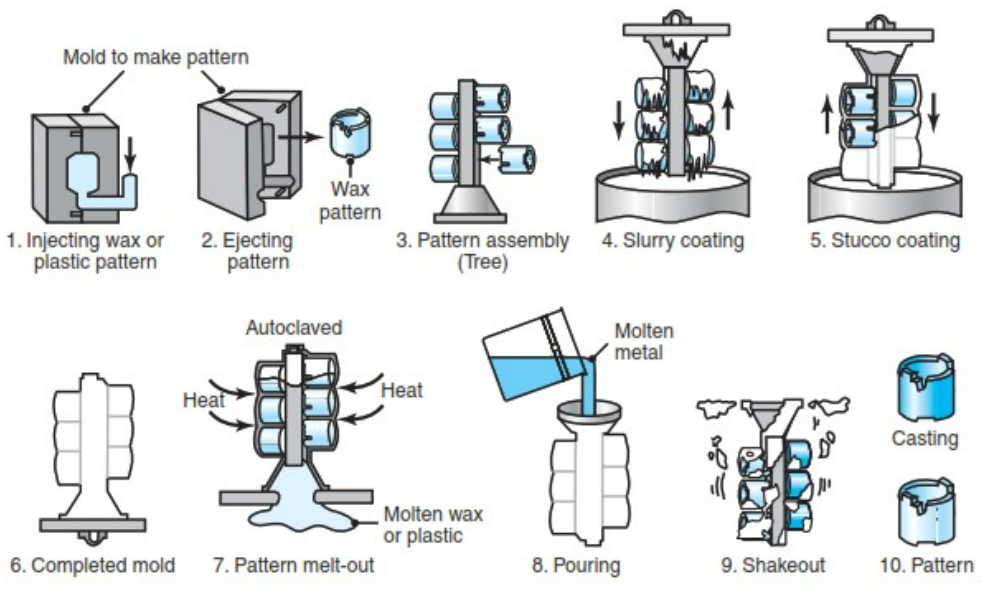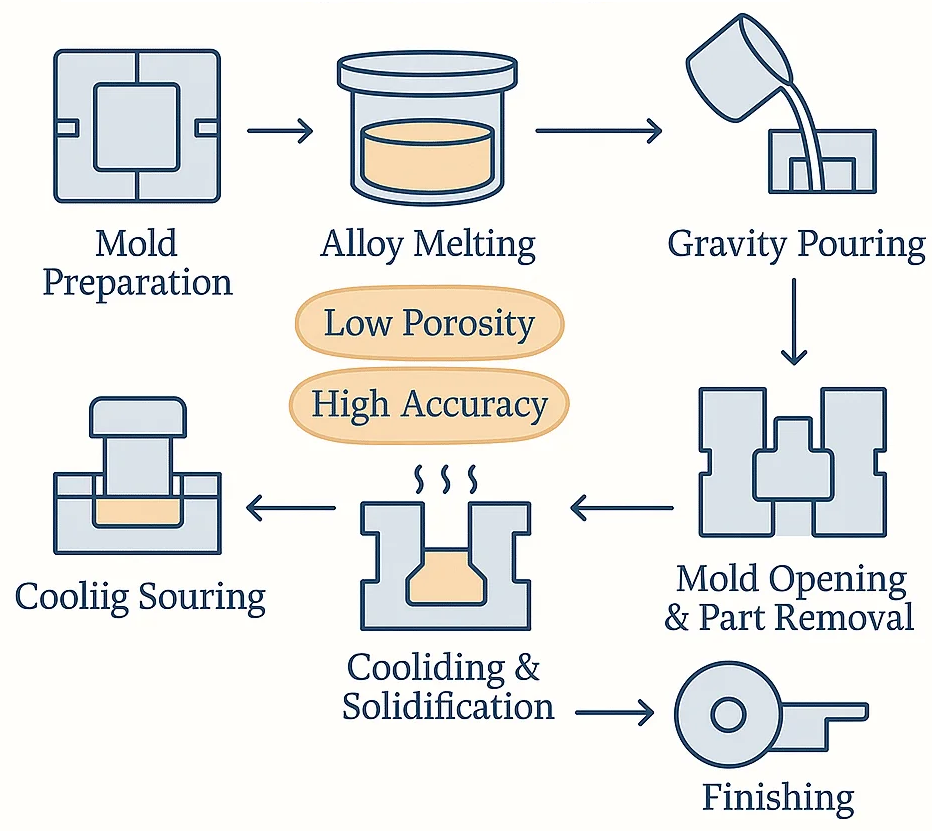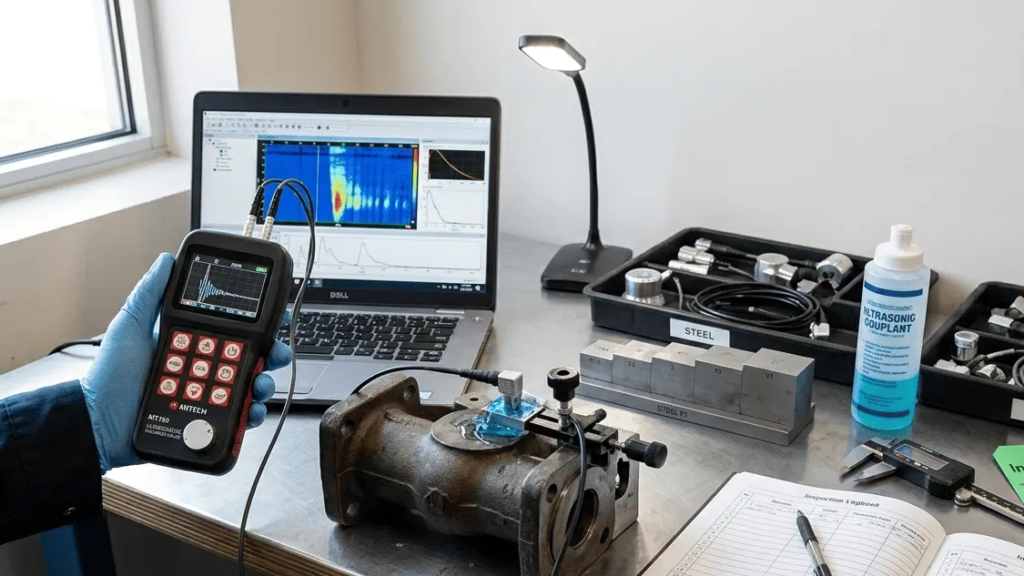
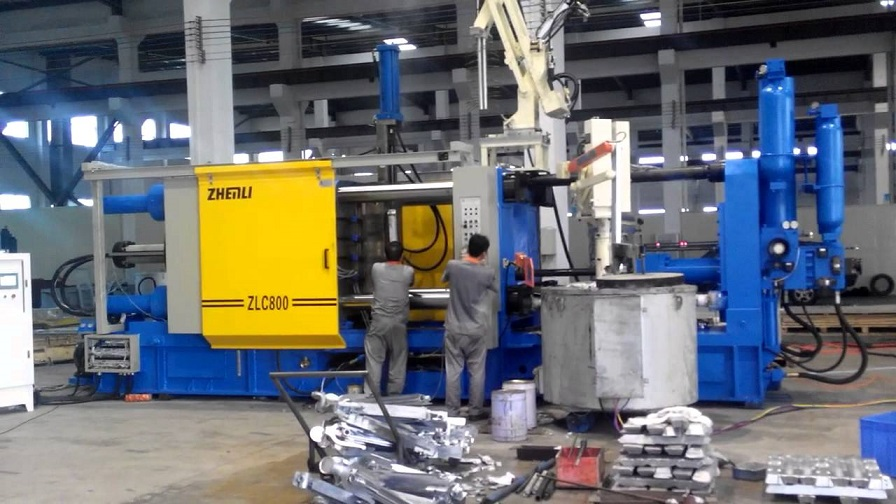
Die casting forces molten metal into a steel die at high speed and pressure, then lets it solidify in seconds. The result is thin, complex, accurate parts with a smooth surface, produced thousands to millions of times from the same die. Most of the aluminum components in motorcycles, cars, and electronics are die cast.
This guide covers what die casting is, hot chamber versus cold chamber machines, the types of die casting, how the machine and its shot phases work, the process step by step, dies, alloys such as A380 and ADC12, common defects, design rules, and why conventional die castings cannot be T6 heat treated or welded. For aluminum casting in general, start with our guide to aluminum casting.
What Is Die Casting?
Die casting is a casting process that uses a permanent metal mold, called a die, into which molten metal is injected under pressure. The full name is high pressure die casting (HPDC). The finished part is a die casting.
Three things set die casting apart from other casting methods:
- A permanent metal die. Unlike a sand mold that is broken up after every pour, a tool steel die is used for tens of thousands to hundreds of thousands of shots.
- High pressure. The metal is not poured under gravity; a plunger drives it into the die in a fraction of a second. That is why walls only 1–2 mm (0.04–0.08 in) thick can fill completely.
- Very fast solidification. A water-cooled steel die freezes the metal in seconds. Total Materia gives cooling rates of roughly 100–1,000 K per second, which produce a fine grain structure.
The metals most often die cast are aluminum, zinc, and magnesium alloys, with a smaller amount of copper alloys. Steel and iron are not die cast commercially because their melting points are too high for steel dies.
For a side-by-side comparison with sand casting and investment casting, see sand casting vs die casting vs investment casting.
Hot Chamber vs Cold Chamber Die Casting
There are two kinds of high pressure die casting machine. The difference is where the injection chamber sits relative to the molten metal.
Hot chamber. A gooseneck injection chamber is submerged in a pot of molten metal. Each time the plunger rises, the chamber refills; when it descends, metal is forced into the die. Cycles are very fast. The method only suits low-melting metals, mainly zinc and some magnesium alloys. Molten aluminum would quickly attack the submerged iron components, so aluminum is not hot chamber cast.
Cold chamber. The metal is melted in a separate furnace and ladled into a shot sleeve for every shot. The plunger then drives it into the die. Cycles are slightly slower, but the method handles aluminum, magnesium, and copper. Almost all aluminum die casting is cold chamber.
| Aspect | Hot chamber | Cold chamber |
|---|---|---|
| Injection chamber | Submerged in the molten metal pot | Separate; metal ladled in each shot |
| Metals | Zinc, some magnesium | Aluminum, magnesium, copper |
| Cycle speed | Very fast | Slightly slower |
| Injection pressure | Lower | Higher |
| Typical parts | Die-cast toys, handles, zipper parts, small hardware | Engine blocks, crankcases, housings, some wheels |
According to OpenLearn, cold chamber die casting pressures range from about 7 to 207 MPa (1,000–30,000 psi).
Types of Die Casting
“Die casting” is often used for several processes that share a metal mold:
| Process | How the metal enters | Character | Examples |
|---|---|---|---|
| High pressure die casting (HPDC) | Driven by a plunger at high speed and pressure | Most productive, thinnest walls, entrapped air | Crankcases, gearbox housings, electronics housings |
| Low pressure die casting (LPDC) | Pushed up from a furnace below the die by low air pressure | Calm filling, less porosity, heat treatable | Car wheels, cylinder heads |
| Gravity die casting (permanent mold) | Poured under gravity into a metal mold | Simpler, thicker walls | Pistons, vehicle parts, hardware |
| Squeeze casting | Poured, then pressed slowly as it solidifies | Very sound, heat treatable | Suspension parts |
| Vacuum HPDC | HPDC with air evacuated from the die cavity | Much lower porosity, weldable and heat treatable | Structural car body parts |
In everyday use, “die casting” almost always means HPDC. The rest of this guide covers HPDC unless stated otherwise.
The Die Casting Machine and Shot Phases
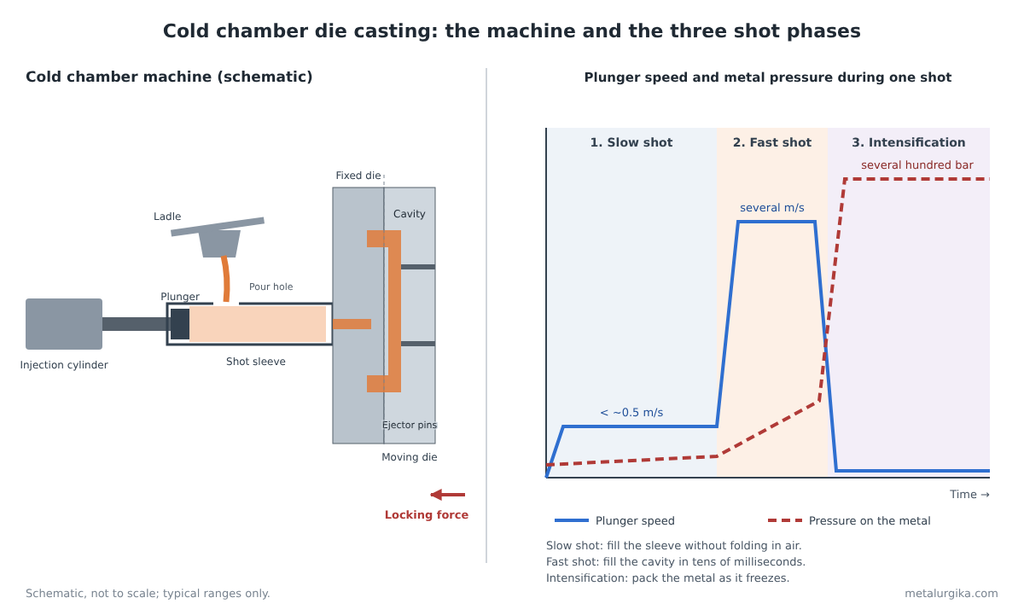
A cold chamber die casting machine has several main units:
- Clamping unit. Closes and locks the two die halves, the fixed (cover) die and the moving (ejector) die. Machine size is given by this locking force in tons. Small machines are tens to hundreds of tons; machines for car engine blocks reach several thousand tons.
- Injection unit. The shot sleeve, plunger, and hydraulic cylinder with accumulators that deliver high speed and pressure.
- Ejectors. Pins that push the casting out of the moving die.
- Peripherals: a holding furnace, automatic ladle, die spray, die temperature control, and an extraction robot.
The locking force must exceed the force trying to open the die, which is the metal pressure multiplied by the projected area of the casting plus runners and overflows. Too little force and metal escapes at the parting line as flash.
Three shot phases. A typical HPDC shot is divided into three phases:
- Slow shot. The plunger moves slowly to fill the shot sleeve and push the metal up to the gate without folding air into it. Plunger speed is typically below about 0.5 m/s (1.6 ft/s).
- Fast shot. Once the metal reaches the gate, the plunger accelerates so the cavity fills in tens of milliseconds, before the metal can freeze in thin walls. Plunger speed is typically several meters per second, and metal velocity at the gate can be tens of meters per second.
- Intensification. Once the cavity is full, pressure is boosted sharply, typically to several hundred bar, to pack the metal as it solidifies and reduce shrinkage porosity.
These are general ranges. Actual settings are tuned for each die and are often developed with digital casting simulation.
The Die Casting Process, Step by Step
- Die preparation. The die is brought to working temperature and sprayed with a release agent so the casting does not stick and the die surface is cooled slightly.
- Closing and locking. The moving die closes against the fixed die and locks at full force. Movable cores slide into position.
- Ladling. The ladle takes metal from the holding furnace and pours it into the shot sleeve. The shot weight must be consistent every cycle.
- Injection. The plunger drives the metal through the three phases, filling the cavity, runners, and overflows.
- Solidification. The metal freezes under intensification pressure, typically within a few seconds to a dozen or so seconds depending on wall thickness.
- Opening and ejection. The die opens, cores retract, and ejector pins push the casting out. A robot removes it, often quenching it in water.
- Trimming. Runners, the biscuit (the slug left at the end of the shot sleeve), overflows, and flash are removed, usually with a trim die in a press.
- Finishing and inspection. Castings are deburred, shot blasted or machined as needed, then checked for dimensions and porosity, for example by X-ray on critical parts.
An aluminum HPDC cycle runs from several tens of seconds to about a minute for large parts.
Die Casting Dies
The die is the most expensive part of die casting. OpenLearn notes that dies for complex parts can cost hundreds of thousands of pounds.
- Material. Dies for aluminum are typically made of hot-work tool steel such as H13 (SKD61 in JIS, 1.2344 in EN), hardened and tempered.
- Temperature control. The die is held at a working temperature with water or oil channels inside it. Too cold a die causes cold shuts; too hot a die causes soldering and lengthens the cycle.
- Heat checking. Repeated heating and cooling creates a network of fine surface cracks on the die. These print as raised lines on the casting and are the main reason dies reach end of life.
- Surface treatment. Dies are often nitrided or PVD coated to resist soldering, erosion, and heat checking.
- Gates and overflows. Runner, gate, overflow, and vent design controls how the metal flows and where the air goes. The principles resemble a gating system in sand casting, but at far higher velocities.
Die Casting Alloys
Die casting alloys are chosen for good fluidity, resistance to hot cracking, and resistance to sticking in the die. For aluminum, that means Al-Si alloys with fairly high silicon and around 1% iron to prevent soldering.
| Alloy | System | Character | Typical use |
|---|---|---|---|
| A380 (ASTM) | Al-Si-Cu | The most common die casting alloy in North America | Housings, brackets, general parts |
| 383 / ADC12 (JIS) | Al-Si-Cu | Higher silicon, excellent fluidity; the most common in Asia | Crankcases, engine covers, thin housings |
| AlSi10MnMg | Al-Si-Mg, low iron | For structural vacuum HPDC; ductile, weldable, heat treatable | Car body and chassis parts |
| Zamak 3 and 5 | Zn-Al | Hot chamber; very fine detail, easy to chrome plate | Handles, die-cast toys, locks |
| AZ91D | Mg-Al-Zn | Lightest; hot or cold chamber | Steering wheel frames, laptop and camera housings |
According to the JIS data published by Yamaha Motor, ADC12 contains 9.6–12.0% silicon and 1.5–3.5% copper, with iron up to 1.3%; it corresponds to alloy 383, while ADC10 corresponds to A380. Silicon gives the fluidity needed for thin walls, copper adds strength, and iron keeps the metal from sticking to the die. The drawbacks are that copper lowers corrosion resistance and high silicon makes anodizing of these alloys dark gray and patchy. Other aluminum alloys are covered in our guide to aluminum alloys.
OpenLearn lists typical die cast properties of about 293–355 MPa tensile strength for zinc (Mazak), 280 MPa for a high-silicon aluminum alloy, and 215 MPa for magnesium, with elongation of only about 2–5%.
Die Casting Defects
| Defect | Appearance | Common causes | Prevention |
|---|---|---|---|
| Gas porosity (entrapped air) | Smooth, round voids inside the casting | Air in the cavity and shot sleeve folded in during filling; gas from release agent | Correct slow shot, vents and overflows, vacuum, minimal die spray |
| Shrinkage porosity | Irregular voids in thick sections | Thick sections freeze last without feed metal | Uniform walls, adequate intensification, local cooling |
| Cold shut and misrun | Seam lines or unfilled areas | Metal or die too cold, filling too slow | Raise temperatures, faster fast shot, improve the gate |
| Flash | Thin fins at the parting line | Insufficient locking force, worn or uneven die | Adequate machine tonnage, die maintenance |
| Soldering | Metal welded to the die, tearing the surface | Die too hot, iron too low in the alloy, too little release agent | Control die temperature, nitride the die, check Fe |
| Blisters | Raised bubbles after heating | Air trapped beneath the skin expands | Reduce gas porosity; do not heat conventional HPDC parts |
| Heat check marks | Raised network of lines | Thermal fatigue cracks in the die surface | Die maintenance and repair, stable die temperature |
Porosity is covered in depth in our article on porosity and hot tearing, and seams in cold shut and misrun.
Design Rules for Die Castings
- Uniform, thin walls. Thick sections freeze last and become porous. Use thin walls of even thickness with ribs for stiffness instead of solid mass.
- Draft angles. Walls parallel to the die opening direction need a slight taper so the casting releases from the die.
- Generous radii. Sharp internal corners concentrate stress in the casting and heat in the die, and they promote heat checking.
- Avoid undercuts. Features that would trap the casting in the die need slides or cores, which raise die cost.
- Plan for machining. Leave small machining allowances on critical faces, and remember that machining can open subsurface porosity.
Why Conventional Die Castings Cannot Be T6 Heat Treated or Welded
Very fast filling traps air and gas from the release agent as fine pores, some just beneath the casting skin. As long as the casting is not heated, these pores do not matter for many uses.
The problem appears when the casting is heated:
- T6 heat treatment requires solution treatment at around 500 °C (930 °F) or higher. At that temperature the gas in the pores expands, the metal softens, and the skin blisters.
- Welding melts the metal around the pores, releasing gas that forms large porosity in the weld.
That is why conventional HPDC parts are used as-cast (F temper) or only given a low-temperature artificial age (T5). Where a part must be heat treated, welded, or carry crash loads, the options are vacuum HPDC with a low-iron alloy such as AlSi10MnMg, squeeze casting, or low pressure die casting.
Gigacasting
Gigacasting is HPDC on very large machines that cast most of a car’s underbody as a single piece. Tesla popularized it with the Giga Press built by IDRA in Italy, with a locking force of about 6,000 tons, for the rear underbody of the Model Y. According to Wikipedia, Tesla said the single-piece front and rear castings replace more than 70 parts. Machines of about 9,000 tons have since been built, and automakers including Toyota and Volvo have announced similar plans.
Gigacasting uses the same principles as ordinary die casting but demands special alloys that are ductile without heat treatment, vacuum control, and enormous dies.
Applications of Die Casting
- Motorcycles: crankcases, clutch and magneto covers, some cylinder heads, brackets, and brake parts.
- Cars: transmission housings, some engine blocks, brackets, steering parts, battery and electric motor housings, and structural body parts. See our automotive casting case study.
- Electronics: laptop and camera housings, router cases, heat sinks, and LED lighting.
- Hardware and tools: door handles, locks, power tools, and machine components.
- Toys and models: die-cast model cars are usually zinc alloy (Zamak) made by hot chamber.
Common Mistakes
- Designing walls with widely varying thickness. Thick sections freeze last and become porous.
- Specifying T6 or welding on conventional HPDC parts. The result is blisters or porous welds.
- Choosing an alloy for strength alone. A380 and ADC12 are strong and castable, but less corrosion resistant and less ductile than Al-Si-Mg alloys.
- Skimping on vents and overflows. Air has nowhere to go and ends up as porosity.
- Ignoring die temperature. A cold die causes cold shuts; an overheated die causes soldering.
- Buying just enough machine tonnage. Marginal locking force causes flash and unstable dimensions.
Frequently Asked Questions
What is die casting? Die casting is a casting process that uses a permanent steel die, into which molten metal is forced at high speed and pressure and then solidifies in seconds. It produces thin, accurate, smooth parts in large volumes.
What is the difference between hot chamber and cold chamber die casting? In hot chamber die casting, the injection chamber sits in the molten metal, which gives fast cycles but suits only low-melting metals such as zinc. In cold chamber die casting, metal is ladled into a separate shot sleeve for each shot, which allows aluminum to be cast.
Is die casting better than sand casting? For high volumes of thin, accurate parts, yes. For large parts, low volumes, steel and iron, or parts that need heat treatment and welding, sand casting or other methods are usually better.
Why can’t die castings be heat treated? Conventional HPDC parts contain entrapped air. At solution treatment temperatures the gas expands and blisters the surface. Vacuum HPDC, squeeze casting, and low pressure die casting are used when T6 is needed.
What is the most common aluminum die casting alloy? A380 in North America and ADC12 (similar to alloy 383) in Asia. Both are Al-Si-Cu alloys chosen for fluidity and resistance to die soldering.
Conclusion
Die casting forces molten metal into a steel die at high speed and pressure, making thin, complex parts quickly and accurately in large volumes. Aluminum is cast on cold chamber machines and zinc on hot chamber machines. Casting quality depends on the shot phases, die temperature, venting, part design, and alloy choice. Because air is entrapped, conventional HPDC parts are not suited to T6 or welding; vacuum HPDC, squeeze casting, and low pressure die casting fill that gap.
Related Articles
- Aluminum Casting: Processes, Alloys, and Common Defects
- Sand Casting vs Die Casting vs Investment Casting
- Aluminum Alloys: Series, Tempers, and Uses
- Casting Defects: Porosity and Hot Tearing
- Types of Casting Defects

Dagus R. Djuanda is a metallurgical engineer with more than 20 years of experience in materials engineering, specializing in magnetic materials. He holds a master’s degree in magnetic materials engineering, is a doctoral candidate in industrial engineering, and works as an engineer at the Ministry of Industry of the Republic of Indonesia. Founder of Metalurgika.