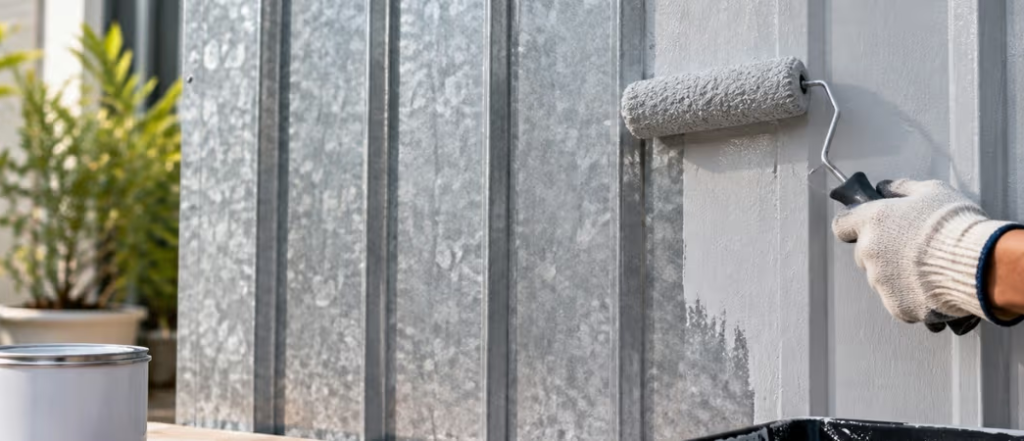
Painting galvanized steel has a reputation for failure: the paint peels off in sheets within months, often with no rust anywhere in sight. The cause is almost always the same. The smooth zinc surface was not prepared, or the primer was not made for zinc. Get the preparation and primer right and galvanized steel becomes one of the best substrates there is for paint, because the zinc underneath stops rust from creeping out from scratches.
This guide covers whether you can paint galvanized steel, why paint peels, how to identify the surface you are dealing with, how to prepare it, which primers work and which to avoid, paint systems for different environments, a step-by-step method for railings and tube, spray paint versus cold galvanizing spray, powder coating, and duplex systems. If you are new to zinc coatings, start with our guide to hot dip galvanizing.
Can You Paint Galvanized Steel?
Yes. Galvanized steel is painted routinely, for three main reasons:
- Color and appearance. Railings, fences, canopies, and frames are painted to match a building, or given a safety color in industrial plants.
- Longer life in aggressive environments. Near the coast and in heavy industrial areas, zinc is consumed faster. Paint shields the zinc so the galvanized coating lasts much longer.
- Chemical resistance. Galvanizing performs best at a pH of roughly 6 to 12. Outside that range, for example where strong acids or alkalis splash, a suitable paint system can protect the zinc.
If the only goal is rust protection in ordinary outdoor air, a thick hot dip galvanized coating does not need paint. The Galvanizers Association of Australia notes that for zinc coatings of about 300 g/m² or more, painting in most atmospheric exposures adds little except color.
Why Paint Peels Off Galvanized Steel
Four causes account for most failures:
- The surface is too smooth. Fresh galvanizing is bright and non-porous, so paint has nothing to key into.
- Invisible contamination. New galvanizing often carries oil, a passivation treatment (applied to delay white rust in storage), and dust. Pre-galvanized sheet and tube from the mill are usually oiled or passivated as well.
- White rust and zinc salts. Galvanized steel stored wet develops a white, powdery deposit. Paint applied over it comes off with it.
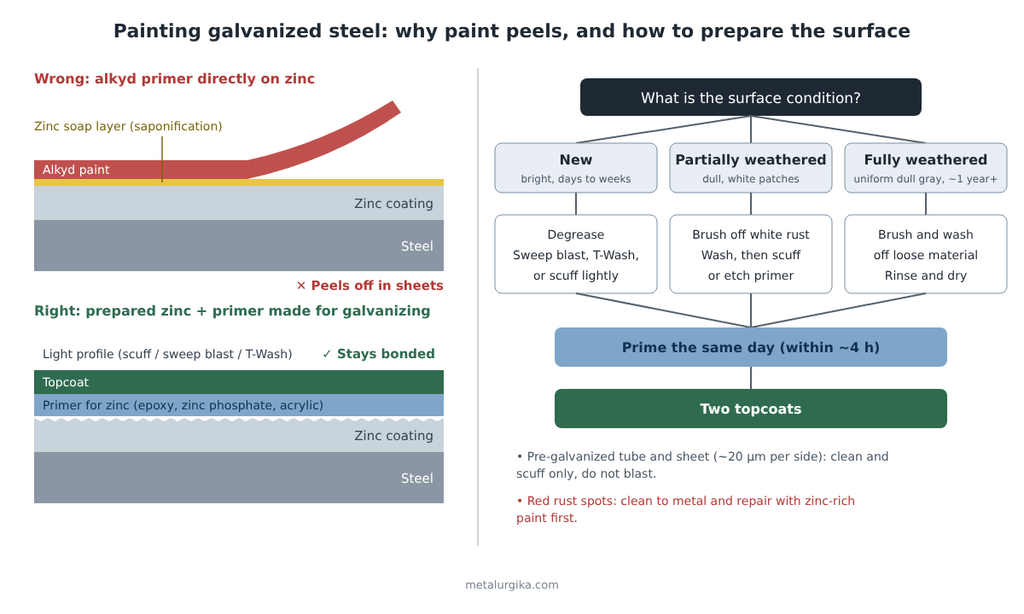
- A primer that reacts with zinc. This is the most underestimated cause. Alkyd (oil-based) paints contain oil-modified resins that react with zinc and form zinc soaps at the paint-metal interface, a process called saponification. That soap layer is weak, so the paint delaminates in sheets.
So paint peeling from galvanized steel is rarely a sign of bad galvanizing. It is a sign of inadequate preparation or the wrong primer.
Identify the Galvanized Surface First
How you prepare the surface depends on the type of coating and its condition.
By coating type:
- Hot dip galvanized (batch). Thick coatings, generally 45 µm (1.8 mils) or more, on frames, sections, poles, and railings dipped after fabrication. Suitable for sweep blasting.
- Pre-galvanized. Tube, sheet, roofing, and light-gauge pipe made from continuously galvanized strip. The coating is thin, about 20 µm (0.8 mil) per side for G90 or Z275, and usually passivated or oiled. Do not blast it, because the zinc is easily removed; clean and abrade it lightly instead.
- Electrogalvanized. A very thin, smooth zinc layer, typically on fasteners, brackets, and small parts. Treat it like pre-galvanized steel.
By surface condition:
| Condition | What it looks like | Suitable preparation |
|---|---|---|
| New | Bright, not yet dulled, days to a few weeks old | Degrease, then sweep blast or T-Wash; for pre-galvanized, clean and scuff lightly |
| Partially weathered | Dulling, with white or gray patches | Brush off white deposits, clean, then scuff or sweep blast; etch primer works well |
| Fully weathered | Uniform dull gray, typically a year or more outdoors | Brush and wash off loose material, rinse, dry; the surface already has enough profile for primer |
| Red rust present | Zinc has been consumed in that area | Remove the rust and repair with zinc-rich paint before painting |
The Galvanizers Association in the UK says natural weathering only becomes fully effective after at least six months of outdoor exposure, and it should not be relied on in marine environments with high chloride levels, where salts get trapped on the surface.
How to Prepare Galvanized Steel for Painting
Nearly every paint failure on galvanizing traces back to surface preparation. For specified work, the reference standards are ASTM D6386 (preparing hot dip galvanized steel for painting) and ASTM D7803 (preparing it for powder coating).
1. Remove oil and dirt
This step is mandatory for every type of galvanizing. Wash with a mild alkaline cleaner (pH below about 12) or a solvent, scrub with a nylon abrasive pad such as Scotch-Brite, then rinse with clean water and let it dry. If you wipe with solvent-soaked rags, change them often, since an oily rag only spreads the oil around.
Light white rust can be removed with a stiff brush. For heavy deposits, the Galvanizers Association of Australia recommends brushing with 1–2% ammonia, or in severe cases one part citric or acetic acid to 25 parts water, followed by a thorough rinse.
2. Give the surface a profile
Choose a method based on the coating and the size of the job:
- Sanding or abrasive pads. The most practical option for railings, tube, and pre-galvanized sheet. Scuff until the shine is gone and the surface looks evenly dull, without cutting through the zinc to dark gray or rusty steel.
- Sweep blasting (brush blasting). For thick hot dip galvanizing in a shop. The aim is to roughen the zinc, not remove it, using a fine abrasive softer than steel at low pressure. The Australian guidance gives about 280 kPa (40 psi), abrasive of 0.2–0.5 mm, an angle of about 45° to the surface, and a nozzle distance of 300–400 mm (12–16 in). AGA also mentions soft media such as corn cob granules. Angular iron grit must never be used. Our article on shot blasting covers blasting in general.
- T-Wash. A modified zinc phosphate solution containing a small amount of copper salt. The Galvanizers Association gives a typical formula of about 9% phosphoric acid and 1% copper carbonate, with the rest water and alcohol-based solvents. Its big advantage is that treated zinc turns dark gray to black, so any missed area is obvious. T-Wash suits new galvanizing, not weathered surfaces. Do not let it pool on horizontal surfaces, and rinse off the excess with water.
- Etch primer (wash primer, self-etching primer). A thin acidic primer that bites into the zinc. Its drawback is that there is no color change, so you can never be sure every surface has reacted. Etch primers are best suited to older, weathered galvanizing.
3. Prime promptly
Prime the prepared surface as soon as possible, ideally the same day. The Australian sample specification calls for the first coat within four hours of preparation, with the surface above 15 °C (59 °F) and at least 3 °C (5 °F) above the dew point. T-Washed surfaces are more forgiving: research cited by the Galvanizers Association found they could be painted up to 30 days later with good adhesion, provided any white salts that formed were brushed off first.
What about vinegar?
Wiping galvanized steel with vinegar before painting is still common advice online. Etching zinc with acids or aggressive salt solutions has long been discredited in professional practice, because the result is uneven and leftover zinc salts can undermine adhesion. Without T-Wash or an etch primer, it is safer to clean and scuff the surface and use a primer that is actually made for galvanizing.
Best Primer for Galvanized Steel
The rule that matters most: use a primer that its manufacturer states is suitable for galvanized steel or zinc, and follow the technical data sheet. In general:
| Primer type | Suitable for galvanizing? | Notes |
|---|---|---|
| Two-component epoxy primer | Yes, the most common industrial choice | Good adhesion and chemical resistance; about 50–100 µm (2–4 mils) per coat |
| Zinc phosphate primer | Yes, if formulated for galvanizing | Widely used as a chromate-free anticorrosive primer |
| Waterborne acrylic (acrylic latex metal primer) | Yes, for decorative work | Good for residential railings and fences; will not dry properly below about 8 °C (46 °F) |
| Etch primer, wash primer | Yes, as a thin tie coat | Must be overcoated with another primer; suits weathered galvanizing |
| Zinc-rich primer | Yes, especially for repairs | Used on welds and damaged areas, then topcoated |
| Alkyd (oil-based) primer | No, directly on zinc | Saponifies with zinc and peels |
| Zinc chromate | Adheres, technically | Contains hexavalent chromium, which is toxic; largely phased out |
An alkyd topcoat can still be used over a primer made for galvanizing, as long as the paint maker says the two are compatible. The problem is alkyd in direct contact with zinc.
Some products are sold as direct-to-galvanized or primer-and-topcoat in one. The Galvanizers Association acknowledges that a limited number of direct application products work without chemical or mechanical pretreatment. Even so, the surface must be free of oil and white rust. Read the data sheet and look for galvanizing or zinc named explicitly.
Topcoats and Paint Systems for Each Environment
The more corrosive the environment, the thicker the total paint system needs to be. The Galvanizers Association of Australia sets out systems by corrosivity. A summary:
| Use | Preparation | Example system | Total dry film thickness |
|---|---|---|---|
| Residential railings, fences, canopies inland | Degrease, light scuff | 1 coat acrylic latex metal primer + 2 coats exterior acrylic | About 70–120 µm (3–5 mils) |
| Same, longer service | Degrease, light scuff | 1 coat epoxy primer (min. 50 µm) + 1 coat acrylic topcoat | About 100–150 µm (4–6 mils) |
| Structures in moderate exposure (more than about 1 km from surf) | Degrease, sweep blast | Epoxy primer 50 µm + 2 coats two-component polyurethane or acrylic | At least 200 µm (8 mils) |
| Coastal or heavy industrial structures | Degrease, sweep blast | High-build epoxy + polyurethane | At least 350–400 µm (14–16 mils) |
Thin decorative systems may not hide the zinc spangle or the thicker zinc at edges; they can show through the paint like wood grain through a painted board. Use a higher-build system if that matters.
For repainting to keep the appearance, the same guidance gives a typical maintenance cycle of about 5–10 years for decorative systems and 10–15 years for the thicker systems.
How to Paint Galvanized Railings and Tube, Step by Step
For residential and small fabrication work:
- Finish all welding and cutting first. Weld zones have lost their zinc. Remove slag and spatter, then apply zinc-rich paint over the welds and cut edges. Repair after welding is covered in our guide to welding galvanized steel.
- Wash the whole surface. Use water with detergent or an alkaline cleaner, scrub with an abrasive pad, rinse, and dry. Do not skip this even if the steel looks clean.
- Scuff lightly. Use fine sandpaper (about 180–240 grit) or an abrasive pad until the shine is gone evenly. Do not cut through the zinc.
- Remove the sanding dust. Wipe with a clean, slightly damp cloth or blow off with compressed air.
- Apply a primer made for galvanizing. Epoxy, zinc phosphate, or acrylic metal primer, according to the data sheet. One thin, even coat is better than one heavy coat that sags.
- Respect the recoat window on the can. Recoating too soon leaves the primer uncured; waiting too long with epoxy can reduce intercoat adhesion.
- Apply two topcoats. Use a paint compatible with the primer, ideally from the same manufacturer.
- Avoid hot or damp conditions. Do not paint steel that is hot from direct midday sun, or during rain or morning dew.
For pre-galvanized tube, think about the inside too. Cap the ends so water cannot get in and consume the zinc from the inside.
Spray Paint for Galvanized Metal vs Cold Galvanizing Spray
Two kinds of aerosol products have confusingly similar names:
- Spray paint for galvanized metal. Decorative paint in a spray can, formulated to bond to zinc, usually acrylic or similar. It adds color.
- Cold galvanizing spray. Actually a zinc-rich paint: zinc dust in a binder, gray in color. It repairs damaged galvanizing and welds rather than adding color. It is not equivalent to hot dip galvanizing, but it does give sacrificial protection as long as its zinc content is high enough. ASTM A780 covers repairing galvanizing with zinc-rich paint.
Zinc-rich paint can be topcoated with a compatible paint. Avoid putting an alkyd directly over it, for the same reason as with galvanizing itself.
Powder Coating Galvanized Steel
Powder coating, in which electrostatically charged powder is sprayed on and then cured in an oven, works well over galvanizing and is widely used for railings, fencing, and outdoor furniture. It gives a thick, even film with no solvents.
The characteristic problem is outgassing: moisture and gases trapped in the zinc coating escape during curing and leave pinholes or blisters in the powder film. AGA explains that this is why ASTM D7803 includes thermal pretreatment: the galvanized part is baked before powder is applied so the gases come out first. ASTM D6386, the painting standard, has no such step. Heavily spangled galvanizing is more prone to outgassing.
Practical points:
- Tell the galvanizer up front that the work will be powder coated, so cooling and post-treatment (such as water quenching or passivation) can be agreed with the powder coater.
- Preheat temperature: a common rule of thumb in the powder coating industry is to degas the parts at roughly 25 °F (about 15 °C) above the powder’s cure temperature, let them cool, and apply the powder while the part is still slightly warm. Follow the powder supplier’s instructions.
- Pretreatment: usually a conversion coating (phosphate or similar) and/or a light sweep blast, as the powder supplier specifies. D7803 does not allow some of the chemical treatments that D6386 permits for liquid paint.
- Powder choice: use a polyester powder for outdoor exposure. The Australian guidance calls for a cured thickness of at least about 70 µm (2.8 mils).
- Scope: ASTM D7803 does not cover continuously galvanized sheet. Pre-galvanized tube and sheet can still be powder coated, following the powder supplier’s procedure.
- Outgassing-forgiving (OGF) powders and degassing additives exist and help, but they are not a substitute for preheating.
For aluminum, the finish most often compared with powder coating is anodizing.
Duplex Systems: Why Galvanizing Plus Paint Lasts So Long
Galvanizing plus paint or powder coating is called a duplex system. The paint shields the zinc from the environment, so the zinc corrodes far more slowly. When the paint eventually breaks down, the zinc still protects the steel, including at scratches, so rust cannot creep under the paint as it does on bare steel.
According to the American Galvanizers Association, a duplex system lasts about 1.5 to 2.5 times the sum of the lives of the galvanizing and the paint used separately. This is known as the synergistic effect. For example, if galvanizing alone would last 20 years and paint alone 10 years in the same environment, the duplex system could last about 45–75 years.
Galvanizing protects steel differently from paint. For a comparison of rust prevention methods, see how to prevent corrosion in metals.
Repainting Galvanized Steel with Peeling Paint
If old paint is peeling off galvanized steel:
- Remove all loose paint. Use a scraper and a stainless or nylon brush. Well-adhered paint can stay, but feather the edges with sandpaper.
- Look underneath. A white or powdery layer under the lifted paint usually means saponification or white rust. Clean back to sound zinc.
- Repair red rust. Red rust means the zinc is gone in that spot. Clean it back to metal and apply zinc-rich paint.
- Repaint following the steps above, with a primer made for galvanizing, not an alkyd directly on zinc.
Common Mistakes
| Mistake | Result | What to do instead |
|---|---|---|
| Painting new galvanizing without cleaning and scuffing | Paint peels within months | Degrease, scuff or sweep blast, then a primer made for zinc |
| Alkyd or oil-based primer directly on zinc | Zinc soaps form and paint delaminates | Epoxy, zinc phosphate, or acrylic metal primer |
| Blasting with angular iron grit or high pressure | Zinc coating removed or damaged | Sweep blast with fine, soft media at low pressure |
| Painting over white rust | Paint lifts with the zinc deposits | Brush and wash the deposits off first |
| Waiting too long after preparation | Surface recontaminated, adhesion drops | Prime the same day |
| Using cold galvanizing spray as a color coat | Dull gray finish, not what was wanted | Use zinc-rich paint for repairs, then a topcoat for color |
| Powder coating without preheating | Pinholes and blisters | Thermal pretreatment per ASTM D7803 |
Frequently Asked Questions
Can you paint galvanized steel? Yes. Clean off oil and white rust, give the surface a light profile by scuffing, sweep blasting, T-Wash, or etch primer, then use a primer formulated for galvanizing. Avoid alkyd primers directly on zinc.
What is the best primer for galvanized steel? A two-component epoxy primer for industrial work, a zinc phosphate primer formulated for galvanizing, or an acrylic latex metal primer for decorative work. An etch primer can be used as a tie coat. The best choice is whichever the paint maker specifically approves for zinc.
Why does paint peel off galvanized steel? Usually because the surface was not cleaned and scuffed, because white rust or passivation residue was left on it, or because an alkyd primer reacted with the zinc and formed a weak layer of zinc soaps.
Do you need to sand galvanized steel before painting? On new, smooth galvanizing, yes: a light scuff with fine sandpaper or an abrasive pad after cleaning, unless you use T-Wash, an etch primer, or a direct-to-galvanized product. Do not sand through the zinc, and do not blast thin pre-galvanized tube.
Can you powder coat galvanized steel? Yes. The parts should be preheated (degassed) before powder is applied to prevent outgassing, and the galvanizer should be told in advance. ASTM D7803 covers the procedure.
Conclusion
Painting galvanized steel successfully comes down to two things: surface preparation and the primer. Remove oil and white rust, give the zinc a profile with sanding, sweep blasting, T-Wash, or an etch primer, and use a primer made for zinc rather than an alkyd. Match the thickness of the paint system to the environment. Done properly, galvanizing and paint protect each other in a duplex system that lasts far longer than either alone.
Related Articles
- Hot Dip Galvanizing: Process, Coating Thickness, Standards, and Galvanized vs Galvalume
- Welding Galvanized Steel: Can You Weld It, MIG and Stick Techniques, Zinc Fumes, and Coating Repair
- How to Prevent Corrosion in Metals
- Types of Metal Corrosion
- Shot Blasting: Process, Machine Types, Media, and Cleanliness Standards

Dagus R. Djuanda is a metallurgical engineer with more than 20 years of experience in materials engineering, specializing in magnetic materials. He holds a master’s degree in magnetic materials engineering, is a doctoral candidate in industrial engineering, and works as an engineer at the Ministry of Industry of the Republic of Indonesia. Founder of Metalurgika.