CF8M is the most widely used cast stainless steel grade in industry. Its chemistry is equivalent to 316 stainless steel, and it is the material behind most stainless ball valves, gate valves, pump casings, impellers, and cast fittings on the market. If a valve body is marked “CF8M”, it was cast from 316-type stainless steel rather than machined from plate or bar.
This guide explains what cast stainless steel is, how to read codes such as CF8M and CF3M, the composition and properties of CF8M, how it compares with CF8, CF3M, and wrought 316, the standards that cover it, how stainless steel casting works, heat treatment, welding, and how to choose the right grade. For an overview of stainless steel families in general, see our guide to types of stainless steel.
What Is Cast Stainless Steel?
Cast stainless steel is stainless steel that is melted and poured into a mold rather than rolled into plate or forged into bar. Casting is chosen for parts with complex, hollow, or uneven shapes, such as valve bodies and pump casings, which would be difficult and expensive to make from wrought material. Stainless steel castings are a branch of high-alloy steel casting.
Cast grades have chemistries similar to their wrought counterparts, but not identical. There are two important differences:
- Wider composition ranges. CF8M may contain 18–21% chromium, compared with 16–18% for wrought 316. The higher chromium helps offset the segregation (uneven composition) that always occurs as metal solidifies in a mold.
- Ferrite. Wrought 304 and 316 are almost fully austenitic. Cast austenitic grades such as CF8 and CF8M are deliberately balanced to contain about 5–20% delta ferrite, distributed as small pools in the austenite. The ferrite makes castings more resistant to hot cracking during solidification and welding, and it also raises strength and resistance to stress corrosion cracking.
Because of this ferrite, CF8M can be slightly magnetic. That is normal and not a sign of a counterfeit material.
What Does CF8M Mean? (The ACI Designation System)
Codes such as CF8M, CF3M, and HK come from the Alloy Casting Institute (ACI) designation system, which ASTM adopted. Each letter and number has a meaning:
- First letter, type of service. C means alloys for liquid corrosion service (corrosion resistant). H means alloys for high-temperature service (heat resistant).
- Second letter, chromium-nickel type. The higher the nickel content, the further along the alphabet. A means almost no nickel (as in CA15, similar to 410), F means the roughly 19% Cr and 9% Ni family (equivalent to 304/316), and K means much higher nickel (as in CK3MCuN and HK).
- Number, maximum carbon. The number is the maximum carbon content multiplied by 100. CF8M has 0.08% C max; CF3M has 0.03% C max.
- Suffix letters, added elements. M means molybdenum, C means niobium (columbium), Cu means copper, and N means nitrogen.
So CF8M reads as: corrosion resistant (C), 19Cr-9Ni type (F), 0.08% maximum carbon (8), with molybdenum (M).
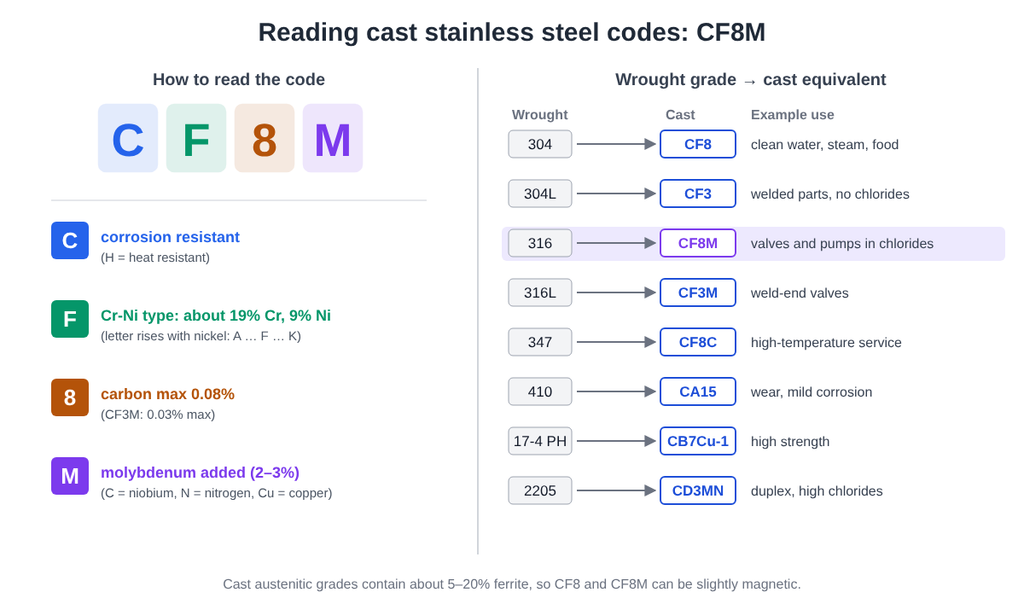
Common Cast Stainless Steel Grades and Their Equivalents
| Cast grade (ASTM) | Closest wrought equivalent | Cr (%) | Ni (%) | Mo (%) | C max (%) | EN / JIS equivalent |
|---|---|---|---|---|---|---|
| CF8 | 304 | 18–21 | 8–11 | – | 0.08 | 1.4308 (GX5CrNi19-10) / SCS13 |
| CF3 | 304L | 17–21 | 8–12 | – | 0.03 | 1.4309 (GX2CrNi19-11) / SCS19A |
| CF8M | 316 | 18–21 | 9–12 | 2–3 | 0.08 | 1.4408 (GX5CrNiMo19-11-2) / SCS14 |
| CF3M | 316L | 17–21 | 9–13 | 2–3 | 0.03 | 1.4409 (GX2CrNiMo19-11-2) / SCS16A |
| CF8C | 347 | 18–21 | 9–12 | – | 0.08 | 1.4552 (GX5CrNiNb19-11) |
| CA15 | 410 | 11.5–14 | 1 max | 0.5 max | 0.15 | – |
| CA6NM | 13Cr-4Ni (no AISI equivalent) | 11.5–14 | 3.5–4.5 | 0.4–1.0 | 0.06 | 1.4317 (GX4CrNi13-4) |
| CB7Cu-1 | 17-4 PH | 15.5–17.7 | 3.6–4.6 | – | 0.07 | – |
| CD4MCuN, CD3MN | Duplex (2205 for CD3MN) | 21–26.5 | 4.5–6.5 | 1.7–3.5 | 0.03–0.04 | 1.4470 (GX2CrNiMoN22-5-3) for CD3MN |
| CK3MCuN | 254 SMO (superaustenitic) | 19.5–20.5 | 17.5–19.5 | 6–7 | 0.025 | – |
| HK | 310 (heat resistant) | 24–28 | 18–22 | 0.5 max | 0.20–0.60 | – |
The EN and JIS grades in the table are the closest matches, not always identical. EN 1.4408, for example, limits molybdenum to 2.0–2.5% and chromium to 18–20%, slightly narrower than CF8M. When ordering, give the full standard and grade, such as “ASTM A351 CF8M”.
Cast duplex and super duplex grades (CD4MCuN, CD3MN, CE3MN) are covered in more detail in our guide to duplex stainless steel.
CF8M Composition and Properties
ASTM A351 specifies the following composition for CF8M:
| Element | Content (%) |
|---|---|
| Carbon (C) | 0.08 max |
| Chromium (Cr) | 18.0–21.0 |
| Nickel (Ni) | 9.0–12.0 |
| Molybdenum (Mo) | 2.0–3.0 |
| Silicon (Si) | 1.50 max |
| Manganese (Mn) | 1.50 max |
| Phosphorus (P) | 0.04 max |
| Sulfur (S) | 0.04 max |
Minimum mechanical properties (ASTM A351, solution annealed): tensile strength 485 MPa (70 ksi), yield strength 205 MPa (30 ksi), and elongation 30%. Typical data-sheet values sit a little above these minimums, for example tensile strength around 540 MPa (79 ksi), yield around 290 MPa (42 ksi), and hardness around 170 HB.
Corrosion resistance. The 2–3% molybdenum gives CF8M far better resistance to pitting and crevice corrosion than CF8, especially in chloride environments such as seawater, brackish water, and brine. The pitting resistance equivalent number (PREN) of CF8M is about 26, compared with about 19 for CF8. Pitting and PREN are explained in our article on pitting corrosion. Like 316, CF8M can still suffer chloride stress corrosion cracking at elevated temperature, although its ferrite helps somewhat (see stress corrosion cracking).
Service temperature. CF8M is used from cryogenic temperatures up to about 538 °C (1,000 °F) for pressure-containing parts. Above about 315 °C (600 °F), long exposure can embrittle its ferrite (see the heat treatment section below).
CF8 vs CF8M vs CF3M
| Aspect | CF8 | CF8M | CF3M |
|---|---|---|---|
| Wrought equivalent | 304 | 316 | 316L |
| Molybdenum | None | 2–3% | 2–3% |
| Maximum carbon | 0.08% | 0.08% | 0.03% |
| PREN (approx.) | 19 | 26 | 26 |
| Chloride resistance | Limited | Good | Good |
| Resistance to sensitization after welding | Low | Low | Good |
| Typical use | Clean water, steam, food, mild chemicals | Seawater, chemicals, offshore oil and gas, pharmaceuticals | Weld-end valves, parts to be welded or weld-repaired |
CF8 or CF8M? The choice mirrors 304 vs 316 stainless steel: CF8 is adequate for clean water, steam, food, and mild chemicals without chlorides. Where there are chlorides, seawater, or a risk of pitting and crevice corrosion, choose CF8M.
CF8M or CF3M? CF3M is the low-carbon version. Low carbon reduces chromium carbide precipitation at grain boundaries during welding (sensitization), so CF3M is chosen for butt-weld and socket-weld end valves and for parts that will be weld-repaired without re-annealing. In practice, many foundries now pour CF8M with carbon below 0.03%, so it can be dual certified as CF8M/CF3M.
Is CF8M the same as 316?
Equivalent, but not identical. The chemistries are similar, corrosion resistance is comparable, and the two are routinely used together, for example a CF8M valve body with ASTM A182 F316 forged flanges and ASTM A312 TP316 pipe. The differences:
- CF8M has a higher chromium range (18–21% vs 16–18%) and slightly lower nickel (9–12% vs 10–14%).
- CF8M contains 5–20% ferrite, while wrought 316 is almost fully austenitic, so CF8M can be slightly magnetic.
- The standards differ: CF8M is for castings (ASTM A351, A743, A744), while 316 is for plate, bar, and pipe (ASTM A240, A276, A312, and others).
Cast Stainless Steel Standards
| Standard | Scope | Notes |
|---|---|---|
| ASTM A351 / ASME SA-351 | Austenitic castings for pressure-containing parts | The most common for valve bodies, pumps, and pressure fittings; includes tensile and inspection requirements |
| ASTM A743 | Corrosion-resistant castings for general application | Not intended for pressure-containing parts; tensile testing only as a supplementary requirement |
| ASTM A744 | Corrosion-resistant castings for severe service | Stricter requirements for highly corrosive environments |
| ASTM A890 / A995 | Duplex castings | A995 for pressure-containing parts |
| ASTM A747 | Precipitation-hardening stainless castings | Includes CB7Cu-1 (cast 17-4 PH) |
| ASTM A297 | Heat-resistant castings | H grades such as HH and HK |
| EN 10213 | Steel castings for pressure purposes, including stainless | 1.4308, 1.4408, 1.4409, and others |
| JIS G 5121 | Japanese stainless castings | SCS13, SCS14, SCS16A, SCS19A |
The same grade, such as CF8M, can appear in A351, A743, and A744 with almost the same chemistry. What differs is the intended service and the testing requirements. For valves and pressure parts, specify A351.
How Stainless Steel Casting Works
Stainless steel casting follows the general steel casting route, with some differences because of the high chromium content.
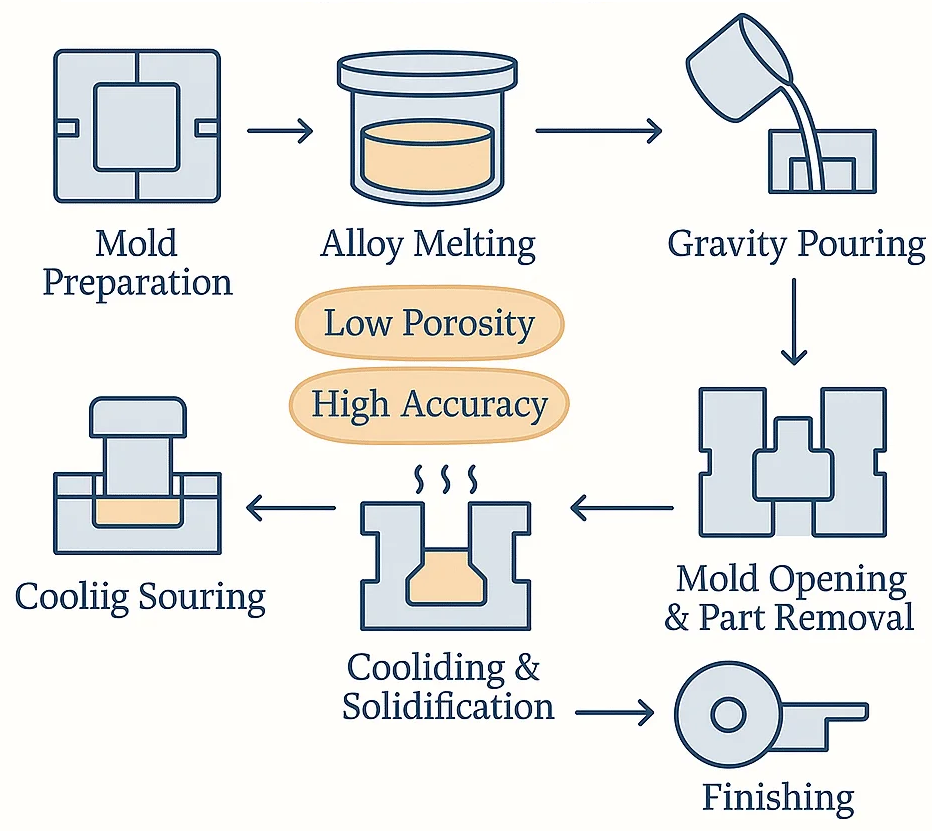
- Melting. Stainless is melted in an induction furnace, or in an electric arc furnace followed by refining in an AOD (argon oxygen decarburization) converter to lower carbon without burning off chromium. Furnace types are covered in our article on melting furnaces.
- Adjusting chemistry and ferrite. The balance of ferrite formers (chromium, molybdenum, silicon) and austenite formers (nickel, carbon, nitrogen, manganese) is adjusted to hit the target ferrite content.
- Pouring. Austenitic stainless is typically poured at about 1,550–1,650 °C (2,820–3,000 °F), depending on wall thickness and molding method. Chromium oxidizes readily, so slag control and smooth metal flow matter to avoid oxide inclusions.
- Solidification and shakeout.
- Removing gates and risers, usually by grinding or plasma cutting.
- Solution annealing and water quenching.
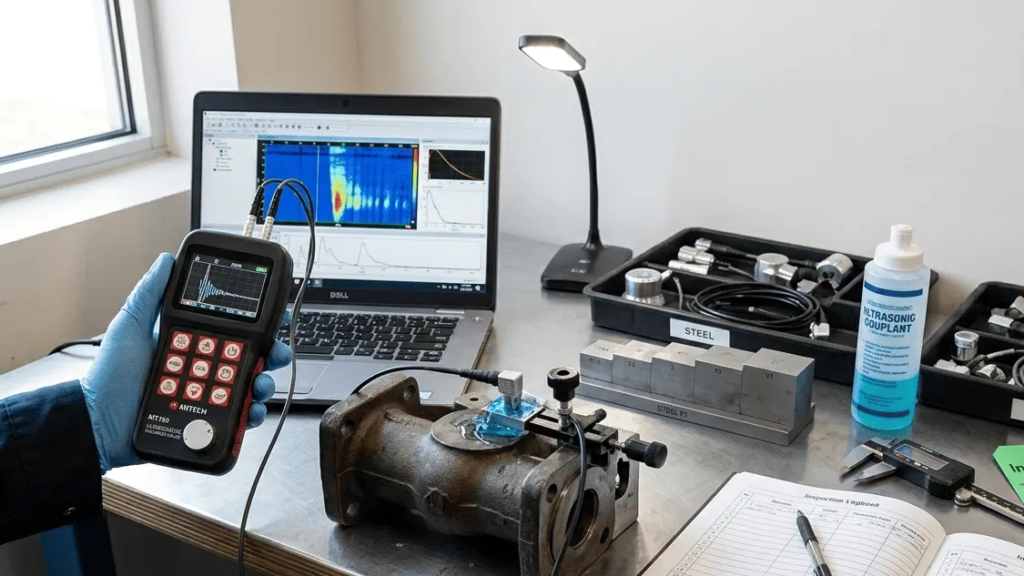
- Cleaning, machining, and inspection, including pressure testing for valves and NDT methods such as radiography or dye penetrant.
- Pickling and passivation to restore the passive film, as explained in our guide to passivation of stainless steel.
Molding methods
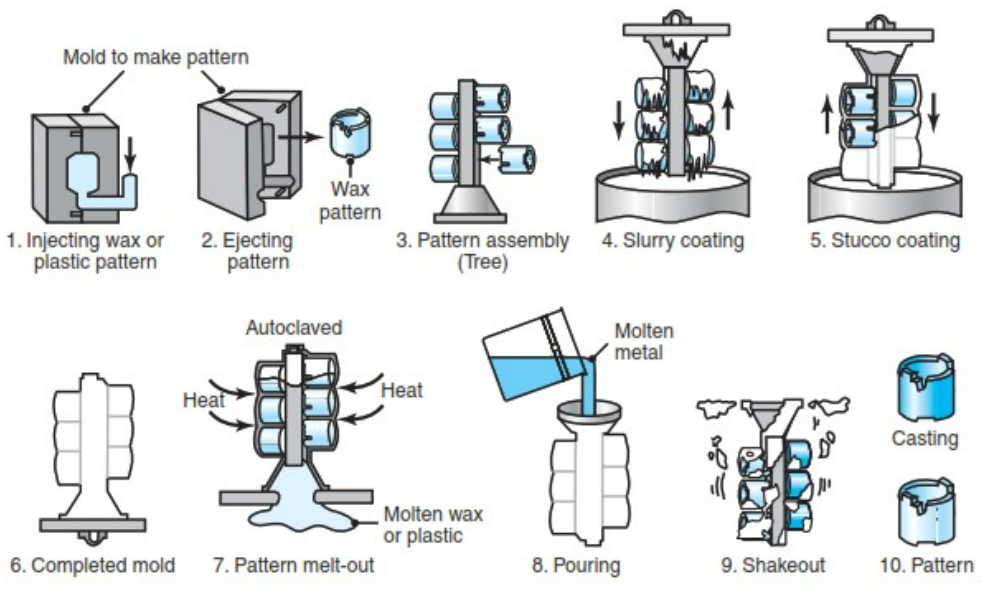
- Investment casting (lost wax). A wax pattern is coated in ceramic, the wax is melted out, and metal is poured into the ceramic shell. The result is a smooth surface and close tolerances, suited to small valves, impellers, and fittings. Most small stainless ball valves are made this way.
- Sand casting. Used for large parts such as pump casings and large valve bodies. Zircon or chromite sand is often used at the mold face because of its high-temperature resistance.
- Centrifugal casting. For cylindrical parts such as pipe, rings, and sleeves.
- Die casting is almost never used for stainless steel, because its melting point is too high for metal dies.
The trade-offs between these methods are covered in sand vs die vs investment casting.
Typical defects in stainless castings
- Hot tears. Occur when ferrite is too low or the design restrains shrinkage. Austenitic stainless has fairly high shrinkage, so riser design and fillets need attention. Causes and prevention are covered in casting porosity and hot tearing.
- Gas and shrinkage porosity. Mainly in isolated heavy sections.
- Chromium oxide inclusions. Slag or oxide skins carried into the mold.
- Off-target ferrite. Too high makes the casting prone to embrittlement at intermediate temperatures; too low raises the risk of hot cracking.
Heat Treatment and the Role of Ferrite
Almost all austenitic castings such as CF8M must be solution annealed: heated to at least about 1,040 °C (1,900 °F), held until uniform, then rapidly quenched in water. This redissolves the chromium carbides and sigma phase that form during slow cooling in the mold. Without solution annealing, the casting’s corrosion resistance can fall well short of expectations.
Ferrite helps during casting and welding, but it has drawbacks at intermediate temperatures:
- Above about 315 °C (600 °F), long exposure can embrittle the ferrite (475 °C embrittlement), lowering toughness.
- Between 425 and 650 °C (800–1,200 °F), chromium carbides tend to precipitate at the edges of ferrite pools, which can lead to intergranular corrosion.
For long service at elevated temperature, designers therefore limit ferrite content or choose another grade.
Welding and Weld Repair of CF8M
CF8M welds readily and needs no preheat. Points to watch:
- Filler metal: 316L (ER316L, E316L) for CF8M and CF3M, 308L for CF8 and CF3. Filler selection and stainless welding technique are covered in our guide to welding stainless steel.
- Low heat input and controlled interpass temperature reduce sensitization and distortion.
- Re-solution annealing after welding gives CF8M the best corrosion resistance. Where that is not possible, specify CF3M from the start.
- Foundry weld repair of casting defects is governed by ASTM A488 (procedure and welder qualification). General practice is covered in repair welding of metal castings.
Applications and What Valve Markings Mean
CF8M is used for:
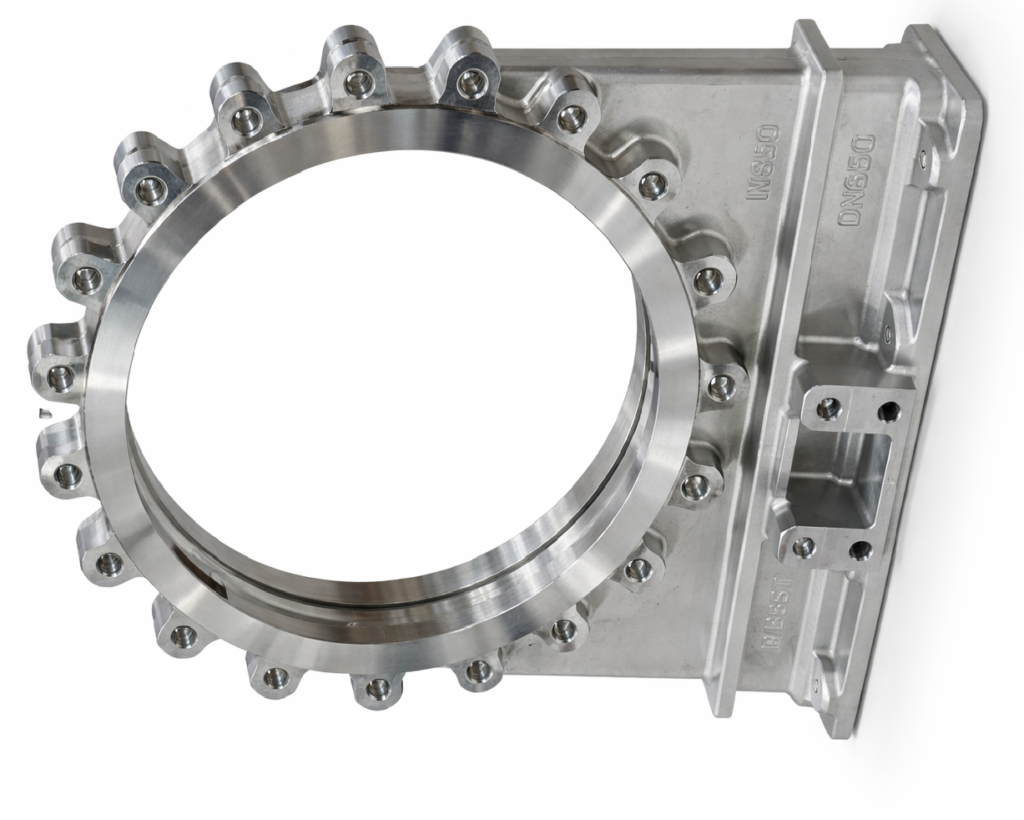
- bodies and bonnets of ball, gate, globe, butterfly, and check valves,
- pump casings and impellers,
- cast fittings and flanges,
- marine and offshore components,
- chemical, food, beverage, and pharmaceutical equipment.
Stainless valve bodies are often marked “CF8M 1000 WOG” or “CF8M 1000 CWP PN63”:
- CF8M is the body material, cast 316-type stainless steel. CF8 means cast 304-type.
- WOG (water, oil, gas) is an older marking meaning the valve is suitable for water, oil, and gas; the number is the working pressure in psi. 1000 WOG means about 1,000 psi (about 69 bar).
- CWP (cold working pressure) is the maximum working pressure at ambient temperature, about −29 to 38 °C (−20 to 100 °F). 1000 CWP means 1,000 psi in that range.
- PN is the nominal pressure in bar, for example PN63 for 63 bar.
The allowable pressure falls as temperature rises, so for steam or hot liquids check the manufacturer’s pressure-temperature chart.
How to Choose a Cast Stainless Grade
| Service | Grade commonly chosen |
|---|---|
| Clean water, steam, food, mild chemicals without chlorides | CF8 |
| Seawater, brackish water, brine, chemicals, pharmaceuticals | CF8M |
| Parts to be welded or weld-repaired | CF3M (or CF8M dual certified as CF3M) |
| High chlorides, warm seawater, high pressure | Cast duplex (CD3MN, CE3MN) |
| Strong acids and very aggressive chlorides | Superaustenitic (CK3MCuN) |
| High strength and wear resistance, mild corrosion | CA15, CA6NM, CB7Cu-1 |
| Very high temperature (furnace parts, heat treatment fixtures) | H grades such as HK |
Common Mistakes
- Assuming a slightly magnetic CF8M part is fake. Its 5–20% ferrite makes it weakly magnetic. To confirm the material, ask for the mill certificate or run an XRF check.
- Ordering “316 stainless” for a cast part. Specify the cast grade, for example ASTM A351 CF8M.
- Field welding CF8M without re-annealing for severe corrosive service. Choose CF3M if the part will be welded.
- Using A743 for pressure parts. For valves and pressure vessels, specify A351.
- Using CF8 in chloride service, which leads to pitting.
- Skipping passivation after machining and cleaning, which leads to rust staining from iron contamination.
Frequently Asked Questions
What is CF8M? CF8M is an austenitic cast stainless steel equivalent to 316, with 18–21% chromium, 9–12% nickel, 2–3% molybdenum, and 0.08% maximum carbon. It is covered by ASTM A351, A743, and A744 and is used mainly for valve bodies, pump casings, and fittings.
Is CF8M the same as 316 stainless steel? Equivalent, but not identical. CF8M is the cast version of 316, with a higher chromium range and 5–20% ferrite. Corrosion resistance is comparable, and the two are often used together in the same piping system.
Is CF8M magnetic? Slightly. The delta ferrite in the casting makes CF8M weakly magnetic. This is normal and does not mean the material is not stainless.
What is the difference between CF8M and CF3M? CF3M is the low-carbon version (0.03% max), equivalent to 316L. It resists sensitization after welding, so it is chosen for weld-end valves and parts that will be weld-repaired.
What does 1000 WOG mean on a CF8M valve? WOG stands for water, oil, gas. The number is the rated working pressure in psi, so 1000 WOG means about 1,000 psi (69 bar) at ambient temperature. CF8M is the body material, cast 316-type stainless steel.
Conclusion
CF8M is the cast equivalent of 316 stainless steel and the standard material for valves, pumps, and fittings in corrosive service. Its code is easy to read with the ACI system: C for corrosion resistant, F for the 19Cr-9Ni type, 8 for 0.08% maximum carbon, and M for molybdenum. Compared with wrought 316, CF8M has a higher chromium range and contains ferrite, which makes it more resistant to hot cracking but slightly magnetic. Choose CF8 where there are no chlorides, CF8M for chloride service, CF3M for parts that will be welded, and make sure castings are solution annealed and passivated for the best corrosion resistance.
Related Articles
- Types of Stainless Steel: Austenitic, Ferritic, Martensitic, Duplex, and Common Grades
- Steel Casting: Types, Grades, Process, and Cast Steel vs Cast Iron vs Forged Steel
- 304 vs 316 Stainless Steel (and 201): Composition, Corrosion Resistance, Cost, and How to Choose
- Duplex Stainless Steel: 2205, Super Duplex 2507, Properties, Welding, and Duplex vs 316
- Sand Casting vs Die Casting vs Investment Casting

Dagus R. Djuanda is a metallurgical engineer with more than 20 years of experience in materials engineering, specializing in magnetic materials. He holds a master’s degree in magnetic materials engineering, is a doctoral candidate in industrial engineering, and works as an engineer at the Ministry of Industry of the Republic of Indonesia. Founder of Metalurgika.