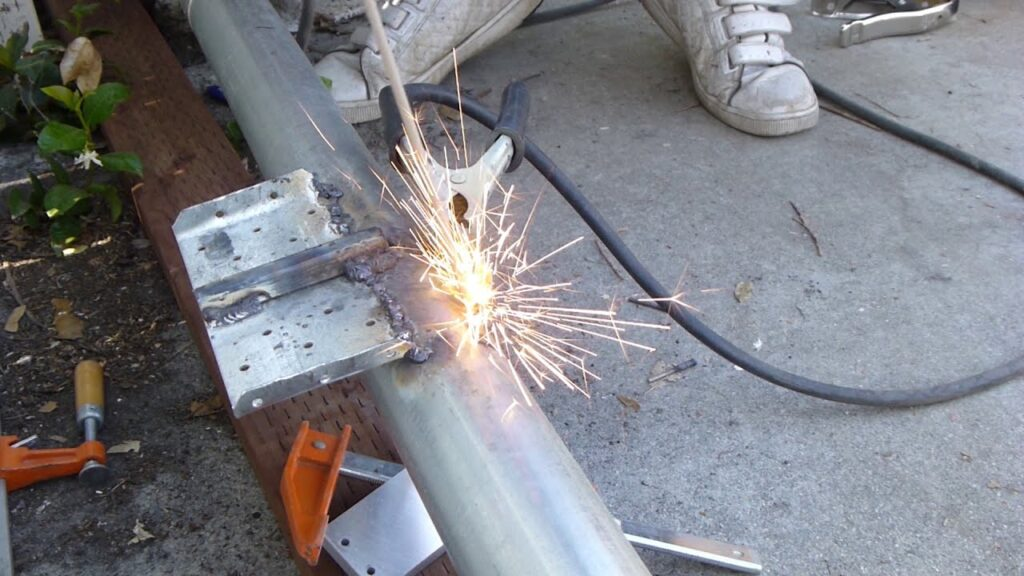
Welding galvanized steel is routine work in fabrication shops: handrails, fence panels, pipe supports, trailer frames, and structural members that were galvanized before they reached the site. The short answer to the most common question is yes, galvanized steel can be welded, and the weld can be as strong as a weld on bare steel. The difficulty is the zinc. Zinc boils at about 907 °C (1,665 °F), long before steel melts, so at the joint the coating turns into vapor and white fume that disturbs the arc, causes porosity, and can make the welder ill.
This guide covers what happens to the zinc when you weld, when to grind the coating off, which processes work best, how to choose filler wire and electrodes, technique for thin sheet and tube, welding galvanized steel to bare steel and to stainless steel, zinc fume fever, how to repair the coating afterwards, and why welding before galvanizing gives the best result. For background on the coating itself, see our guide to hot dip galvanizing.
Can You Weld Galvanized Steel?
Yes. Galvanized steel is ordinary low-carbon steel with a zinc coating, and the steel underneath welds like any other mild steel. The Galvanizers Association (UK and Ireland) cites tests at The Welding Institute (TWI), sponsored by ILZRO, showing that high-quality welds can be made on hot dip galvanized steel with tensile, bend, and fatigue properties virtually identical to welds on uncoated steel. The American Galvanizers Association (AGA) says the same for tensile, bend, and impact properties.
The condition is that the joint is made correctly. Welding speeds are usually slower, there is more spatter, and the coating next to the weld is destroyed. The only real difference between welding galvanized steel and welding bare steel is how you deal with the zinc.
The same applies to zinc-plated (electrogalvanized) steel and pre-galvanized sheet and tube. Their coatings are much thinner than batch hot dip galvanizing, so they give off less fume, but the same rules apply.
What Happens When You Weld Galvanized Steel
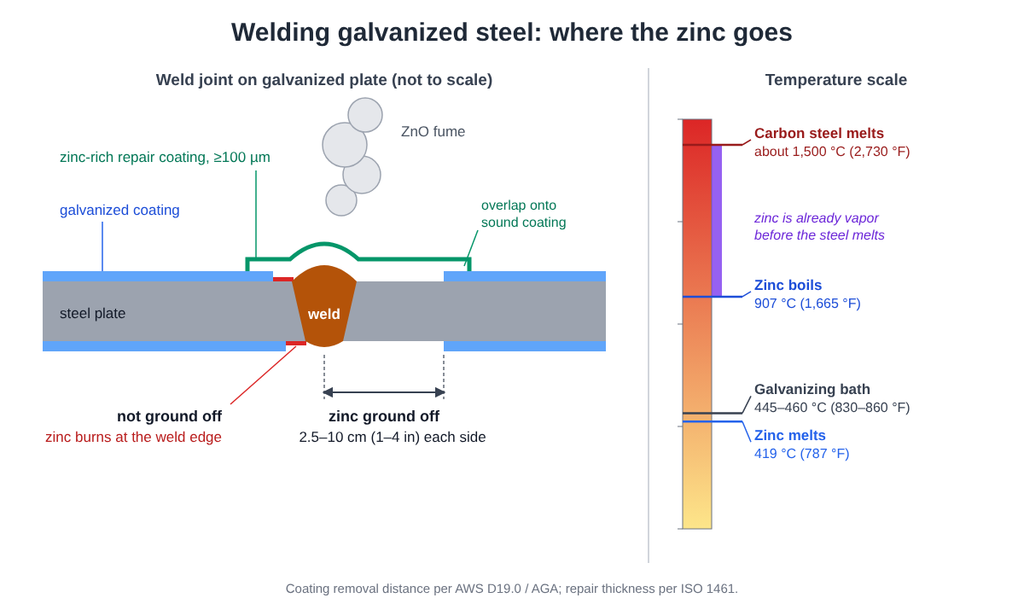
Zinc melts at about 419 °C (787 °F) and boils at about 907 °C (1,665 °F). Carbon steel melts at around 1,500 °C (2,730 °F), and the weld pool is hotter still. So the zinc around the joint is boiling well before the steel underneath begins to melt. The consequences:
- White zinc oxide fume. Zinc vapor reacts with air to form dense zinc oxide fume, the cause of metal fume fever (covered below).
- Porosity. Zinc vapor trapped in the weld pool leaves gas pores. The risk is highest in lap joints and T-joints, where vapor is trapped between the plates. It is the same gas porosity described in our article on casting porosity and hot tearing.
- Spatter and an unstable arc. Zinc vapor makes the arc wander, especially with straight CO₂ shielding.
- Reduced penetration. Some of the heat goes into vaporizing zinc, so penetration on galvanized steel tends to be shallower than on bare steel at the same settings.
- Cracking risk. Molten zinc drawn into the weld metal or heat-affected zone can penetrate grain boundaries and cause cracking, particularly in highly restrained joints, high-strength steels, and high-silicon weld metal. That is why the AWS specification for welding zinc-coated steel (AWS D19.0) calls for welds to be made on zinc-free steel.
- Coating damage around the weld. The zinc is burned off along the weld and a few millimeters either side. Unrepaired, that strip is the first place to rust.
Should You Remove the Zinc Coating First?
For structural joints and any load-bearing weld, yes. Following AWS D19.0, the AGA recommends removing the zinc at least 1 to 4 in (2.5–10 cm) from either side of the intended weld, on both faces of the steel. Grinding with a flap disc or sanding disc down to bright steel is the most effective method.
Removing the coating:
- greatly reduces fume,
- gives a stable arc with little spatter,
- practically eliminates zinc-related porosity and cracking,
- lets you use the same procedure as for bare steel.
Some jobs are welded without removing the coating, for example light fence or shelving work in pre-galvanized sheet or tube with a thin coating (about 20 µm per side). That can work if you slow down so the zinc burns off ahead of the pool, ventilate well, and check the weld for porosity. On batch hot dip galvanized steel with 70 µm or more of zinc, welding through the coating almost always gives a poor weld.
Choosing a Welding Process
MIG/MAG welding (GMAW)
MIG welding galvanized steel is the most common approach. The continuous arc and adjustable travel speed give the zinc time to vaporize ahead of the weld pool.
- Straight CO₂ is cheap and penetrates well, but produces the most spatter on galvanized steel.
- Argon/CO₂ mixes (for example Ar + 15–25% CO₂) give a smoother arc and less spatter.
- Travel a little slower than on bare steel, especially if the coating has not been removed.
Stick welding (SMAW)
Stick welding galvanized steel works too. The Galvanizers Association of Australia recommends manual metal arc welding only for galvanized steel 1.6 mm (about 1/16 in) thick or more, because thinner gauges burn through easily. Both rutile electrodes such as E6013 and low-hydrogen electrodes (E7016, E7018) can be used, provided a test weld is made first.
Technique: hold the arc briefly at the front of the pool, or use a slight forward whip, so the zinc ahead of the pool burns off before the bead advances, then continue as for bare steel. Remove all slag afterwards.
TIG welding (GTAW)
TIG is a poor fit for galvanized steel. Zinc vapor contaminates the tungsten and degrades the arc quickly, and the slow weld pool gives zinc vapor time to become trapped. If you must TIG weld galvanized steel, remove the coating completely.
Spot welding and MIG brazing for thin sheet
Thin galvanized sheet, such as car body panels, is widely joined by resistance spot welding; welded wire mesh is made the same way. In galvanized high-strength steels, spot welding can trigger liquid metal embrittlement cracking, which has become a major research topic in the automotive industry.
MIG brazing uses a silicon bronze wire (CuSi3) that melts at around 1,000 °C (1,830 °F), well below the melting point of steel. The steel does not melt, heat input is lower, and less zinc is burned off around the joint. It is widely used in body shops for thin galvanized sheet.
Welding Wire and Rods for Galvanized Steel
There is no “galvanized” filler with a special chemistry. What you are welding is mild steel, so the filler is mild steel filler. The questions are how well it copes with zinc vapor and whether the part will be galvanized after welding.
| Filler | Process | When to use | Notes |
|---|---|---|---|
| ER70S-6 | MIG/MAG | Most common for already-galvanized steel | Higher silicon and manganese deoxidize the pool and reduce porosity |
| ER70S-3 | MIG/MAG | Parts to be galvanized after welding | Lower silicon, so the coating over the weld does not grow too thick |
| E6013 (rutile) | Stick | 1.6 mm (1/16 in) and thicker, general work | Soft arc, easy to use, slag must be fully removed |
| E7016, E7018 (low hydrogen) | Stick | Structural welds needing strength and toughness | Keep electrodes dry |
| CuSi3 (silicon bronze) | MIG brazing | Thin sheet, automotive panels | Not a fusion weld; lower strength than a steel weld |
| ER309L, E309L | MIG or stick | Galvanized to stainless steel, only after all zinc is removed | See the stainless section below |
“Welding rod for galvanized steel” in a store usually just means a standard E6013 or E7018 electrode.
Technique and Settings
- Slightly wider root gap. Because penetration is shallower on galvanized steel, butt joints need a slightly wider gap than bare steel.
- Slower travel speed. Give the zinc time to vaporize before the pool reaches it.
- Torch angle and motion. In MIG welding, a small back-and-forth whip helps sweep zinc vapor out of the weld path.
- Lap and T-joints. These are the most common source of porosity. Remove the zinc from the faying surfaces, or leave a small gap so vapor can escape.
- Anti-spatter sprays. If the part will be galvanized after welding, use a water-based spray, not a silicone one (explained below).
- Run a test piece. Voltage, wire speed, and travel speed that suit bare steel do not always suit galvanized steel.
Welding galvanized pipe and thin tube
Welding galvanized pipe and pre-galvanized tube brings two extra problems: the wall is thin and burns through easily, and the inside surface cannot be reached for repair.
- Grind the zinc off the pipe end and the joint area.
- Use MIG with 0.030 in (0.8 mm) wire at low settings, or small stick electrodes at the lowest current that still gives a stable arc.
- Tack first, then weld in short stitches so heat does not build up and the tube does not distort.
- When joining tube to plate, direct the arc more toward the thicker part.
- Clean off slag and spatter and repair the outside with zinc-rich paint.
- Cap open tube ends, because the burned zinc on the inside cannot be repaired and water getting in will rust it from within.
For galvanized water pipe, threaded or mechanical fittings are usually a better choice than welding, because the inside coating at the weld is lost.
Welding Galvanized Steel to Steel and to Stainless Steel
Welding galvanized steel to bare steel. The principle is the same: remove the zinc on the galvanized side, use carbon steel filler, and repair the coating afterwards. The whole joint, including the bare steel, then needs painting to keep it from rusting.
Welding galvanized steel to stainless steel. This is the more serious case. Molten zinc penetrates the grain boundaries of austenitic stainless steel and causes what is called liquid metal cracking. The AGA notes that every type of zinc coating, including zinc-rich paint, can cause it if heated until molten in contact with stainless steel. So:
- remove all zinc from the joint area; one pipe welding training text calls for grit blasting at least 2 in (50 mm) back from the joint face,
- never use the same grinding disc on galvanized and stainless steel, because zinc dust transfers,
- use 309L filler, as described in our guide to welding stainless steel,
- after welding, consider galvanic corrosion between stainless and galvanized steel in damp conditions, as explained in types of metal corrosion.
For the different stainless grades, see our overview of types of stainless steel.
Zinc Fumes and Metal Fume Fever
The white fume from welding galvanized steel is zinc oxide. Breathing enough of it causes metal fume fever (zinc fume fever), an occupational illness that feels like the flu.
- Symptoms: fever, chills, headache, muscle aches, cough, a metallic taste, nausea. Symptoms typically appear 3 to 10 hours after exposure, often in the evening after work.
- Duration: usually self-limiting within 24 to 48 hours.
- “Monday fever”: the body builds a short-lived tolerance after exposure, but it fades after a day or two without exposure. That is why symptoms often appear on the first day back after a weekend.
- Exposure limits: OSHA sets 5 mg/m³ of zinc oxide fume as an 8-hour average, and NIOSH recommends 5 mg/m³ over a 10-hour shift with a 15 mg/m³ ceiling. In NIOSH-funded research, most volunteers developed a mild fever after breathing 5 mg/m³ for only two hours.
How to prevent it:
- Remove the zinc coating at the weld. This is the most effective step because it removes the source.
- Use local exhaust ventilation close to the arc, or at least a fan that blows the fume away from your face.
- In enclosed spaces or for long jobs, wear a particulate respirator (at minimum N95 or P2; P100 or P3 is better).
- Keep your head out of the plume.
The shop advice to “drink milk before welding galvanized” has no evidence behind it. Ventilation and respiratory protection are the only real protection. If you develop severe shortness of breath, or a fever that has not gone after two days, see a doctor and mention that you have been welding galvanized steel.
Repairing the Coating After Welding
The weld and the ground-back area no longer have zinc protection. Left alone, that is where red rust appears first. ASTM A780 recognizes three repair methods:
| Method | How it works | Advantages | Drawbacks |
|---|---|---|---|
| Zinc-rich paint | Zinc dust in a binder, brushed or sprayed | Easiest; no special equipment | Weaker sacrificial protection than metallic zinc, needs several coats, color mismatch |
| Zinc-based solder | A zinc alloy stick is melted onto the heated steel | Closest color match to the surrounding galvanizing | Needs torch heating; awkward for large areas |
| Sprayed zinc (metallizing) | Zinc is melted in a flame or arc and sprayed | Best performance; nearly pure zinc | Needs equipment and a trained operator |
Repair with zinc-rich paint:
- Remove slag, spatter, and rust. Clean to bright metal, and lightly abrade the surrounding galvanizing so the paint keys in.
- Make sure the surface is dry and free of oil.
- Brush or spray zinc-rich paint in several coats, covering the whole damaged area with some overlap onto sound galvanizing.
- Check dry film thickness if you have a gauge.
ASTM A780 requires the paint to contain 65–69% or more than 92% zinc dust in the dry film. ISO 1461 requires a repair thickness of at least 100 µm (about 4 mils) unless otherwise agreed, and the AGA notes that zinc-rich paint usually needs several coats to reach the required thickness. If appearance matters, an aluminum paint topcoat makes the repair look closer to new galvanizing.
What about cold galvanizing spray? Cold galvanizing spray and cold galvanizing compound are zinc-rich paint in a can. Despite the name, no galvanizing takes place. Check the zinc content on the label, and apply several thin coats, because a single pass gives only a fraction of the required thickness.
Weld First, Then Galvanize
Where you have the choice, the best sequence is to finish all welding and fabrication first, then hot dip galvanize the whole assembly. There is no zinc fume during welding, the weld is coated as thickly as the rest of the part, and no repair is needed. Points to watch:
- Remove all weld slag. The galvanizer’s chemical cleaning (degreasing and pickling) cannot dissolve weld slag or flux. Slag left from stick, submerged arc, or flux-cored welding leaves bare spots.
- Avoid silicone anti-spatter sprays. The AGA notes that silicone films survive the galvanizing pretreatment and leave bare areas near the weld. Use water-based products.
- Match the filler to the base steel. High-silicon weld metal reacts faster with molten zinc. According to the AGA, the coating over high-silicon weld metal can be more than twice as thick as the surrounding coating, so the weld stands out thick and dull. It is the same Sandelin effect explained in our hot dip galvanizing guide.
- Seal-weld or vent overlapping plates, so pickling acid is not trapped. Choose steel suited to galvanizing, such as low-carbon steel with controlled silicon.
Painting Over Welded Galvanized Steel
Once the weld area is repaired with zinc-rich paint, it can be top-coated. If the whole galvanized part is to be painted, the surface needs preparing first (light abrasion, sweep blasting, or an etch treatment) and a primer made for zinc, such as an epoxy or etch primer. Ordinary alkyd paint is not recommended directly over zinc, because it reacts with the zinc and peels. Galvanizing plus paint is called a duplex system. Other protection methods are compared in our guide on how to prevent corrosion in metals.
Common Mistakes
| Mistake | Result | Better practice |
|---|---|---|
| Welding batch galvanized steel through the coating | Porous weld, heavy spatter, dense fume | Grind the zinc 1–4 in (2.5–10 cm) back from the weld on both sides |
| Welding in a closed space without ventilation | Metal fume fever | Local exhaust and a respirator |
| Leaving the weld unrepaired | Red rust along the weld within months | Several coats of zinc-rich paint, at least 100 µm |
| Silicone anti-spatter on parts to be galvanized | Bare spots near the weld | Water-based anti-spatter |
| Leaving slag on parts to be galvanized | Uncoated spots on the weld | Brush and grind clean |
| Welding galvanized steel straight to stainless steel | Cracking in the stainless from molten zinc | Remove all zinc, use 309L filler |
| Too much heat on thin tube | Burn-through, distortion, wide coating damage | Low settings, tack first, stitch weld |
Frequently Asked Questions
Can you weld galvanized steel? Yes. The steel under the zinc welds like ordinary mild steel, and tests show weld properties equivalent to bare steel. You need to deal with the zinc: remove it at the joint, ventilate, and repair the coating afterwards.
What is the best welding rod or wire for galvanized steel? For MIG, ER70S-6 is the usual choice. For stick, E6013 for general work and E7016 or E7018 for structural welds. If the part will be galvanized after welding, choose a lower-silicon wire such as ER70S-3.
Can you weld galvanized steel to regular steel? Yes. Remove the zinc on the galvanized side, use mild steel filler, and paint the whole joint afterwards, including the bare steel.
Is welding galvanized steel dangerous? The zinc oxide fume can cause metal fume fever, with flu-like symptoms a few hours after welding. It usually clears within one or two days, but it should be prevented by removing the coating, using ventilation, and wearing a respirator.
How do you stop a weld on galvanized steel from rusting? Remove slag and spatter, clean to bright metal, and apply several coats of zinc-rich paint over the whole damaged area. ISO 1461 calls for a repair thickness of at least 100 µm.
Conclusion
Welding galvanized steel is straightforward once the zinc is handled properly. Zinc boils long before steel melts, so the coating at the joint is best removed, especially for structural welds and thick batch galvanizing. MIG with ER70S-6 wire is the most practical process, stick welding suits material 1.6 mm and thicker, and TIG is best avoided. Protect the welder from zinc fume, repair the weld with zinc-rich paint or sprayed zinc afterwards, and whenever possible, finish all welding before the part is galvanized.
Related Articles
- Hot Dip Galvanizing: Process, Coating Thickness, Standards, and Galvanized vs Galvalume
- Welding Stainless Steel: Filler Selection, TIG, MIG, and Stick, Sensitization, and Passivation
- How to Prevent Corrosion in Metals
- Types of Metal Corrosion
- Repair Welding of Metal Castings

Dagus R. Djuanda is a metallurgical engineer with more than 20 years of experience in materials engineering, specializing in magnetic materials. He holds a master’s degree in magnetic materials engineering, is a doctoral candidate in industrial engineering, and works as an engineer at the Ministry of Industry of the Republic of Indonesia. Founder of Metalurgika.