6061 aluminum is a wrought alloy from the 6xxx series, with magnesium and silicon as its main alloying elements. It is most often sold as 6061-T6 and goes into frames, machine parts, jigs and fixtures, bicycle frames, and boats. The reasons are simple: it is reasonably strong, machines well, can be welded and anodized, resists corrosion, and is easy to buy as plate, bar, tube, and extrusions. This guide covers its composition, density and physical properties, mechanical properties by temper, how to work it, and how 6061 compares with the three alloys it is most often weighed against: 7075, 6063, and 5052.
What Is 6061 Aluminum?
6061 was developed in 1935 under the original name “61S.” The leading 6 marks the 6xxx series, the aluminum-magnesium-silicon alloys. Those two elements form Mg₂Si, which can be strengthened by heat treatment, so 6061 is a heat-treatable alloy. All the aluminum alloy series are compared in our guide to aluminum alloys.
On catalogs and certificates, 6061 appears under several names:
- AA6061 or A6061 (Aluminum Association; also used in Japanese JIS standards)
- EN AW-6061 or EN AW-AlMg1SiCu (European standard EN 573-3)
- UNS A96061
- 61S (the old name)
The letters and digits after the hyphen, such as T6 or T651, are the temper code, which records how the metal has been processed. They are explained in full in our guide to aluminum heat treatment.
6061 Aluminum Composition
The table compares the composition limits of 6061 with the three alloys it is most often compared with (weight percent; balance aluminum).
| Element | 6061 | 6063 | 7075 | 5052 |
|---|---|---|---|---|
| Magnesium (Mg) | 0.8–1.2 | 0.45–0.9 | 2.1–2.9 | 2.2–2.8 |
| Silicon (Si) | 0.4–0.8 | 0.2–0.6 | ≤0.4 | ≤0.25 |
| Copper (Cu) | 0.15–0.4 | ≤0.1 | 1.2–2.0 | ≤0.1 |
| Zinc (Zn) | ≤0.25 | ≤0.1 | 5.1–6.1 | ≤0.1 |
| Chromium (Cr) | 0.04–0.35 | ≤0.1 | 0.18–0.28 | 0.15–0.35 |
| Iron (Fe) | ≤0.7 | ≤0.35 | ≤0.5 | ≤0.4 |
| Manganese (Mn) | ≤0.15 | ≤0.1 | ≤0.3 | ≤0.1 |
What each element does:
- Magnesium and silicon form the Mg₂Si precipitates that make 6061 strong after T6.
- Copper, in small amounts, makes 6061 stronger than 6063 but slightly harder to extrude.
- Chromium refines the grain and helps corrosion resistance.
- Zinc in large amounts is the signature of 7075. Zinc and magnesium make 7075 far stronger, while its copper lowers corrosion resistance.
6061 Aluminum Density and Physical Properties
| Property | Value |
|---|---|
| Density | 2.70 g/cm³ (0.0975 lb/in³, 2,700 kg/m³) |
| Melting range | About 582–652 °C (1080–1205 °F) |
| Modulus of elasticity | About 69 GPa (10,000 ksi) |
| Coefficient of thermal expansion | About 23.6 × 10⁻⁶ /°C (13.1 × 10⁻⁶ /°F), 20–100 °C |
| Thermal conductivity (T6) | About 150–170 W/m·K |
| Magnetic | No |
The density of 6061 is essentially the same in every temper, because heat treatment does not change the composition. At 2.70 g/cm³, 6061 weighs about one third as much as steel. To estimate plate weight, multiply volume by density: a 1,000 × 1,000 × 10 mm plate has a volume of 10,000 cm³ and weighs about 27 kg. In inch units, a 12 × 12 × 1 in plate is 144 in³ and weighs about 14 lb.
The modulus of about 69 GPa is also nearly the same for every aluminum alloy, including 7075. Switching from 6061 to 7075 makes a part stronger, not stiffer. If the problem is deflection, the answer is a deeper or thicker section, not a stronger alloy.
6061 Mechanical Properties by Temper
| Temper | Tensile strength | Yield strength | Elongation | Notes |
|---|---|---|---|---|
| 6061-O | 150 MPa (22 ksi) maximum | 83 MPa (12 ksi) maximum (sheet) | 10–18% | Annealed, softest, for forming |
| 6061-T4 | 241 MPa (35 ksi) typical | 145 MPa (21 ksi) typical | 10–16% | Naturally aged, still easy to bend |
| 6061-T6 | 310 MPa (45 ksi) typical, 290 MPa (42 ksi) minimum | 276 MPa (40 ksi) typical, 240 MPa (35 ksi) minimum | 8–17% | The most common temper |
| 6061-T651 | Same as T6 | Same as T6 | Same as T6 | Plate stretched for stability during machining |
| 6061-T6511 | Same as T6 | Same as T6 | Same as T6 | Stretched extruded bar and shapes |
The yield strength of 6061-T6, about 276 MPa (40 ksi), is higher than that of common mild structural steel such as A36 (about 250 MPa, 36 ksi) at one third of the weight. That is why 6061-T6 is so common in frames that must be light.
The difference between T6 and T651 comes up often when buying plate. Strength is the same; T651 is stretched after quenching, so residual stress is low and the plate is far less likely to warp when deeply machined. The full explanation is in our guide to aluminum heat treatment.
Working With 6061 Aluminum
Machining
6061-T6 turns, mills, and drills well with sharp carbide or HSS tools and leaves a good surface finish. In the O or T4 condition the metal is softer and tends to gum up the tool. For thick plate that will be deeply machined, choose T651 so the part does not move after material is removed.
Welding
6061 can be TIG or MIG welded with 4043 or 5356 filler. Do not weld 6061 autogenously, without filler: weld metal with the composition of 6061 alone is prone to hot cracking. Welding heat drops the strength of the heat-affected zone to roughly T4 level, about 40% below the base metal. Welded structures must be designed for this lower strength, or given a full re-heat treatment after welding.
Forming
6061-T6 can be bent, but it needs a generous bend radius; too tight and the outside of the bend cracks. For tight bends, form in the O or T4 condition and then heat treat to T6. If a part needs a lot of bending and does not need T6 strength, 5052 is usually the better choice.
Anodizing and corrosion resistance
6061 anodizes well, for both decorative color and hard anodizing. Color is slightly less uniform than on 6063, which is designed for decorative extrusions. The process is covered in our guide to aluminum anodizing.
6061 resists corrosion well in ordinary air and reasonably well near the coast, though not as well as 5052 in seawater. Its small copper content makes it slightly less resistant than 6063. Avoid direct contact with steel, copper, or stainless steel in wet conditions, because the aluminum becomes the anode and corrodes faster. Causes and prevention are covered in our article on aluminum corrosion.
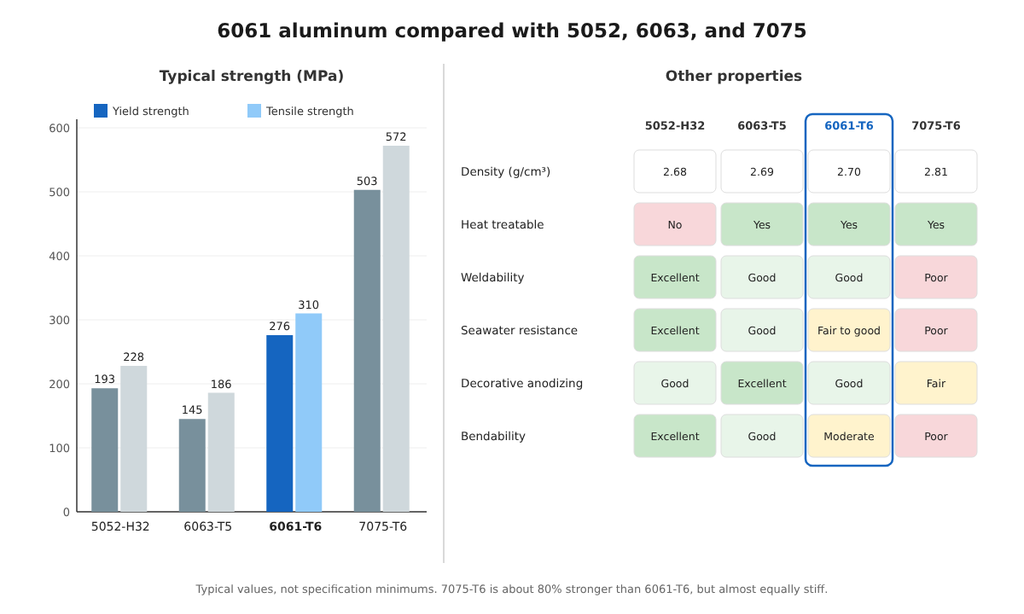
6061 vs 7075, 6063, and 5052
| Property | 5052-H32 | 6063-T5 | 6061-T6 | 7075-T6 |
|---|---|---|---|---|
| Series and main elements | 5xxx, Mg | 6xxx, Mg and Si | 6xxx, Mg and Si | 7xxx, Zn, Mg, Cu |
| Density (g/cm³) | 2.68 | 2.69 | 2.70 | 2.81 |
| Typical tensile strength | 228 MPa (33 ksi) | 186 MPa (27 ksi) | 310 MPa (45 ksi) | 572 MPa (83 ksi) |
| Typical yield strength | 193 MPa (28 ksi) | 145 MPa (21 ksi) | 276 MPa (40 ksi) | 503 MPa (73 ksi) |
| Heat treatable | No | Yes | Yes | Yes |
| Weldability | Excellent | Good | Good | Poor (generally not welded) |
| Seawater resistance | Excellent | Good | Fair to good | Poor, prone to SCC |
| Decorative anodizing | Good | Excellent | Good | Fair |
| Bendability | Excellent | Good | Moderate | Poor |
| Common product forms | Sheet and plate | Extrusions | Plate, bar, extrusions, tube | Plate and bar |
6061 vs 7075
7075-T6 is about 80% stronger than 6061-T6 (typical yield strength 503 MPa vs 276 MPa, or 73 ksi vs 40 ksi) and only about 4% heavier. That is why 7075 is used in aircraft structures, plastic injection molds, heavily loaded fixtures, and high-end sporting goods.
The drawbacks of 7075:
- It is essentially not weldable with ordinary arc welding, because it hot cracks. 7075 parts are joined with bolts or rivets.
- Its corrosion resistance is lower, and in the T6 temper it is prone to stress corrosion cracking. Parts under sustained stress in humid service use 7075-T73 or T7351.
- It is harder to form and costs more.
Stiffness is almost the same. Choose 7075 when a part fails because it is not strong enough, not because it deflects too much. For most general structures, welded frames, and outdoor parts, 6061 is the more sensible choice.
The properties of 7075 by temper, including when to choose T73 over T6, are covered in our guide to 7075 aluminum.
6061 vs 6063
6063 is the extrusion alloy: window and door frames, storefronts, handrails, and furniture profiles. Its lower magnesium and silicon content lets it flow through complex extrusion dies and gives a smooth surface. Architectural profiles are commonly supplied in the T5 temper.
The trade-off is strength. Typical yield strength of 6063-T5 is about 145 MPa (21 ksi), roughly half that of 6061-T6. Choose 6063 for architectural and decorative extrusions that will be anodized; choose 6061 for load-bearing frames, machined parts, and anything that needs strength. For the full picture, see our guide to 6063 aluminum.
6061 vs 5052
5052 is an aluminum-magnesium alloy from the 5xxx series and cannot be heat treated. It gets its strength from cold work, shown by H tempers such as 5052-H32.
Its strengths are formability and seawater resistance. It is used for sheet that is bent a lot, fuel tanks, small boat hulls, panels, and enclosures. Typical yield strength of 5052-H32 is about 193 MPa (28 ksi), below 6061-T6, and it cannot be strengthened further by heat treatment. See our full guide to 5052 aluminum.
A practical rule: if the part is made from bent sheet, especially for marine use, choose 5052. If it is machined from plate or bar, or is a frame that must be strong, choose 6061.
Product Forms and Standards for 6061
| Form | ASTM standard | Common tempers | Notes |
|---|---|---|---|
| Sheet and plate | ASTM B209 | T6 (sheet), T651 (plate) | AMS 4027 covers aerospace T6 sheet and T651 plate |
| Bar, rod, and wire | ASTM B211 | T6, T651 | Cold-finished bar |
| Extruded bar, rod, shapes, and tube | ASTM B221 | T6, T6511 | The most common form |
| Standard structural shapes | ASTM B308 | T6 | Angles, channels, and I-beams |
| Drawn tube | ASTM B210, B483 | T6 | Precision and general-purpose tube |
In Europe, composition is set by EN 573-3 and product properties by EN 485 or EN 755. In Japan, A6061 is covered by JIS H4000 (sheet and plate) and JIS H4040 (bar).
How to confirm you have 6061
6061, 6063, 5052, and 7075 cannot be told apart by eye, by magnet, or by weight. Reliable ways to check:
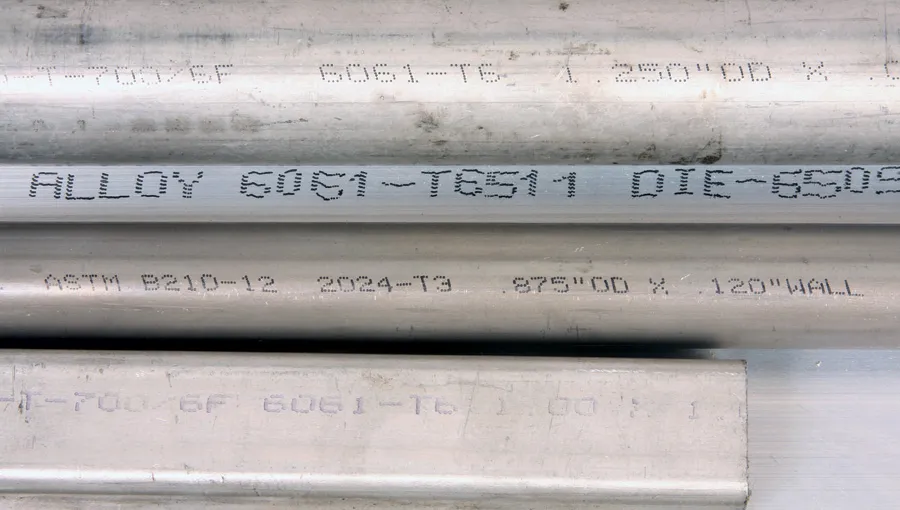
- Ink marking on the surface. Plate and bar from major mills are usually printed with alloy, temper, and lot number.
- The mill certificate, which lists the composition and tensile test results for that lot.
- XRF or optical emission spectrometry (OES) for material of unknown origin.
- Hardness and electrical conductivity testing to confirm the temper, as described in our guide to aluminum heat treatment.
Common Uses of 6061 Aluminum
- Machine frames, conveyor frames, and light structural frames
- CNC-machined jigs, fixtures, brackets, and machine parts
- Bicycle frames and vehicle components
- Small boat hulls, floating docks, and ladders
- Light aircraft and drone parts
- High-pressure gas cylinders such as scuba tanks
- Electronics enclosures, heat sinks, and flashlight bodies
- Hydraulic and pneumatic components
6061 is a wrought alloy. Cast parts use different alloys, such as A356 or A380, as covered in our guide to aluminum casting.
How to Choose: 6061 or Another Alloy?
| Requirement | Good choice |
|---|---|
| General-purpose frames and parts, machined and welded | 6061-T6 |
| Thick plate machined deeply, must stay flat | 6061-T651 |
| Highest strength, no welding | 7075-T6 or T651 |
| High strength in humid service under sustained stress | 7075-T73 or T7351 |
| Window frames, storefronts, anodized decorative profiles | 6063-T5 or T6 |
| Heavily bent sheet, tanks, marine service | 5052-H32 |
| Castings | A356 (can be T6) or A380 (die casting) |
Common Mistakes With 6061 Aluminum
- Using 7075 for welded structures. 7075 is essentially not weldable; use 6061, or bolt 7075 parts together.
- Designing 6061 welds with T6 strength. The weld zone drops to roughly T4, about 40% lower.
- Bending 6061-T6 too tightly. The outside of the bend cracks; bend in O or T4, or choose 5052.
- Choosing 7075 to reduce deflection. 7075 is about as stiff as 6061; increase the section instead.
- Using plain 6061-T6 for thick plate that will be deeply machined. The part can warp; use T651.
- Letting 6061 touch steel or stainless steel in wet service. Separate them with insulating washers, sleeves, or paint.
- Buying unidentified “aircraft aluminum.” Ask for the alloy, temper, and mill certificate.
FAQ
What is 6061 aluminum? 6061 is a wrought aluminum alloy from the 6xxx series, with magnesium and silicon as its main alloying elements. It can be strengthened by heat treatment, is most often sold as 6061-T6, and is used for frames, machine parts, and lightweight structures.
What is the density of 6061 aluminum? 2.70 g/cm³ (0.0975 lb/in³, 2,700 kg/m³), the same in every temper. A 1 m × 1 m plate 10 mm thick weighs about 27 kg.
Is 7075 stronger than 6061? Yes, much stronger: typical yield strength is about 503 MPa (73 ksi) for 7075-T6 vs 276 MPa (40 ksi) for 6061-T6. But 7075 is essentially not weldable, has lower corrosion resistance, is harder to form, and costs more. For general construction, 6061 is usually enough.
What is the difference between 6061 and 6063? 6063 has less magnesium, silicon, and copper, so it extrudes into complex shapes with a smooth finish that anodizes well, but it is only about half as strong. 6063 is used for window frames and decorative profiles; 6061 for structural and machined parts.
Can 6061 aluminum be welded? Yes, by TIG or MIG with 4043 or 5356 filler. Strength around the weld drops to roughly T4 level, about 40% below 6061-T6, unless the part is fully re-heat treated after welding.
Related Articles
- Aluminum Alloys: Series, Tempers, and Uses
- Aluminum Heat Treatment: Solution Treating, Aging, and Temper Codes (T6, T651, T73)
- Aluminum Anodizing: Process, Types (I, II, III), Thickness, Colors, and Sealing
- Aluminum Corrosion: Causes, Types, and Prevention
- Aluminum Casting: Processes, Alloys, and Common Defects

Dagus R. Djuanda is a metallurgical engineer with more than 20 years of experience in materials engineering, specializing in magnetic materials. He holds a master’s degree in magnetic materials engineering, is a doctoral candidate in industrial engineering, and works as an engineer at the Ministry of Industry of the Republic of Indonesia. Founder of Metalurgika.