7075 aluminum is a 7xxx series wrought alloy whose main alloying elements are zinc, magnesium, and copper. In the T6 temper its yield strength is about 500 MPa (73 ksi), comparable to many medium carbon steels at a third of the weight. That is why 7075 is used for aircraft structures, plastic injection molds, bicycle and firearm components, and heavily loaded jigs. Its drawbacks are just as clear: it is practically unweldable, less corrosion resistant, and in the T6 temper susceptible to stress corrosion cracking. This guide covers the composition, physical properties, mechanical properties by temper, what T6, T651, T73, and T7351 mean, how to work 7075 aluminum, and how it compares with 6061 and 2024.
What Is 7075 Aluminum?
The leading 7 marks the 7xxx series, the aluminum-zinc alloys. Zinc and magnesium form extremely fine MgZn₂ precipitates during heat treatment, which is the source of 7075’s high strength. Copper is added to raise strength and resistance to stress corrosion cracking. All the aluminum alloy series are covered in our guide to aluminum alloys.
7075 was first developed by Sumitomo Metal in Japan in 1935 and used in the airframe of the Mitsubishi A6M Zero fighter. Alcoa developed a similar alloy after studying captured Japanese aircraft, and 7075 was standardized for aerospace use in 1945. It is still the benchmark high-strength aluminum alloy.
Designations of 7075 in different standards:
| System | Designation |
|---|---|
| Aluminum Association (US) | AA 7075, UNS A97075 |
| Europe (EN 573) | EN AW-7075, EN AW-AlZn5.5MgCu |
| Germany (material number) | 3.4365, AlZnMgCu1.5 |
| Japan (JIS) | A7075 |
| Russia (GOST) | V95 (В95) |
| Trade names | Zicral, Ergal, Fortal |
7075 is sometimes called “aircraft aluminum,” and in some markets it is sold loosely as “dural.” Duralumin originally meant the 2xxx aluminum-copper alloys, so always ask for the alloy number and temper.
7075 Aluminum Composition
| Element | Composition limits (wt%) |
|---|---|
| Zinc (Zn) | 5.1–6.1 |
| Magnesium (Mg) | 2.1–2.9 |
| Copper (Cu) | 1.2–2.0 |
| Chromium (Cr) | 0.18–0.28 |
| Iron (Fe) | 0.5 max |
| Silicon (Si) | 0.4 max |
| Manganese (Mn) | 0.3 max |
| Titanium (Ti) | 0.2 max |
| Others | 0.05 max each, 0.15 max total |
| Aluminum (Al) | Remainder (about 87–91) |
What each element does:
- Zinc and magnesium form the MgZn₂ precipitates that make 7075 so strong after aging.
- Copper adds strength and helps resistance to stress corrosion cracking, but lowers general corrosion resistance and makes 7075 hard to weld.
- Chromium forms fine dispersoids that restrict grain growth and also improve stress corrosion resistance.
- Iron and silicon are impurities. Their limits are kept low because they form coarse particles that reduce toughness.
7075 Aluminum Density and Physical Properties
| Property | Value |
|---|---|
| Density | 2.81 g/cm³ (0.101 lb/in³) |
| Melting range | About 477–635 °C (890–1175 °F) |
| Modulus of elasticity | About 71–72 GPa (10.4 × 10⁶ psi) |
| Coefficient of thermal expansion | About 23.4 × 10⁻⁶ /°C (20–100 °C) |
| Thermal conductivity | About 130 W/m·K (T6) to 155 W/m·K (T73) |
| Electrical conductivity | About 33% IACS (T6) and 40% IACS (T73) |
| Magnetic | No |
The density of 2.81 g/cm³ is slightly higher than 6061 (2.70 g/cm³) because of the zinc. To estimate weight, multiply volume by density: a 7075 plate 1,000 × 500 × 20 mm has a volume of 10,000 cm³ and weighs about 28 kg (62 lb).
The modulus is almost the same as other aluminum alloys. 7075 is far stronger than 6061, but not stiffer. If the problem is deflection, the answer is a bigger section, not a stronger alloy.
The difference in electrical conductivity between T6 and T73 is used in aerospace to verify temper with eddy current testing. A part that should be T73 but reads low conductivity has probably not been processed correctly.
7075 Aluminum Properties by Temper
| Temper | Typical tensile strength | Typical yield strength | Typical elongation | Hardness | Notes |
|---|---|---|---|---|---|
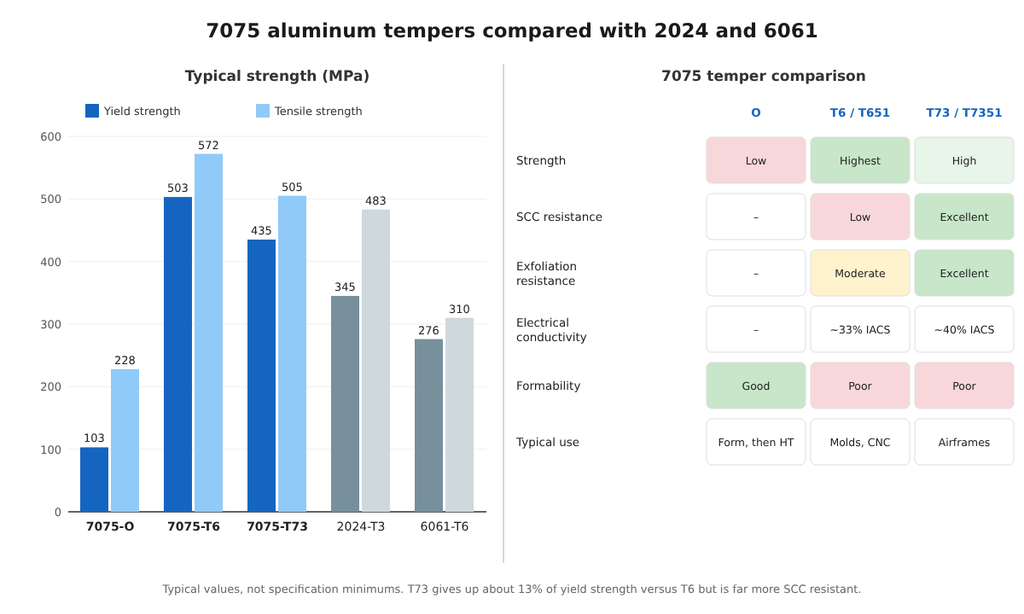
| 7075-O | 228 MPa (33 ksi) | 103 MPa (15 ksi) | 17% | About 60 HB | Annealed, softest, for forming |
| 7075-T6 | 572 MPa (83 ksi) | 503 MPa (73 ksi) | 11% | About 150 HB | Peak strength |
| 7075-T651 | 572 MPa (83 ksi) | 503 MPa (73 ksi) | 11% | About 150 HB | T6 plate stretched for machining stability |
| 7075-T73 | 505 MPa (73 ksi) | 435 MPa (63 ksi) | 13% | About 135 HB | Overaged, highly resistant to stress corrosion cracking |
| 7075-T7351 | 505 MPa (73 ksi) | 435 MPa (63 ksi) | 13% | About 135 HB | Stretched T73 plate |
These are typical values for thin to medium products. Specification minimums are lower and drop further for thick plate. For example, 7075-T7351 plate 6–100 mm (0.25–4 in) thick is guaranteed a minimum yield strength of roughly 330–390 MPa (48–57 ksi), depending on thickness. For design calculations, use the minimums from the specification or mill certificate, not typical values.
Compared with T6, the T73 temper gives up about 13% of yield strength but gains a large increase in stress corrosion resistance. Other tempers you will see:
- T76 and T7651: overaged less than T73. Strength sits between T6 and T73, with good resistance to exfoliation corrosion.
- T6511 and T73511: stretched extruded bar and shapes.
- Alclad 7075: 7075 sheet clad on both sides with a thin layer of 7072 alloy for corrosion protection.
What T6, T651, T73, and T7351 Mean
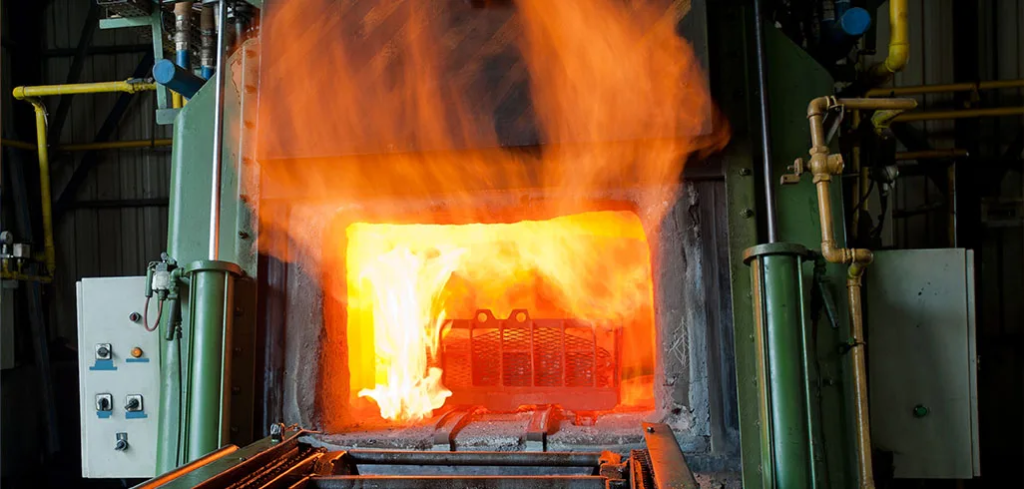
Every 7075 temper used for parts starts with solution treatment at about 465–480 °C (870–900 °F) followed by a fast water quench. The difference is what comes next:
- T6: artificially aged at about 120 °C (250 °F) for around 24 hours to peak strength.
- T651: same as T6, but the plate is stretched 1.5–3% after quenching to relieve residual stress. T651 plate is much more stable in deep machining, so specify T651 for mold blocks and CNC parts.
- T73: two-step overaging, for example about 107 °C (225 °F) for 6–8 hours, then about 163–177 °C (325–350 °F) for about a day. The precipitates coarsen and space out along grain boundaries, interrupting the path for stress corrosion cracks.
- T7351: T73 for plate, stretched like T651.
The suffix 51 always means “stress relieved by stretching.” Solution treating, quenching, aging, and the temper code system are explained in our guide to aluminum heat treatment.
One important point: T6 can be converted to T73 by additional aging, but T73 cannot return to T6 without a new solution treatment. Avoid holding 7075-T6 parts above about 120 °C (250 °F) for long periods, for example in a paint bake oven, because strength can drop.
Corrosion and Stress Corrosion Cracking
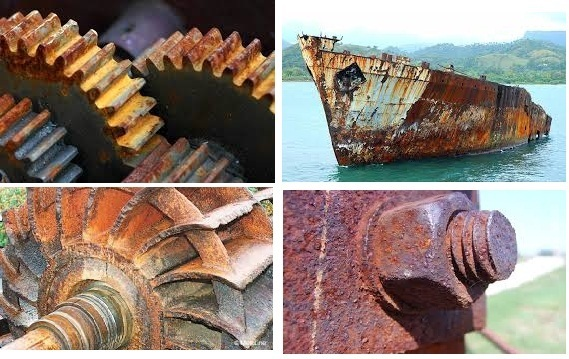
Copper and zinc make 7075 less corrosion resistant than 6061 and 5052. It holds up well in dry air, but in marine or humid environments it needs protection: anodizing, paint, chromate conversion coating, or Alclad for sheet. The forms of aluminum corrosion and how to prevent them are covered in our guide to aluminum corrosion.
The more serious problem is stress corrosion cracking (SCC). 7075-T6 can crack under sustained tensile stress, for example from a tightened bolt, a press fit, or residual stress, in humid service. Cracks run along grain boundaries, especially in the plate’s short transverse direction. This is why the T73 and T7351 tempers were developed. The mechanism and prevention are explained in our guide to stress corrosion cracking.
Anodizing. 7075 aluminum can be anodized, including hard anodizing (Type III) for wear-resistant surfaces. For decorative anodizing, the finish tends to be slightly yellowish and less bright than 6061 or 6063 because of the zinc and copper. The process is covered in our guide to aluminum anodizing.
Working with 7075 Aluminum
Machining
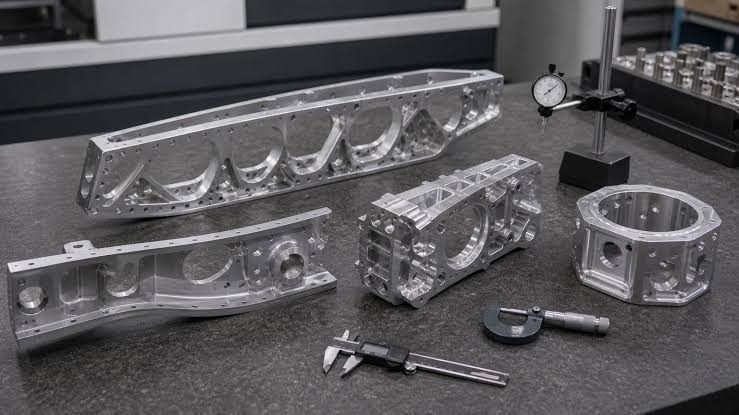
7075-T6 and T651 machine very well. Because the alloy is hard, chips break short and the surface finish is fine, better than 6061, which tends to smear on the tool. This is one reason 7075 is chosen for molds and precision parts. Use sharp carbide tools and coolant. For deep machining of thick plate, choose T651 or T7351 to avoid distortion.
Welding
7075 is practically unweldable by conventional arc welding (TIG or MIG). The weld is prone to hot cracking as it solidifies, and the heat-affected zone loses much of its strength. 7075 parts are joined with bolts, rivets, or structural adhesives. Friction stir welding can join 7075 in aerospace production, but it is not a job-shop option. If a part must be welded, use 6061 or a 5xxx alloy.
Forming
In the T6 temper, 7075 is hard to bend and can crack at tight radii. Severe forming is done in the O temper or immediately after quenching (W condition), and the part is then heat treated to T6 or T73.
7075 vs 6061 vs 2024
| Property | 6061-T6 | 2024-T3 | 7075-T6 |
|---|---|---|---|
| Series and main elements | 6xxx, Mg and Si | 2xxx, Cu and Mg | 7xxx, Zn, Mg, Cu |
| Density (g/cm³) | 2.70 | 2.78 | 2.81 |
| Typical tensile strength (MPa) | 310 | 483 | 572 |
| Typical yield strength (MPa) | 276 | 345 | 503 |
| Hardness (HB, approx.) | 95 | 120 | 150 |
| Fatigue and crack growth resistance | Good | Excellent | Good |
| Weldability | Good | Poor | Poor |
| Corrosion resistance | Good | Poor | Poor |
| Typical uses | Frames, general structures, welded parts | Fuselage skin, lower wing skin, rivets | Upper wing skin, molds, highly loaded parts |
7075 vs 6061. 7075-T6 is about 80% stronger than 6061-T6 and only about 4% heavier. In return, 6061 is weldable, more corrosion resistant, easier to bend, and cheaper. Choose 7075 when a part fails for lack of strength and does not need welding. The full comparison, including 6063 and 5052, is in our guide to 6061 aluminum.
7075 vs 2024. 7075 is stronger and harder, while 2024 has better fatigue resistance and slower crack growth. On aircraft, 2024 goes where loads are mainly cyclic tension, such as fuselage skin and the lower wing, while 7075 goes where loads are compressive and high static, such as the upper wing. Both are hard to weld and less corrosion resistant. The full guide to 2024, including the T3 and T351 tempers and Alclad, is in our article on 2024 aluminum.
For very thick plate, aerospace now often uses 7050 or high-purity versions of 7075 such as 7175 and 7475, which are tougher and less sensitive to thickness.
Common Uses of 7075 Aluminum
- Aircraft structures: upper wing skins, frames, highly loaded fittings
- Plastic injection molds, blow molds, and prototype tooling
- Heavily loaded jigs and fixtures
- Bicycle parts: chainrings, stems, and derailleur pulleys
- Climbing gear: carabiners and cams
- Firearm receivers and frames (for example AR-15)
- Racing and high-performance automotive parts
- Rocket and space components
How to Choose a Temper or Alloy
| Requirement | Suitable choice |
|---|---|
| Maximum strength, dry service, no welding | 7075-T6 |
| Block for CNC machining or molds | 7075-T651 |
| Parts under sustained stress in humid service | 7075-T73 or T7351 |
| Parts that need severe forming | 7075-O, then heat treat |
| Welded structures | 6061 or a 5xxx alloy, not 7075 |
| Cyclic tension and crack resistance | 2024-T3 or T351 |
| Unprotected marine service | 5083 or 6061 |
Common Mistakes
- Buying “aircraft aluminum” or “dural” without an alloy number. It could be 2017, 2024, 6061, or 7075, with very different properties.
- Welding 7075 parts. The weld cracks or loses strength. Bolt it or change alloy.
- Using 7075-T6 for parts under sustained stress in humid service. The SCC risk is high; use T73 or T7351.
- Machining thick 7075-T6 plate that has not been stretched. It can warp; specify T651.
- Holding 7075-T6 above about 120 °C (250 °F) for long periods. Strength drops.
- Choosing 7075 to reduce deflection. It is about as stiff as 6061; increase the section.
- Designing with typical strength values. Use minimums from the specification or mill certificate.
FAQ
What is 7075 aluminum? 7075 aluminum is a 7xxx series wrought alloy whose main elements are zinc (5.1–6.1%), magnesium, and copper. In the T6 temper its typical yield strength is about 503 MPa (73 ksi), among the highest of widely available aluminum alloys.
What is the difference between 7075-T6 and T651? Strength is the same. 7075-T651 is T6 plate stretched after quenching to relieve residual stress, so it does not warp during deep machining.
Which is stronger, 7075 or 6061 aluminum? 7075-T6 is much stronger, with a typical yield strength of about 503 MPa (73 ksi) versus 276 MPa (40 ksi) for 6061-T6. But 7075 is practically unweldable, less corrosion resistant, harder to bend, and more expensive.
Can 7075 aluminum be welded? Not practically with conventional TIG or MIG welding, because it is prone to hot cracking and loses strength in the weld zone. 7075 parts are bolted, riveted, or bonded. Friction stir welding is used in industry but is rarely available in job shops.
What is the density of 7075 aluminum? About 2.81 g/cm³ (0.101 lb/in³), slightly heavier than 6061 (2.70 g/cm³) and about a third the weight of steel.
Related Articles
- 6061 Aluminum: Properties, Density, Composition, and 6061 vs 7075, 6063, and 5052
- Aluminum Alloys: Series, Tempers, and Uses
- Aluminum Heat Treatment: Solution Treating, Aging, and Temper Codes (T6, T651, T73)
- Stress Corrosion Cracking (SCC): Causes, Mechanism, Types, and Prevention
- Aluminum Anodizing: Process, Types (I, II, III), Thickness, Colors, and Sealing

Dagus R. Djuanda is a metallurgical engineer with more than 20 years of experience in materials engineering, specializing in magnetic materials. He holds a master’s degree in magnetic materials engineering, is a doctoral candidate in industrial engineering, and works as an engineer at the Ministry of Industry of the Republic of Indonesia. Founder of Metalurgika.