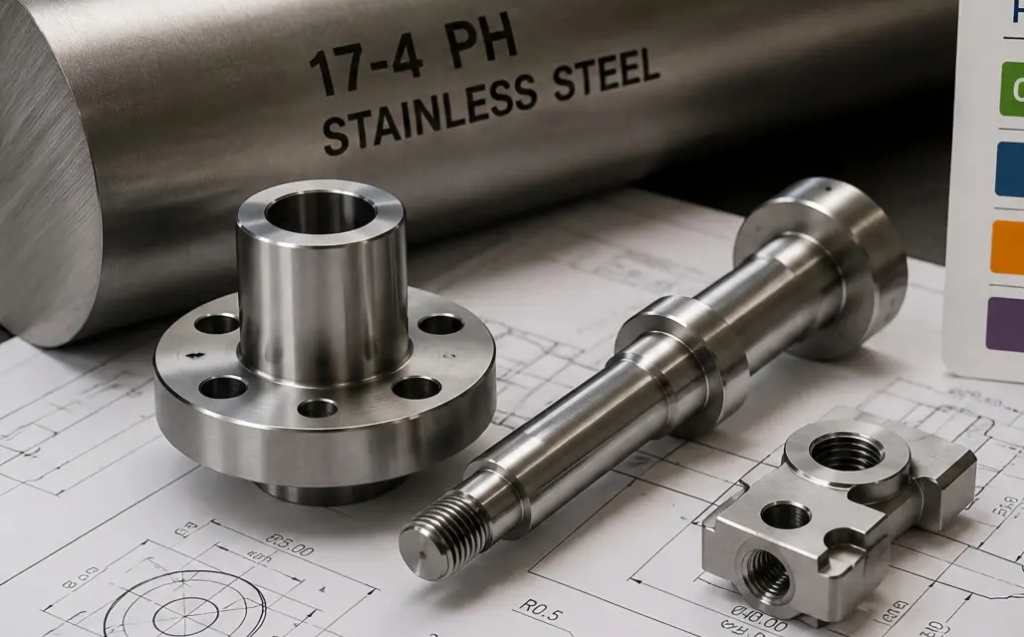
17-4 PH stainless steel can be hardened to a yield strength above 1,100 MPa (170 ksi) while keeping corrosion resistance close to that of 304. The name comes from its composition, about 17% chromium and 4% nickel, and from how it is hardened: precipitation hardening (PH). It is also listed as Type 630, UNS S17400, 1.4542, and SUS 630. It is used for pump and valve shafts, high-strength fasteners, aircraft parts, and plastic molds. This guide covers its composition, the H900 to H1150 heat treat conditions, properties in each condition, how to machine and weld it, and how it compares with 15-5 PH, 17-7 PH, 316, and 420.
What Is Precipitation Hardening Stainless Steel?
Stainless steels fall into five families by microstructure: austenitic, ferritic, martensitic, duplex, and precipitation hardening. All five are compared in our guide to types of stainless steel.
Precipitation hardening grades combine two things:
- A strong base structure. In 17-4 PH this is low-carbon martensite, which forms as the metal cools from the solution temperature.
- Strengthening by aging. The metal is reheated to 480–620 °C (900–1150 °F) for a few hours. In 17-4 PH, copper precipitates as extremely fine particles that block dislocation movement.
The principle is the same as aluminum T6 heat treatment: solution treat, cool, then age. In aluminum the precipitates are Mg₂Si or copper compounds; in 17-4 PH they are copper-rich particles. The mechanism is explained in our guide to aluminum heat treatment.
PH stainless steels split into three groups:
| Group | Structure after solution treatment | Examples | Typical product forms |
|---|---|---|---|
| Martensitic | Martensite | 17-4 PH, 15-5 PH, 13-8 Mo | Bar, forgings, plate |
| Semi-austenitic | Austenite, converted to martensite by an extra treatment | 17-7 PH, 15-7 Mo | Sheet, strip, spring wire |
| Austenitic | Austenite | A-286 | High-temperature bolts and parts |
17-4 PH Designations
| System | Designation |
|---|---|
| AISI / ASTM | Type 630 (ASTM A564 bar, A693 plate and sheet, A705 forgings) |
| UNS | S17400 |
| Europe (EN 10088) | 1.4542, X5CrNiCuNb16-4 |
| Japan (JIS G4305) | SUS 630 |
| Aerospace | AMS 5643 (bar and forgings), AMS 5604 (sheet and plate) |
| Casting | CB7Cu-1 (ASTM A747) |
| Welding filler | ER630 (AWS A5.9), E630 (AWS A5.4) |
Composition of 17-4 PH, 15-5 PH, and 17-7 PH
| Element (%) | 17-4 PH (S17400) | 15-5 PH (S15500) | 17-7 PH (S17700) |
|---|---|---|---|
| Chromium (Cr) | 15.0–17.5 | 14.0–15.5 | 16.0–18.0 |
| Nickel (Ni) | 3.0–5.0 | 3.5–5.5 | 6.5–7.75 |
| Copper (Cu) | 3.0–5.0 | 2.5–4.5 | – |
| Aluminum (Al) | – | – | 0.75–1.5 |
| Niobium + tantalum (Nb + Ta) | 0.15–0.45 | 0.15–0.45 | – |
| Carbon (C), max | 0.07 | 0.07 | 0.09 |
| Manganese (Mn), max | 1.0 | 1.0 | 1.0 |
| Silicon (Si), max | 1.0 | 1.0 | 1.0 |
What each element does:
- Chromium provides corrosion resistance, as in any stainless steel.
- Nickel balances the structure. In 17-4 PH it is low enough that the metal transforms to martensite on cooling.
- Copper is the precipitating element in 17-4 PH and 15-5 PH. In 17-7 PH, aluminum plays that role.
- Niobium ties up carbon, so chromium stays in solution and corrosion resistance is preserved.
Condition A and the H900 to H1150 Conditions
17-4 PH is supplied in Condition A: solution treated at about 1040 °C (1900 °F) and air cooled. In this condition it is martensitic, hardness is 38 HRC maximum, and it can be machined. Condition A is not intended for service; parts are always aged first.
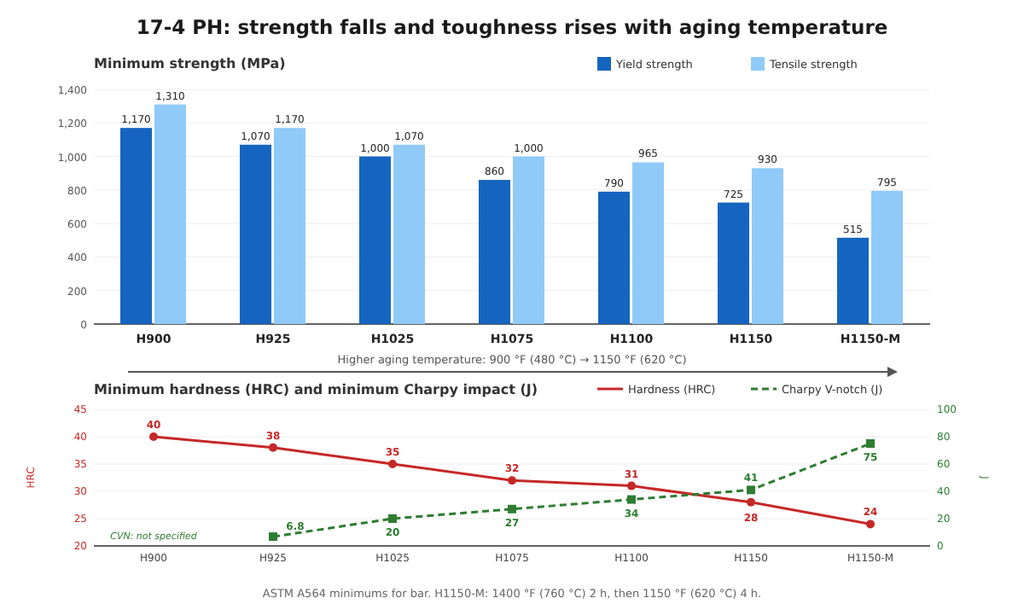
The H number is the aging temperature in degrees Fahrenheit: H900 means aged at 900 °F (480 °C). The higher the aging temperature, the lower the strength, but the higher the toughness and the resistance to stress cracking.
| Condition | Aging | Min. yield strength | Min. tensile strength | Min. elongation | Min. hardness | Min. Charpy V-notch |
|---|---|---|---|---|---|---|
| A (solution treated) | 1040 °C (1900 °F), air cool | – | – | – | 38 HRC max | – |
| H900 | 480 °C (900 °F), 1 h | 1170 MPa (170 ksi) | 1310 MPa (190 ksi) | 10% | 40 HRC | Not specified |
| H925 | 495 °C (925 °F), 4 h | 1070 MPa (155 ksi) | 1170 MPa (170 ksi) | 10% | 38 HRC | 6.8 J (5 ft·lb) |
| H1025 | 550 °C (1025 °F), 4 h | 1000 MPa (145 ksi) | 1070 MPa (155 ksi) | 12% | 35 HRC | 20 J (15 ft·lb) |
| H1075 | 580 °C (1075 °F), 4 h | 860 MPa (125 ksi) | 1000 MPa (145 ksi) | 13% | 32 HRC | 27 J (20 ft·lb) |
| H1100 | 595 °C (1100 °F), 4 h | 790 MPa (115 ksi) | 965 MPa (140 ksi) | 14% | 31 HRC | 34 J (25 ft·lb) |
| H1150 | 620 °C (1150 °F), 4 h | 725 MPa (105 ksi) | 930 MPa (135 ksi) | 16% | 28 HRC | 41 J (30 ft·lb) |
| H1150-M | 760 °C (1400 °F) 2 h, then 620 °C (1150 °F) 4 h | 515 MPa (75 ksi) | 795 MPa (115 ksi) | 18% | 24 HRC | 75 J (55 ft·lb) |
These are ASTM A564 minimums for bar. All aging steps end with an air cool.
How to read the table:
- H900 is the strongest and hardest condition, but also the most brittle. Impact toughness is not guaranteed, and it is the condition most susceptible to stress corrosion cracking and hydrogen cracking.
- H1025 to H1100 are the most common compromise for shafts, valves, and machine parts.
- H1150 and H1150-M are chosen when toughness and crack resistance matter more than strength. H1150-M has the best notch toughness and is recommended for cryogenic service.
- H1150D (double aged at 620 °C) is used for oil and gas service with H₂S. NACE MR0175 / ISO 15156 limits 17-4 PH in that service to 33 HRC maximum.
Heat Treating 17-4 PH in Practice
A typical sequence:
- Buy in Condition A (or H1150 for heavy machining).
- Machine close to final size. Condition A machines with carbide tools at moderate feeds. H1150 machines more easily because it is softer and more ductile.
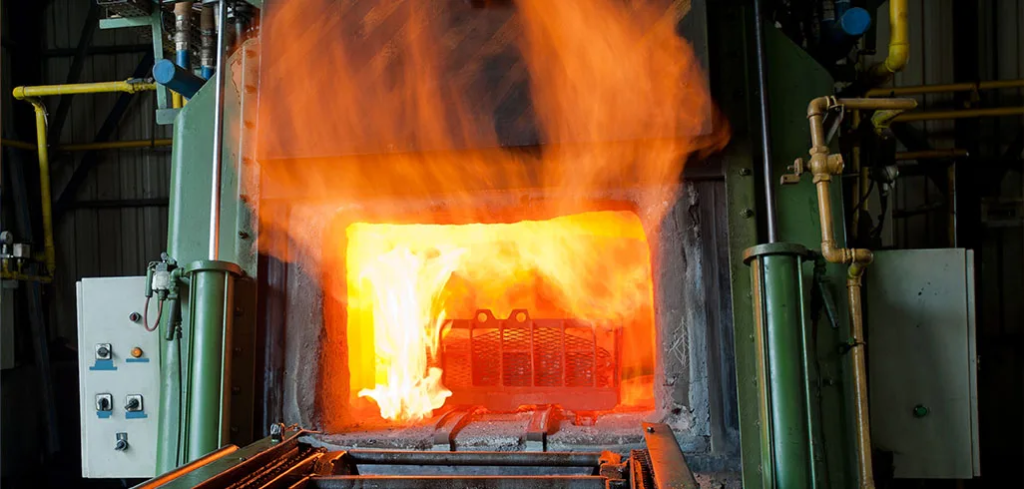
- Age in an air furnace at the chosen condition’s temperature, then air cool.
- Finish critical features by grinding or light machining if needed.
Points to watch:
- Dimensional change. Parts shrink slightly during aging, on the order of a few ten-thousandths of an inch per inch. This is usually ignored on small parts, but large parts or tight tolerances need an allowance or finish machining after aging.
- Distortion is small and scale is light, because aging temperatures are low. This is a key advantage over quenched steels.
- Avoid carbon- or nitrogen-bearing atmospheres during heat treatment. Argon or clean air is safer.
- Changing condition. A part already in H900 can be re-aged at a higher temperature (for example to H1150), but not the other way round. To return to higher strength, it must be re-solution treated to Condition A first.
Corrosion Resistance and Other Properties
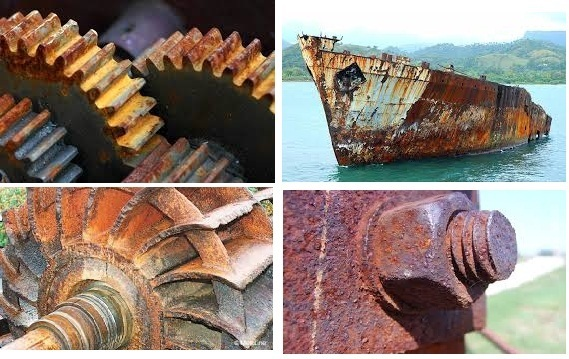
Corrosion resistance. In most environments, 17-4 PH stainless steel approaches 304 and is better than ordinary martensitic stainless steels such as 410 and 420. In coastal air it can develop light rust and slow pitting; in seawater, 17-4 PH shafts are usually used with cathodic protection. For seawater and high chlorides, 316 or duplex is safer. After machining, passivation helps restore the passive film.
Stress cracking. Resistance to stress corrosion cracking and hydrogen cracking rises sharply from H900 to H1150. For bolts and parts under sustained stress in humid service, avoid H900.
Is 17-4 PH magnetic? Yes. 17-4 PH stainless steel has a martensitic structure, so it is magnetic in every condition. This is normal, not a sign of a counterfeit.
Service temperature. 17-4 PH is generally used up to about 300 °C (570 °F). Long exposure above that can embrittle it.
Nitriding. The surface of 17-4 PH can be hardened further by nitriding, usually at or slightly below its aging temperature so the core does not soften. The process is covered in our guide to nitriding.
Welding 17-4 PH
17-4 PH stainless steel can be welded by TIG, MIG, or stick, with procedures similar to 300 series stainless steels. No preheat is needed up to about 100 mm (4 in) thick.
- ER630 wire or E630 electrodes are used when the weld must match base metal strength.
- 308 or 309 filler is used when corrosion resistance matters more and lower joint strength is acceptable.
- Post-weld treatment: single-pass welds can simply be aged. Multipass welds should be re-solution treated to Condition A first, then aged, for uniform properties.
Stainless welding basics are covered in our guide to welding stainless steel.
17-4 PH vs 15-5 PH vs 17-7 PH
| Property | 17-4 PH | 15-5 PH | 17-7 PH |
|---|---|---|---|
| Group | Martensitic | Martensitic | Semi-austenitic |
| Typical conditions | H900 to H1150 | H900 to H1150 (same codes) | TH1050, RH950, CH900 |
| Typical product forms | Bar, forgings, plate | Bar, forgings, plate | Sheet, strip, wire |
| Main advantage | Most common and easiest to buy | Better transverse toughness, less delta ferrite, usually remelted | Formable in Condition A like 301, then hardened |
| Typical uses | Shafts, valves, fasteners, molds | Critical aerospace parts, large forgings | Springs, spring washers, diaphragms, sheet aerospace parts |
15-5 PH is a lower-chromium version of 17-4 PH whose microstructure is almost free of delta ferrite. It is usually vacuum arc or electroslag remelted. The result is better toughness and transverse ductility, especially in large sections. Its condition codes are the same as 17-4 PH.
17-7 PH is austenitic in Condition A, so it forms like Type 301 stainless. After forming, it is transformed to martensite and aged, for example to TH1050 or RH950. Sheet cold rolled at the mill (Condition C) can be aged directly to CH900, the strongest condition, used for springs.
17-4 PH vs 316 and 420
| Property | 316 | 420 | 17-4 PH (H1025) |
|---|---|---|---|
| Family | Austenitic | Martensitic | Precipitation hardening |
| How it is hardened | Cold work only | Quench and temper | Low-temperature aging |
| Typical yield strength | About 205–290 MPa (30–42 ksi) | Can exceed 1300 MPa (190 ksi) after hardening | 1000 MPa (145 ksi) minimum |
| Corrosion resistance | Best of the three | Lowest | Close to 304 |
| Distortion when hardened | – | Large (quench) | Small |
| Magnetic | No | Yes | Yes |
| Typical uses | Chemical equipment, marine, food | Knives, cutting tools, molds | Shafts, valves, high-strength fasteners |
316 and other austenitic grades are compared in 304 vs 316 stainless steel. For 420, the hardening principle is the same as quenching and tempering of steel.
Cast 17-4 PH: CB7Cu-1
The cast version of 17-4 PH is CB7Cu-1 in ASTM A747, used for valve bodies, impellers, and pump parts that need more strength than CF8M. Its name follows the same ACI system as CF8M, which is explained, along with other cast stainless grades, in our guide to CF8M stainless steel.
Common Uses of 17-4 PH
Typical applications of 17-4 PH stainless steel include:
- Pump shafts, boat propeller shafts, and valve stems
- High-strength bolts, nuts, and fasteners
- Aircraft and turbine components
- Plastic injection molds and mold components
- Food, paper, and chemical processing equipment
- Oil and gas pump and valve components (H1150D)
- Surgical instruments and medical components
- Metal 3D-printed parts
How to Choose a 17-4 PH Condition
| Requirement | Suitable condition |
|---|---|
| Maximum strength and hardness, no impact loads, dry service | H900 |
| General machine parts: shafts, valves, small gears | H1025 or H1075 |
| Bolts and parts under sustained stress in humid service | H1100 or H1150 |
| Maximum toughness, low temperature | H1150-M |
| Oil and gas service with H₂S (NACE MR0175) | H1150D, 33 HRC maximum |
| Stock for machining before aging | Condition A, or H1150 for heavy machining |
Common Mistakes
- Putting 17-4 PH into service in Condition A. It is unaged, toughness is low, and properties are not stable.
- Choosing H900 for bolts in humid service. H900 is the most prone to stress corrosion and hydrogen embrittlement; use H1100 or H1150.
- Writing “17-4 PH” on a drawing without a condition. Always state it, for example “17-4 PH H1025 per ASTM A564.”
- Assuming 17-4 PH resists seawater like 316. It is closer to 304; in seawater it needs cathodic protection, or choose another grade.
- Multipass welding and then only aging. Re-solution treat to Condition A first so the weld and base metal match.
- Treating magnetism as a sign of a fake. 17-4 PH is magnetic by nature.
FAQ
What is 17-4 PH stainless steel? 17-4 PH is a precipitation hardening stainless steel with about 17% chromium, 4% nickel, and 4% copper. After solution treating and aging, its minimum yield strength ranges from 725 to 1170 MPa (105 to 170 ksi) depending on condition, with corrosion resistance close to 304.
What is the hardness of 17-4 PH H900? ASTM A564 requires a minimum of 40 HRC for 17-4 PH H900, with a minimum yield strength of 1170 MPa (170 ksi). In Condition A, hardness is 38 HRC maximum.
Is 17-4 PH magnetic? Yes. Its structure is martensite, so 17-4 PH is magnetic in every condition.
Is 17-4 PH the same as 630 stainless steel? Yes. Type 630 is the AISI/ASTM designation for 17-4 PH, which is also UNS S17400, SUS 630 in Japan, and 1.4542 in Europe.
Which is more corrosion resistant, 17-4 PH or 316? 316 is more corrosion resistant, especially in chloride environments such as seawater. 17-4 PH is closer to 304. Choose 17-4 PH for high strength and 316 when corrosion resistance comes first.
Related Articles
- Types of Stainless Steel: Austenitic, Ferritic, Martensitic, Duplex, and Common Grades
- 304 vs 316 Stainless Steel (and 201): Composition, Corrosion Resistance, Cost, and How to Choose
- Stress Corrosion Cracking (SCC): Causes, Mechanism, Types, and Prevention
- Nitriding: Process Steps, Types, Suitable Steels, and the White Layer
- CF8M Stainless Steel: Composition, Properties, CF8 vs CF3M, and How Stainless Steel Casting Works
Dagus R. Djuanda is a metallurgical engineer with more than 20 years of experience in materials engineering, specializing in magnetic materials. He holds a master’s degree in magnetic materials engineering, is a doctoral candidate in industrial engineering, and works as an engineer at the Ministry of Industry of the Republic of Indonesia. Founder of Metalurgika.