
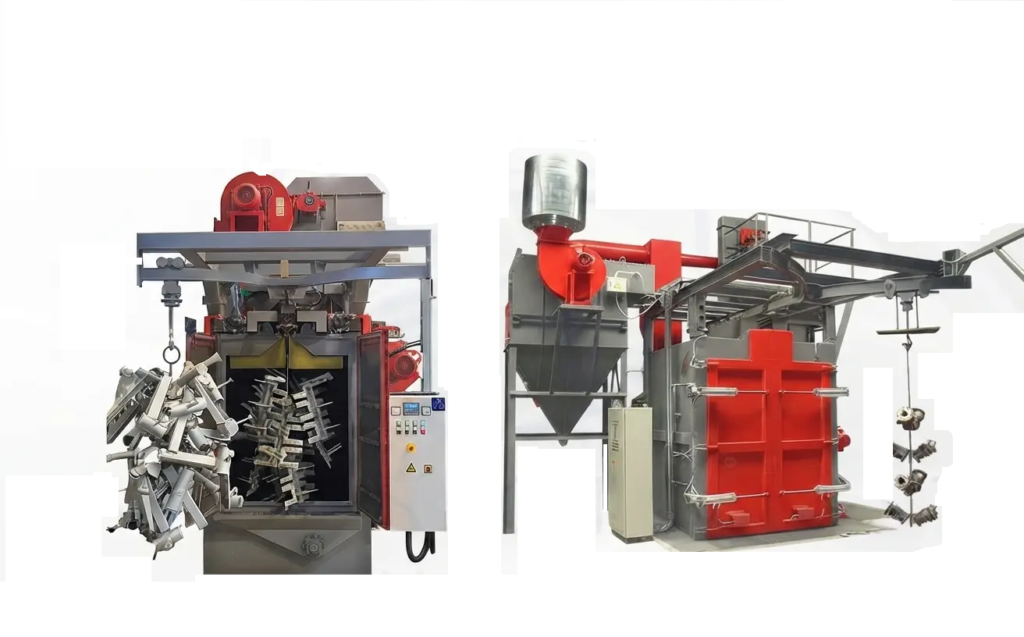
Shot blasting is a surface cleaning process that throws small abrasive particles at a metal part at high speed. The impact of millions of particles knocks off molding sand, oxide scale, and rust, and leaves a clean, uniform surface.
In a foundry, shot blasting is one step in finishing metal castings. It comes after shakeout and after the gates and risers have been cut off during fettling.
What Shot Blasting Does
- Cleans sand, scale, and rust from the surface.
- Prepares the surface for paint or coating. A slightly rough surface gives the coating something to grip.
- Evens out the appearance of the casting.
- Makes inspection easier, because cracks and surface defects are no longer hidden under sand.
How the Shot Blasting Process Works
There are two ways to throw the abrasive.
1. Wheel blasting. A bladed wheel spins at high speed and throws the abrasive by centrifugal force, typically at about 60 to 80 meters per second. It uses no compressed air, handles large volumes, and is the standard choice in foundries.
2. Air blasting. Compressed air pushes the abrasive through a nozzle that an operator or a robot aims at the part. It is slower, but it reaches cavities and corners that a wheel cannot hit.
In both methods the spent abrasive falls to the bottom of the machine, is separated from dust and sand, and goes back into circulation. A dust collector captures the fines.
A typical cycle for castings looks like this:
- Load the parts on a hanger, table, or belt.
- Close the cabinet and start the wheels.
- Blast for a set time, usually a few minutes, while the parts rotate or tumble.
- Stop the wheels and let the abrasive drain.
- Unload, blow out trapped shot, and inspect.
Types of Shot Blasting Machines
| Machine type | How the part is held | Best for |
|---|---|---|
| Tumble blast (tumble belt) | Parts tumble on a moving belt | Small, sturdy castings in large quantities |
| Hanger (spinner hanger) | Parts hang from a hook and rotate | Medium to large castings, complex shapes |
| Rotary table | Parts sit on a turning table | Flat or heavy parts |
| Roller conveyor or continuous | Parts travel through the blast chamber | Plate, sections, mass production |
| Blast room | An operator blasts with a nozzle | Very large parts or one-off jobs |
Tumble blasting is the cheapest per part, but the parts hit each other. Thin or fragile castings go on a hanger or a table instead.
Shot Blasting Media
| Media | Shape | Surface result | Typical use |
|---|---|---|---|
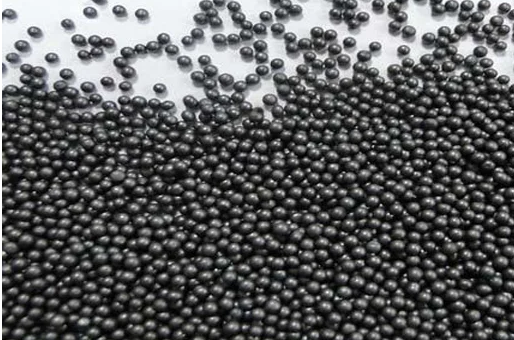
| Steel shot | Round | Smooth, dimpled | Cleaning castings, shot peening |
| Steel grit | Angular | Rough, sharp profile | Heavy scale removal, coating preparation |
| Cut wire | Small cylinders | Similar to steel shot | Peening, long service life |
| Stainless steel shot | Round | Clean, no rust staining | Aluminum, stainless steel, non-ferrous alloys |
| Glass beads | Round | Fine, satin | Decorative finishing |
| Aluminum oxide | Angular | Rough | Hard metals, coating preparation |
Larger and harder particles clean more aggressively and leave a rougher surface. Many foundries run a mix of shot and grit to get both cleaning power and a consistent finish.
For aluminum and copper alloy castings, avoid carbon steel media. Iron particles left on the surface can rust and stain the part.
Shot Blasting vs Sandblasting vs Shot Peening
The three terms are often used as if they meant the same thing. They do not.
| Shot blasting | Sandblasting | Shot peening | |
|---|---|---|---|
| Purpose | Cleaning | Cleaning | Better fatigue life |
| Media | Steel shot or grit | Sand or mineral abrasive | Selected round shot |
| How it is thrown | Usually a wheel | Compressed air | Wheel or compressed air |
| What is controlled | Cleanliness grade | Cleanliness grade | Intensity and coverage |
Shot blasting vs sandblasting. Both clean a surface by impact. Sandblasting uses compressed air and a mineral abrasive, so it suits site work, large structures, and small workshops. Shot blasting usually uses a wheel and reusable steel media, so it suits production lines. Blasting with silica sand is now banned or tightly restricted in many countries because the dust causes silicosis. Low-silica mineral abrasives have replaced it.
Shot blasting vs shot peening. Shot peening uses the same principle for a different goal. The impact of round shot leaves a layer of compressive stress at the surface, which slows the growth of fatigue cracks. It is used on springs, gears, and aircraft parts, and its intensity is measured with Almen strips. Shot blasting gives a light peening effect as a side benefit, but it is not a controlled peening process.
Surface Cleanliness Standards: Sa 2.5 and Others
The cleanliness of a blasted steel surface is usually specified to ISO 8501-1. The SSPC and NACE grades used in North America line up with it as follows.
| ISO 8501-1 | Description | SSPC / NACE |
|---|---|---|
| Sa 1 | Light blast cleaning | SP 7 / NACE 4 (brush-off) |
| Sa 2 | Thorough blast cleaning | SP 6 / NACE 3 (commercial) |
| Sa 2½ | Very thorough blast cleaning, only faint stains remain | SP 10 / NACE 2 (near-white) |
| Sa 3 | Blast cleaning to visually clean steel | SP 5 / NACE 1 (white metal) |
Sa 2½, often written Sa 2.5, is the grade most often requested before industrial painting. Besides cleanliness, the surface profile (roughness) is usually specified too, so that it matches the paint system.
Common Problems
- Sand left in internal cavities. Change how the part hangs, or add a nozzle blast for the cavity.
- Thin walls warp. Reduce the blast time, the wheel speed, or the media size.
- Shot trapped in holes and passages. This is dangerous in hydraulic and engine parts, so blow out and check every passage.
- Surface too rough for a thin coating. Use smaller or rounder media.
- Media wears out fast. This usually means the separator is not working well, so sand keeps circulating and wears the machine.
Shot blasting also exposes defects that were already in the casting. If cleaned parts show pinholes or cracks, the cause is upstream. See our guide to the types of casting defects.
Safety
- Keep the dust collector working and its filters maintained.
- Keep doors and curtains fully closed while the wheels are turning.
- Wear hearing protection, eye protection, and a respirator near the machine or in a blast room.
- Sweep up spilled shot. It makes the floor very slippery.
Frequently Asked Questions
Does shot blasting change the size of a part? Very little. What comes off is mainly scale and dirt. Too long a cycle can round sharp edges and wear away fine detail.
Is shot blasting done before or after heat treatment? Often both. Before heat treatment to remove sand, and after it to remove the scale that forms in the furnace.
Does a shot blasted surface rust quickly? Yes. Freshly blasted steel is very reactive and can show rust within hours in humid air, so coat it as soon as possible. The forms this attack can take are covered in our article on the types of metal corrosion.
What is the difference between steel shot and steel grit? Steel shot is round and leaves a smooth, dimpled surface. Steel grit is angular and cuts a sharper profile, which removes heavy scale faster and suits coating preparation.
Conclusion
Shot blasting cleans castings quickly and evenly, and prepares the surface for inspection and coating. The result depends on three choices: a machine that suits the shape of the part, media that suits the material and the roughness you need, and a cycle long enough to clean without damaging detail.
Related Articles
- Finishing Metal Castings: Fettling, Shot Blasting, and Machining
- What Is Fettling in Casting? Process, Tools, and Safety
- Types of Heat Treatment of Metals: Processes, Purposes, and Effects
- Non-Destructive Testing (NDT) Methods for Detecting Defects in Metal Castings
- Types of Metal Corrosion and How to Prevent Them in Industry


