
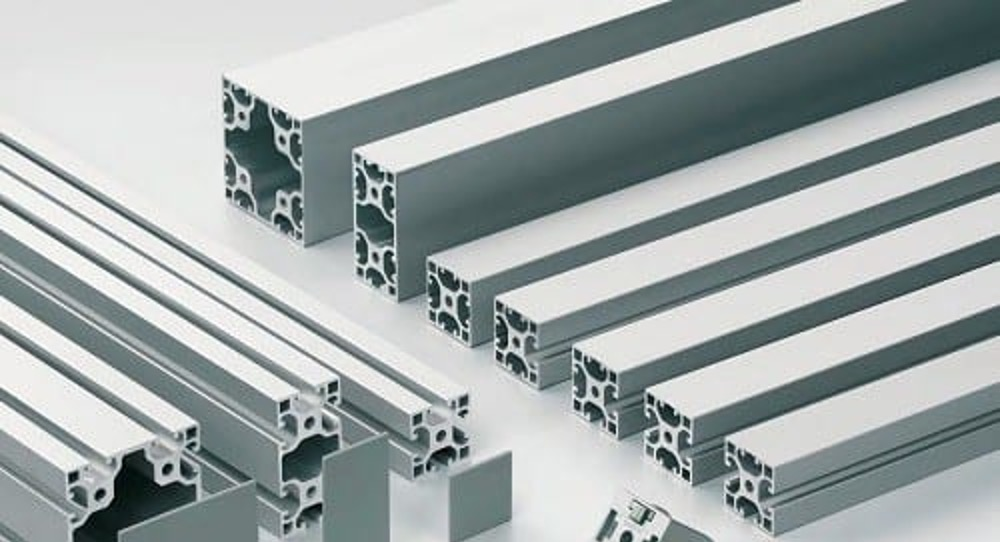
Aluminum alloys are aluminum mixed with small amounts of other elements, such as copper, manganese, magnesium, silicon, or zinc. Pure aluminum is light and corrosion resistant, but soft: its tensile strength is only about 90 MPa (13 ksi). With the right alloying and heat treatment, strength can rise more than sixfold with almost no added weight.
Nearly all aluminum used in industry is an alloy, from window frames and beverage cans to car wheels and aircraft structures. This article explains how aluminum alloys are grouped, what the series and temper codes mean, which casting alloys are most common, and how to choose between them.
Two Main Families: Wrought and Cast Alloys
Aluminum alloys fall into two families based on how they are shaped.
- Wrought alloys are formed in the solid state by rolling, extrusion, drawing, or forging. They become sheet, plate, extrusions, bar, and wire.
- Cast alloys are shaped by pouring into a mold. Their compositions are designed to flow well and fill molds, usually with fairly high silicon.
Each family is further split into heat-treatable alloys and non-heat-treatable alloys. The second group can only be strengthened by cold work, such as rolling.
Wrought Aluminum Alloy Series (1xxx to 8xxx)
Wrought alloys carry a four-digit number under the Aluminum Association system. The first digit shows the main alloying element.
| Series | Main alloying element | Heat-treatable? | Key traits | Examples and uses |
|---|---|---|---|---|
| 1xxx | Pure aluminum (≥99%) | No | Best corrosion resistance and conductivity, but soft | 1100, 1050: electrical conductors, foil, chemical equipment |
| 2xxx | Copper | Yes | Very strong, fatigue resistant, but less corrosion resistant | 2024: aircraft structures, rivets |
| 3xxx | Manganese | No | Moderate strength, easy to form, corrosion resistant | 3003, 3004: roofing, beverage cans, heat exchangers |
| 4xxx | Silicon | Mostly no | Lower melting point | 4043, 4047: welding wire and brazing alloys |
| 5xxx | Magnesium | No | Strongest non-heat-treatable alloys, excellent in seawater, easy to weld | 5052, 5083: boats, tanks, truck bodies |
| 6xxx | Magnesium and silicon | Yes | Medium to high strength, easy to extrude, corrosion resistant | 6061, 6063: extrusions, window frames, frames, machine parts |
| 7xxx | Zinc (with magnesium, copper) | Yes | Strongest of all aluminum alloys | 7075, 7050: aircraft, sports equipment, molds |
| 8xxx | Other elements (lithium, iron) | Some | Depends on the alloy | 8011: packaging foil; Al-Li: aircraft |
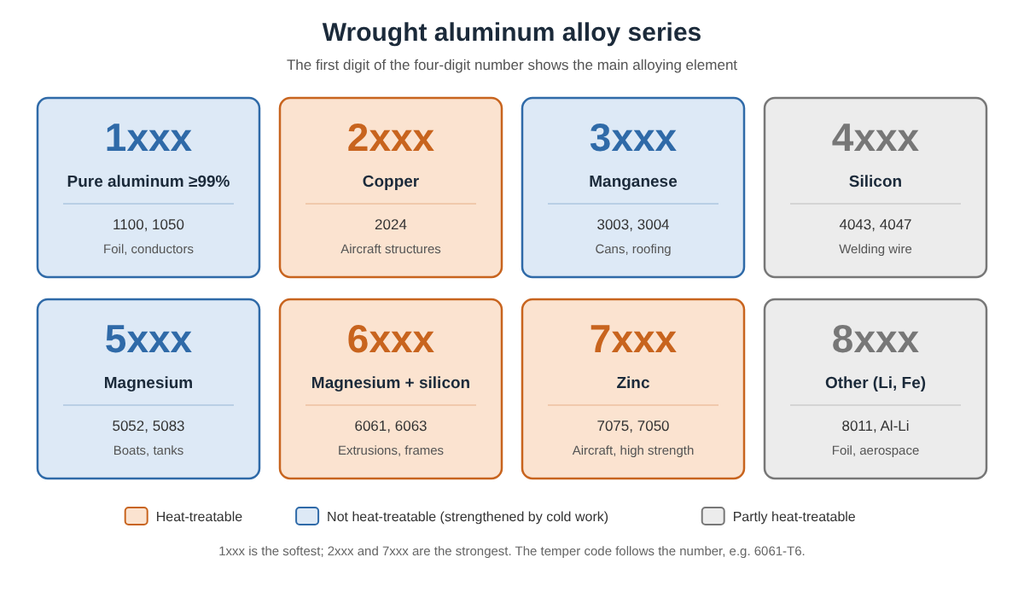
The last two digits identify a specific alloy within the series. In the 1xxx series they show purity instead: 1050 means at least 99.50% aluminum. The second digit indicates a modification of the original alloy.
The Most Common Aluminum Alloys
| Alloy | Typical tensile strength | Strengths | Limitations |
|---|---|---|---|
| 1100-O | ~90 MPa (13 ksi) | Very ductile, corrosion resistant | Soft |
| 3003-H14 | ~150 MPa (22 ksi) | Easy to form, inexpensive | Limited strength |
| 5052-H32 | ~230 MPa (33 ksi) | Seawater resistant, easy to weld | Not heat-treatable |
| 5083-H116 | ~315 MPa (46 ksi) | First choice for boats | Prone to intergranular corrosion after long exposure to heat |
| 6063-T5 | ~185 MPa (27 ksi) | Smooth finish for architectural extrusions | Moderate strength |
| 6061-T6 | ~310 MPa (45 ksi) | Versatile, machines and welds well | Loses strength at welds |
| 2024-T3 | ~480 MPa (70 ksi) | Fatigue resistant | Less corrosion resistant, hard to weld |
| 7075-T6 | ~570 MPa (83 ksi) | Strongest common alloy | Expensive, hard to weld, prone to stress corrosion cracking |
These are typical values and vary with product thickness. For design, use minimum values from the standard and the material certificate. The casting process itself, from melting to T6 heat treatment, is covered in our guide to aluminum casting.
Cast Aluminum Alloy Series
Cast alloys use three digits and a decimal (for example, 356.0). The first digit again shows the main alloying element.
| Series | Main alloying element | Example |
|---|---|---|
| 1xx.x | Pure aluminum | 170.0: electric motor rotors |
| 2xx.x | Copper | 206.0: high-strength parts |
| 3xx.x | Silicon with copper and/or magnesium | A356, A380: wheels, engine blocks, transmission housings |
| 4xx.x | Silicon | 413.0: thin-walled castings |
| 5xx.x | Magnesium | 535.0: marine parts |
| 7xx.x | Zinc | 712.0: parts that age naturally without heat treatment |
The 3xx.x series is by far the most widely used. Silicon improves the fluidity of molten metal and reduces shrinkage, so these alloys fill complex molds easily.
A356, A380, ADC12, and AlSi10Mg
A few casting alloy names come up again and again in shops and catalogs:
- A356 (Al-Si7Mg). The most common alloy for gravity casting and sand molds. It can be heat treated to the T6 temper and is ductile and corrosion resistant. Used for wheels, pump housings, and structural parts.
- A380 (Al-Si8.5Cu3.5). The most common die casting alloy in North America. It casts easily and is inexpensive, but its copper lowers corrosion resistance.
- ADC12 (Al-Si11Cu2). The Japanese (JIS) die casting alloy widely used across Asia, for example in motorcycle parts. Its composition is close to A383.
- AlSi10Mg. Used for die casting and for metal 3D printing (additive manufacturing), because it produces dense parts and can be heat treated.
Which casting process suits each alloy is covered in our comparison of sand vs die vs investment casting.
Temper Codes: What T6, H32, and O Mean
After the alloy number there is usually a letter and digits, as in 6061-T6. This is the temper designation, which shows the treatment the material has received.
| Code | Meaning |
|---|---|
| F | As fabricated, with no control of properties |
| O | Annealed, the softest condition (see annealing) |
| H | Strain hardened by cold work. H1x is cold worked only, H2x is cold worked then partially annealed, H3x is cold worked then stabilized. The second digit shows hardness, for example H14 is half hard and H18 is full hard |
| W | Solution treated but not yet stable |
| T4 | Solution treated, then naturally aged at room temperature |
| T5 | Cooled from shaping, then artificially aged |
| T6 | Solution treated, then artificially aged. The strongest condition for many alloys |
| T7 | Solution treated, then overaged, for example T73, for better resistance to stress corrosion cracking |
| Tx51 | The added “51” means residual stress was relieved by stretching, as in T651 |
The T6 temper comes from precipitation hardening. The alloy is heated until its alloying elements dissolve (about 500–540°C, or 930–1000°F, for 6061), quenched quickly, and then aged at about 160–180°C (320–355°F) for several hours. The fine particles that form during aging block dislocation movement and raise strength. The broader principles are covered in our guide to heat treatment of metals. The casting process itself, from melting to T6 heat treatment, is covered in our guide to aluminum casting.
How to Choose an Aluminum Alloy
| Requirement | Common choice |
|---|---|
| Marine and coastal service | 5083, 5052, 6061 |
| Architectural extrusions, window frames | 6063-T5 or T6 |
| General structures and machine parts | 6061-T6 |
| Highest strength at minimum weight | 7075-T6 or T73, 2024-T3 |
| Sheet that must be formed heavily | 3003, 5052 |
| Electrical conductors | 1350, 6101 |
| Ductile, corrosion-resistant castings | A356-T6 |
| High-volume die casting | A380, ADC12 |
Keep three points in mind:
- Welding. 5xxx and 6xxx alloys weld easily, but 6xxx alloys lose part of their strength in the weld zone. 2xxx and most 7xxx alloys are difficult to weld with ordinary arc welding.
- Corrosion. Copper-bearing alloys (2xxx, 7xxx, and casting alloys such as A380 and ADC12) are the most susceptible. The reasons are explained in our article on aluminum corrosion.
- Cost and availability. 6061 and 6063 are the easiest to find. Aerospace alloys such as 7075 and 2024 cost more and are often made to order.
For a comparison with cast iron and cast steel, see our guide to choosing materials for metal casting. Aluminum alloys are also the most common matrix for metal matrix composites made by stir casting.
Frequently Asked Questions
What is the difference between pure aluminum and an aluminum alloy? Pure aluminum (1xxx series) contains at least 99% aluminum. It is soft, highly corrosion resistant, and an excellent electrical conductor. Aluminum alloys contain alloying elements that make them much stronger, at some cost in corrosion resistance or conductivity.
What is the strongest aluminum alloy? The 7xxx series, such as 7075-T6, with a tensile strength of about 570 MPa (83 ksi), comparable to many structural steels.
Which is better, 6061 or 7075? 7075 is far stronger, but it costs more, is hard to weld, and is less corrosion resistant. 6061 is more versatile and easier to work. For most general construction, 6061 is enough.
What is ADC12 equivalent to? ADC12 is similar to A383 in the U.S. system and close to A380. All three are aluminum-silicon-copper die casting alloys.
Can aluminum alloys be welded? Most can, especially the 1xxx, 3xxx, 5xxx, and 6xxx series, using TIG or MIG welding with a suitable filler wire (usually 4043 or 5356). 2xxx alloys and 7075 are usually joined with rivets or bolts.
Conclusion
Aluminum alloys are divided into four-digit wrought alloys (1xxx to 8xxx) and three-digit cast alloys. The first digit shows the main alloying element, and the temper code that follows shows how the material has been treated. Understanding both codes makes it easier to choose the right alloy: 5xxx for marine service, 6061 and 6063 for general use, 7075 for maximum strength, A356 for ductile castings, and A380 or ADC12 for high-volume die casting.
Related Articles
- Aluminum Corrosion: Causes, Types, and Prevention
- Choosing Materials for Metal Casting: Cast Iron, Cast Steel, and Aluminum Alloys
- Sand Casting vs Die Casting vs Investment Casting
- Heat Treatment: Process, Types, and Effects on Metal Properties
- Fluidity of Molten Metal: Definition, Factors, and How to Test It


