Neodymium-iron-boron (NdFeB) magnets are the strongest permanent magnets produced at scale. Their strength rests on neodymium and praseodymium. But these magnets have a weakness: they lose strength as they heat up. For applications that run hot, such as electric vehicle traction motors, two more elements are needed in small amounts: dysprosium (Dy) and terbium (Tb). The quantities are small, but their role is decisive, and their supply is among the most fragile in the entire rare earth chain.
The High-Temperature Problem of NdFeB Magnets
Every permanent magnet has a coercivity, its resistance to losing magnetization under an opposing magnetic field or heat. The coercivity of NdFeB magnets falls quite sharply as temperature rises. In an EV traction motor under heavy load, magnet temperature can climb well above room temperature. Without enough coercivity, the magnet can permanently lose part of its magnetization, and motor performance drops.
How Dysprosium and Terbium Work
When some neodymium atoms in the magnet crystal are replaced by dysprosium or terbium, the magnetic anisotropy field increases. In other words, the direction of magnetization inside each grain becomes much harder to reverse. The magnet stays stable at higher operating temperatures.
Terbium is more effective but scarcer. Per unit weight, terbium raises coercivity more than dysprosium. But terbium is much rarer and is among the most expensive rare earth metals.
There is a trade-off. Adding Dy and Tb slightly reduces remanence, the strength of the magnetic field the magnet produces. Their content is therefore always kept to the minimum the operating temperature requires.
Other Applications Beyond Magnets
Terbium is used as a green phosphor in lighting and displays, and in the magnetostrictive alloy Terfenol-D, which changes dimensions under a magnetic field and is used in sonar and precision actuators.
Dysprosium is used in nuclear reactor control rods because it absorbs neutrons well, and in some specialized laser and lighting applications. A broader view of such uses is covered in rare earth applications beyond electric vehicles.
Highly Concentrated Supply

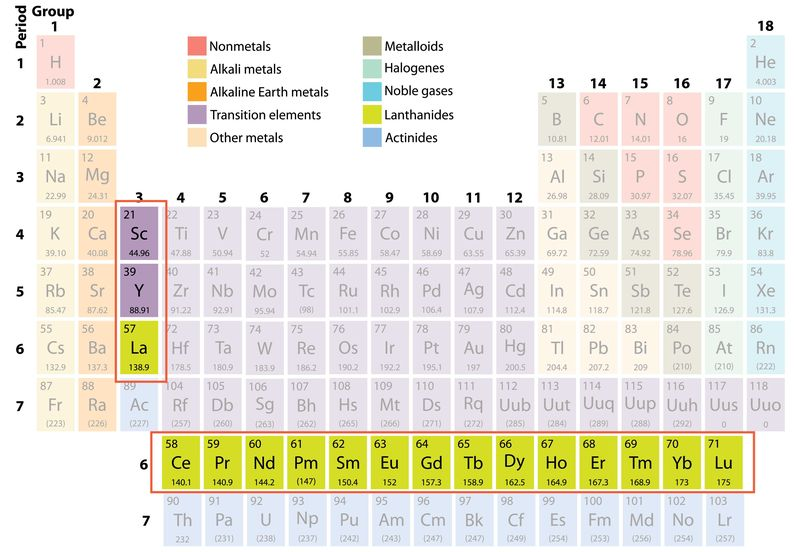
Dysprosium and terbium belong to the heavy rare earth elements (HREE). Their main sources are ion-adsorption clays in southern China and Myanmar, which are naturally rich in heavy elements and can be extracted with relatively simple leaching. Most deposits elsewhere are dominated by light elements such as cerium and lanthanum, with only small Dy and Tb content.
This concentration makes Dy and Tb supply highly vulnerable to policy decisions and disruptions in just a few locations. In 2025, China imposed export controls on several medium and heavy rare earths, including dysprosium and terbium, showing how easily these elements become bargaining chips in supply chain geopolitics. In addition, poorly controlled mining of ion-adsorption clays causes serious environmental damage, especially soil and water pollution from leaching chemicals.
Separating Dy and Tb from other elements is also difficult because rare earths are chemically very similar, as discussed in rare earth extraction and refining.
Reducing Dependence
Grain boundary diffusion (GBD). Instead of mixing Dy or Tb throughout the magnet, this technique diffuses them only into the grain boundaries, where magnetization reversal usually begins. This significantly cuts Dy and Tb consumption without sacrificing much coercivity, and it is now widely used by magnet makers.
Grain refinement. Magnets with finer grains naturally have higher coercivity, reducing the need for heavy elements.
Cooler motor design. Better cooling lowers magnet operating temperature, allowing magnets with less Dy to be used.
Recycling. Recovering Dy and Tb from end-of-life magnets, as discussed in rare earth recycling from electronic waste, is becoming an increasingly important secondary source.
Alternative technologies. Some automakers are developing motors without rare earth magnets, covered in non-rare-earth magnet alternatives.
Small Quantities, Large Influence
Dysprosium and terbium make up only a small share of a magnet’s composition, yet without them many high-performance motors cannot run reliably. Anyone analyzing supply chain risk for neodymium magnets should therefore pay special attention to Dy and Tb, not just neodymium. For Indonesia, which is exploring rare earth downstream processing, the presence of heavy elements in domestic deposits, such as tin by-product minerals, is a factor that shapes the strategic value of those projects.