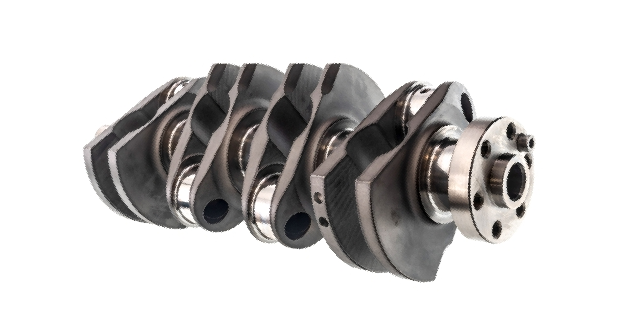
Nitriding is a surface hardening process that diffuses nitrogen into the surface of steel at about 500–550 °C (930–1,020 °F). The nitrogen reacts with alloying elements in the steel to form very hard nitrides. Because the temperature stays below the steel’s transformation range and there is no quench, distortion is very small. That is why nitriding is chosen for crankshafts, die casting dies, and extruder screws that have already been machined close to final size.
Nitriding belongs to the diffusion family of surface hardening methods, alongside carburizing and carbonitriding. This guide explains how it works, the process steps, the types of nitriding, which steels and other metals can be nitrided, the white layer, how case depth is measured, and how nitriding compares with other methods.
What Is Nitriding?
Nitriding is a thermochemical heat treatment: the metal surface is enriched with nitrogen, which then diffuses inward. The result is a hard surface layer over a core that stays tough.
Three things set nitriding apart from carburizing:
- Lower temperature. Gas nitriding runs at about 500–550 °C (930–1,020 °F), far below carburizing at 850–950 °C (1,560–1,740 °F). The steel stays ferritic and never transforms to austenite.
- No quench. Hardness comes from fine nitrides that form directly, not from martensite. After treatment the parts are simply cooled slowly.
- A thin but very hard case. Case depth is usually 0.1–0.6 mm (0.004–0.024 in), with surface hardness around 600 HV on 4140 and above 1,000 HV on nitralloy steels.
How Nitriding Works
The nitrogen source
In gas nitriding the nitrogen source is ammonia (NH₃). On the hot steel surface, ammonia dissociates into atomic nitrogen and hydrogen, and the atomic nitrogen enters the steel. In plasma nitriding, nitrogen is activated by a glow discharge, and in salt bath nitriding it comes from molten cyanate salts.
The two zones of a nitrided case
A nitrided steel surface has two zones:
- The compound layer, usually called the white layer because it looks white under the microscope after etching. It consists of iron nitrides, the ε phase (Fe₂₋₃N) and the γ′ phase (Fe₄N), and is about 5–25 µm thick. It is hard and resists wear and galling, but it can be brittle if it grows too thick.
- The diffusion zone beneath it, where nitrogen is dissolved in the steel and forms very fine alloy nitride precipitates. This zone sets the case depth and the fatigue strength.
The role of alloying elements
Iron nitrides alone do not make steel very hard. High hardness comes from nitride-forming elements: aluminum (the strongest), chromium, molybdenum, vanadium, and titanium. The more of these elements a steel contains, the harder the surface, but the case tends to be shallower because the nitrogen is “trapped” near the surface.
Nitrogen in the diffusion zone also creates compressive residual stress at the surface. This stress holds back fatigue cracks, so the fatigue strength of the part rises considerably.
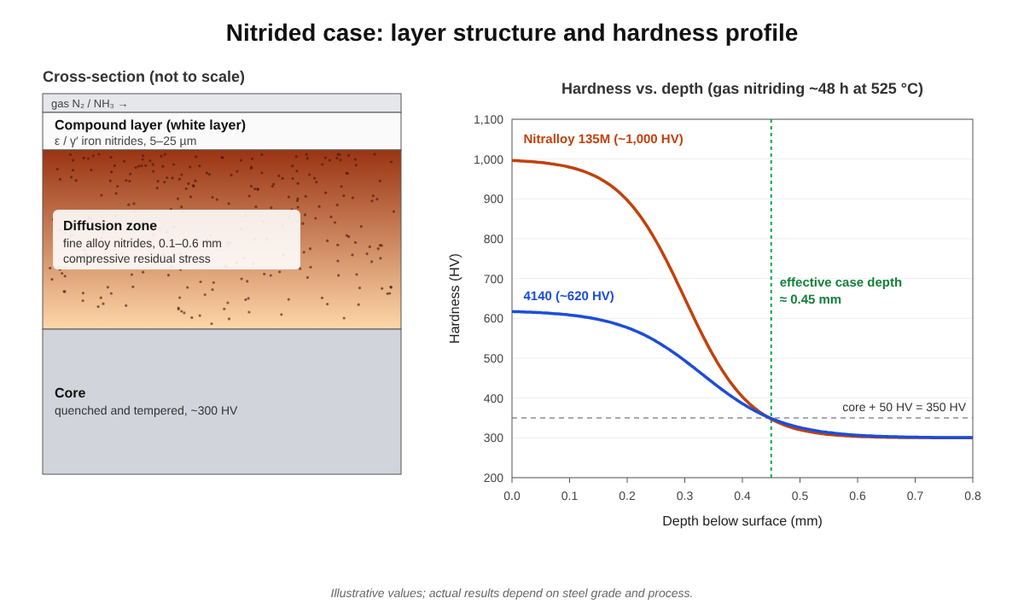
The diagram above shows this layer structure and the hardness profile. The values are illustrative for gas nitriding for about 48 hours at 525 °C (975 °F). Nitralloy 135M reaches about 1,000 HV at the surface, while 4140 reaches about 620 HV. In both steels, the effective case depth (to core hardness + 50 HV) is about 0.45 mm.
The Nitriding Process, Step by Step
1. Hardening and tempering first
Steel to be nitrided is usually quenched and tempered first, so the core is strong enough to support the hard case. One rule matters most: the tempering temperature must be above the nitriding temperature, typically by about 30 °C (55 °F). Otherwise the core will soften during a nitriding cycle that lasts many hours.
2. Stress relief and final machining
For precision parts, the steel is stress relieved below the tempering temperature after rough machining, then machined to final size. The principle is similar to stress relief annealing. This step keeps parts from warping once they are heated in the nitriding furnace.
3. Cleaning and masking
The surface must be free of oil, grease, and oxides, because dirt blocks nitrogen and leaves soft spots. Areas that must stay soft are masked. In gas nitriding this is usually done with copper plating or tin-based stop-off paint, while in plasma nitriding simple mechanical masks such as metal plates or plugs are enough.
4. Nitriding
The parts are heated to process temperature and held in a nitrogen-bearing environment. The time depends on the case depth required. Conventional gas nitriding usually takes 10 to more than 60 hours.
5. Cooling
When the cycle ends, the parts are cooled slowly in the furnace or in a protective gas. There is no quench, so size and shape barely change. The only change is a small growth, usually a few micrometers, caused by the compound layer.
Types of Nitriding
Gas nitriding
Gas nitriding uses ammonia in a sealed furnace, usually at 495–525 °C (925–975 °F). Its advantages are a low cost per part in high volumes, nitriding of every surface including deep holes, and, with modern atmosphere control, closely controlled results.
Two variants are commonly mentioned:
- Single-stage: temperature and gas composition stay constant throughout. The compound layer that forms is relatively thick.
- Double-stage (Floe process): a first stage at about 495–525 °C (925–975 °F) builds the case, then a second stage at about 550–565 °C (1,020–1,050 °F) with a higher ammonia dissociation rate. The second stage thins the white layer and deepens the diffusion zone.
Plasma nitriding (ion nitriding)
Plasma nitriding, or ion nitriding, takes place in a vacuum vessel filled with a low-pressure mix of nitrogen and hydrogen. The parts are made the cathode, so a glow discharge forms around them. The ions striking the surface also clean it (sputtering).
Advantages of plasma nitriding:
- Shorter cycle times than gas nitriding for the same case depth.
- The composition and thickness of the white layer are easy to control, and it can be avoided altogether.
- It can run at lower temperatures, around 400 °C (750 °F), which matters for stainless steels and steels that must not soften.
- Masking is purely mechanical, and there is no ammonia or salt waste.
On the downside, the equipment is expensive, and narrow, deep holes are hard to nitride evenly.
Salt bath nitriding (liquid nitriding)
Parts are dipped into molten cyanate salts at about 560–580 °C (1,040–1,075 °F). Because these salts also release carbon, the process is more accurately called nitrocarburizing. It is fast, usually only a few hours, and gives uniform results. The main concern is handling the salts and their waste.
A note on soft nitriding, QPQ, and Melonite
Terms such as gas soft nitriding, Tufftride, QPQ (quench-polish-quench), and Melonite are often treated as types of nitriding. In fact they are all ferritic nitrocarburizing (FNC): nitrogen and a little carbon are added together at about 560–590 °C (1,040–1,090 °F), forming a wear- and corrosion-resistant compound layer over a shallow diffusion zone. QPQ adds oxidation and polishing, leaving a black, more corrosion-resistant surface. The full comparison is in our article on surface hardening.
Steels and Metals That Can Be Nitrided
| Material | Examples | Surface hardness (approx.) | Notes |
|---|---|---|---|
| Nitralloy steels (Al-bearing) | Nitralloy 135M, EN41B | 900–1,100 HV | Hardest; shallower, more brittle case |
| Cr-Mo alloy steels | 4140, 4340, SCM440, EN19, EN40B | 550–700 HV | Most common choice for shafts and gears |
| Hot-work tool steel | H13 / SKD61 | 1,000–1,200 HV | Die casting dies, molds, mandrels |
| Stainless steels | 410, 420, 316, 17-4 PH | 900–1,200 HV | Passive film must be removed first; plasma suits best |
| Carbon steels | 1045, A36 | 250–400 HV (diffusion zone) | Only the compound layer is hard; FNC suits better |
| Cast irons | Gray, ductile | 400–600 HV | For wear resistance on machine parts |
| Titanium | Ti-6Al-4V | TiN layer | Much higher temperature |
The values in this table are general ranges. Actual figures depend on steel composition, core hardness, and process parameters.
Nitralloy 135M
Nitralloy 135M is a steel designed specifically for nitriding, with about 0.4% carbon, 1.6% chromium, 0.4% molybdenum, and 1% aluminum. Aluminum forms very hard nitrides, so the surface can reach about 1,000 HV or more. The trade-off is a more brittle compound layer, so this steel is used where wear resistance comes first, such as cylinder liners, pump shafts, and valve parts.
Cr-Mo alloy steels (4140 and similar)
4140 (equivalent to SCM440 and EN19) and 4340 are the most common nitriding steels. Their surface hardness is lower than nitralloy’s, around 600 HV, but the case is tougher and fatigue strength rises a great deal. EN40B (a Cr-Mo-V steel popular in the UK and India) also belongs to this group.
Nitriding stainless steel
Stainless steel can be nitrided, but two points need attention:
- The chromium oxide passive film blocks nitrogen. It must be broken first, for example by chemical activation in gas nitriding or by sputtering in plasma nitriding. That is why plasma is used most often.
- Corrosion resistance can drop. At normal nitriding temperatures (about 500 °C, or 930 °F, and above), chromium is tied up as chromium nitride, leaving less chromium to protect the steel from rusting. For austenitic grades such as 316, low-temperature nitriding (below about 450 °C, or 840 °F) is used instead. It forms an expanded austenite layer (S phase) that is hard yet still corrosion-resistant.
For precipitation-hardening grades such as 17-4 PH, nitriding is usually done near the aging temperature so the core does not soften. The forms of corrosion that can follow are covered in our article on types of metal corrosion.
Can carbon steel be nitrided?
Yes, but the results are limited. Low carbon steel and medium-carbon steels lack strong nitride-forming elements, so the diffusion zone is only slightly harder than the core. Only the thin compound layer at the surface is hard. Nitrided carbon steel is still useful for light wear and corrosion resistance, for example on blackened carbon steel parts. For carbon steels the better process is usually nitrocarburizing (FNC). When a deep hard case is needed on low-carbon steel, the choice is carburizing.
Cast iron and titanium
Ductile iron and gray cast iron can also be nitrided for parts such as cast iron crankshafts, liners, and molds. Nitriding titanium and its alloys forms a hard, wear-resistant titanium nitride (TiN) layer, but at much higher temperatures, about 700–900 °C (1,290–1,650 °F), usually by plasma or in pure nitrogen gas.
Temperature, Time, and Case Depth
Nitrogen diffuses slowly at nitriding temperatures, so case depth grows roughly with the square root of time. For a Cr-Mo steel such as 4140 gas nitrided at about 525 °C (975 °F), a rough guide is:
| Cycle time | Case depth (approx.) |
|---|---|
| 12 hours | about 0.2 mm (0.008 in) |
| 24 hours | about 0.3 mm (0.012 in) |
| 48 hours | about 0.45 mm (0.018 in) |
| 72 hours | about 0.55 mm (0.022 in) |
Doubling the time therefore does not double the depth. Cases deeper than about 0.6–0.7 mm are rarely economical. If a part needs a deeper hard case, carburizing or induction hardening is a better fit.
How nitriding case depth is measured
Case depth is measured by microhardness (Vickers) testing on a polished section, from the surface toward the core. For nitriding, the effective case depth is the distance from the surface to the point where hardness is 50 HV above the core hardness (ISO 18203). White layer thickness is measured separately under the microscope after etching. When ordering nitriding, state both: the case depth and the maximum white layer thickness.
The White Layer: When You Want It and When You Don’t
The white layer is a double-edged sword.
You want it when the goal is sliding wear resistance, anti-galling, and corrosion resistance, for example on hydraulic rods, liners, and lightly loaded sliding parts. A dense ε layer is best for this.
You limit or avoid it on parts that carry high contact or shock loads, such as gears and crankshafts. A thick white layer, especially a porous mix of ε and γ′, cracks and spalls easily.
How to control or remove it:
- Control the process: double-stage gas nitriding, nitriding potential control in the furnace, or plasma nitriding with low nitrogen.
- Remove it afterward: fine grinding, lapping, or polishing. Because the white layer is only a few micrometers thick, the grinding allowance is very small.
Properties of Nitrided Steel
- High surface hardness, about 600–1,100 HV depending on the steel.
- Higher fatigue strength from compressive residual stress at the surface.
- Excellent wear and galling resistance.
- Hot hardness: a nitrided surface stays hard up to roughly its process temperature. A carburized case starts to soften above about 200 °C (390 °F), while a nitrided case holds up to about 500 °C (930 °F). This is why nitriding is used on die casting dies and extruder screws.
- Slightly better corrosion resistance on carbon and low-alloy steels, especially when a compound layer is present. On stainless steels the effect can be the opposite.
- Very low distortion, so parts can be treated after final machining.
Nitriding vs. Carburizing vs. Induction Hardening
| Aspect | Nitriding (gas) | Carburizing | Induction hardening |
|---|---|---|---|
| Process temperature | 500–550 °C (930–1,020 °F) | 850–950 °C (1,560–1,740 °F) | Rapid austenitizing |
| Quench | No | Yes | Yes |
| Case depth | 0.1–0.6 mm | 0.5–2 mm | 0.5–6 mm |
| Surface hardness | 600–1,100 HV | 58–64 HRC (about 650–800 HV) | 50–60 HRC |
| Distortion | Very low | Medium to high | Low to medium |
| Hot hardness | Holds to about 500 °C (930 °F) | Softens above about 200 °C (390 °F) | Softens above about 200 °C (390 °F) |
| Suitable steels | Cr-Mo-Al alloy steels, tool steels | Low-carbon steels | Medium-carbon steels, cast irons |
| Cycle time | 10–60+ hours | Several hours | Seconds |
In short, nitriding is chosen when distortion must be minimal, the surface must be very hard, or the part runs hot. Carburizing is chosen when contact and bending loads are very high and a deep case is needed, as in large transmission gears. For some precision gears, either can do the job, and the final choice comes down to the steel, the loads, and the cost.
Common Nitriding Problems
- White layer too thick or porous: spalls under contact loads. Fix with a double-stage cycle or atmosphere control, or grind it off.
- Soft core: the prior tempering temperature was too low. Tempering must be above the nitriding temperature.
- Soft spots: dirty surfaces or remaining oxide films. Cleaning must be thorough.
- Low hardness: the steel lacks enough nitride-forming elements, or it was decarburized before nitriding.
- Cracks at sharp edges: nitrogen enters from two sides at a corner, making the case brittle there. Add a radius to edges.
- Dimensional growth: small, but it still has to be allowed for on tight tolerances.
Applications of Nitriding
- Crankshafts and camshafts in automotive and diesel engines, for fatigue strength and journal wear resistance.
- Aluminum die casting dies in H13/SKD61, for resistance to wear, soldering, and heat checking. This high-pressure process is covered in our articles on sand vs. die vs. investment casting and aluminum casting.
- Extruder screws and barrels and plastic injection molds.
- Precision gears that must not change shape.
- Hydraulic rods and cylinders, valves, and bushings.
- Firearm and tool parts blackened by nitrocarburizing (QPQ/Melonite).
Frequently Asked Questions
What is nitriding? Nitriding is a surface hardening process that diffuses nitrogen into the surface of steel at about 500–550 °C (930–1,020 °F). The nitrogen forms hard nitrides with alloying elements, giving a hard, wear-resistant surface without a quench.
What is the difference between nitriding and carburizing? Carburizing adds carbon at 850–950 °C (1,560–1,740 °F) followed by a quench, and suits low-carbon steels with a 0.5–2 mm case. Nitriding adds nitrogen at 500–550 °C (930–1,020 °F) with no quench, giving a thinner (0.1–0.6 mm) but harder case with very little distortion.
What is the nitriding temperature? Gas nitriding usually runs at 495–550 °C (925–1,020 °F), with a second stage up to about 565 °C (1,050 °F) in the double-stage process. Plasma nitriding can run anywhere from about 400 °C to 600 °C (750–1,110 °F), and salt bath nitriding at about 560–580 °C (1,040–1,075 °F).
Can carbon steel be nitrided? Yes, but only a thin compound layer at the surface becomes hard, because carbon steel lacks strong nitride-forming elements. For carbon steels, nitrocarburizing (FNC) is usually the better choice, and for a deep case, carburizing.
What is the white layer in nitriding? The white layer is a compound layer of iron nitrides about 5–25 µm thick on the surface of nitrided steel. It resists wear and corrosion but can be brittle if too thick, so on gears and crankshafts its thickness is limited or it is ground off.
Related Articles
- Surface Hardening (Case Hardening): Methods, Comparison, and How to Choose
- Carburizing: Process Steps, Types, Case Depth, and Suitable Steels
- Quenching and Tempering
- Types of Heat Treatment of Metals: Processes, Purposes, and Effects
- Ductile Iron: Nodularization and Inoculation

Dagus R. Djuanda is a metallurgical engineer with more than 20 years of experience in materials engineering, specializing in magnetic materials. He holds a master’s degree in magnetic materials engineering, is a doctoral candidate in industrial engineering, and works as an engineer at the Ministry of Industry of the Republic of Indonesia. Founder of Metalurgika.