Hot dip galvanizing protects steel from rust by dipping it in molten zinc at about 450 °C (840 °F). The zinc does not simply sit on top like paint. It reacts with the iron at the steel surface to form several zinc-iron alloy layers, capped by a layer of almost pure zinc. That is why a galvanized coating is so hard to knock off, and why the zinc keeps protecting the steel even where the coating is scratched.
This guide explains how zinc protects steel, the hot dip galvanizing process step by step, the structure of the coating, the thickness required by ISO 1461 and ASTM A123, how hot dip galvanized steel compares with electrogalvanized steel and Galvalume, and what to watch for when designing, welding, and painting galvanized steel. For an overview of galvanizing alongside other protection methods, see our guide on how to prevent corrosion in metals.
What Is Hot Dip Galvanizing?
Galvanizing means coating iron or steel with zinc to prevent corrosion. Zinc can be applied in several ways, but the thickest and longest-lasting is hot dip galvanizing (HDG), in which the steel is immersed in a bath of molten zinc. The product is called hot dip galvanized steel, HDG steel, or simply galvanized steel.
There are two main forms of hot dip galvanizing:
- Batch galvanizing. Finished articles such as frames, beams, poles, railings, fasteners, and castings are dipped one at a time or in baskets. Common standards are ISO 1461 and ASTM A123 (ASTM A153 for fasteners and small hardware).
- Continuous galvanizing. Steel strip or wire runs continuously through a zinc bath and is coiled. This produces galvanized sheet, corrugated roofing, and the feedstock for pre-galvanized tube and light-gauge framing. Standards include ASTM A653 and EN 10346. The coating is much thinner than on batch-galvanized articles.
How Zinc Protects Steel
Zinc protects steel in two ways at once.
1. Barrier protection. The zinc separates the steel from water and oxygen. In air, the zinc surface gradually forms a dense, adherent zinc carbonate patina, so the zinc itself corrodes far more slowly than steel.
2. Cathodic (sacrificial) protection. Zinc is more active than iron in the galvanic series. At a scratch or a cut edge, wet zinc and steel form a galvanic cell. The zinc becomes the anode and dissolves, while the steel becomes the cathode and is protected. It is the same mechanism as the galvanic corrosion described in our article on types of metal corrosion, put to deliberate use. A scratch a few millimeters wide usually shows no red rust as long as zinc remains around it.
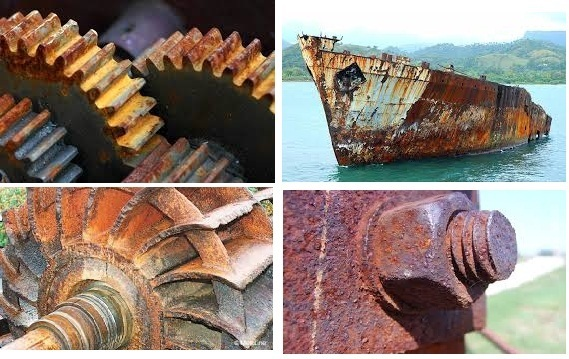
Ordinary paint offers only the first kind of protection. Once paint is scratched, the steel underneath starts to rust and the rust creeps under the film. That is the main advantage of galvanizing over paint.
The Hot Dip Galvanizing Process, Step by Step
Molten zinc only reacts with chemically clean steel, so most of the galvanizing process is cleaning.
- Degreasing. Articles are dipped in a hot alkaline (or mild acid) solution to remove oil, grease, and dirt. Paint, labels, and welding slag are not removed here and must be taken off mechanically beforehand.
- Rinsing.
- Pickling. Articles are immersed in dilute hydrochloric acid to dissolve rust and mill scale.
- Rinsing.
- Fluxing. Articles are dipped in a zinc ammonium chloride solution. The flux removes the last traces of oxide and keeps the surface from reoxidizing before it enters the zinc.
- Drying. Articles are dried so no water is carried into the bath. Water entering molten zinc can cause a dangerous splash.
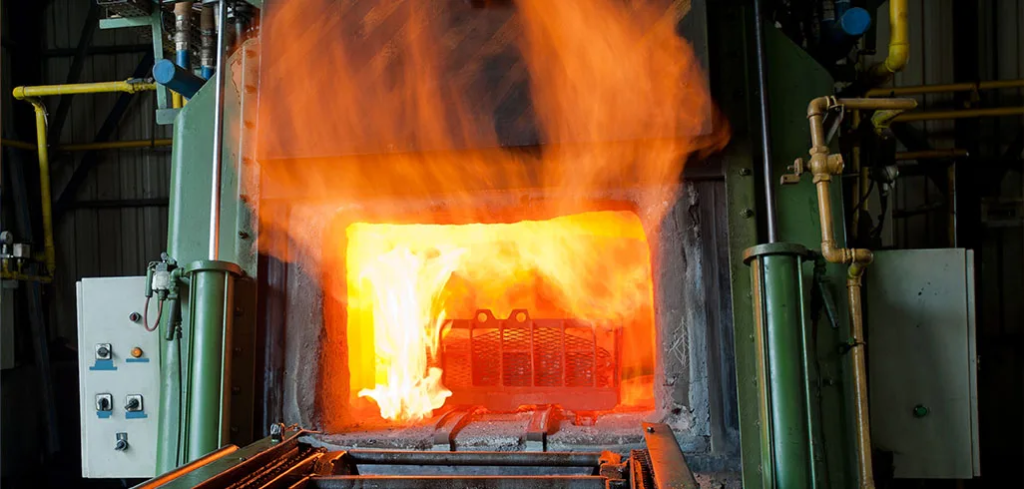
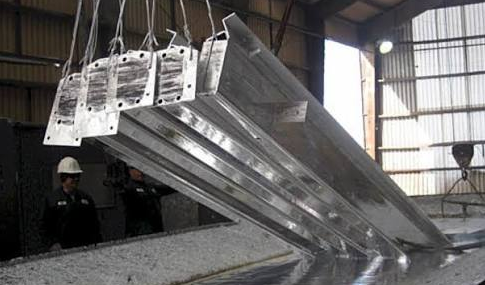
- Galvanizing. Articles are immersed in molten zinc at about 445–460 °C (830–860 °F). The zinc in the bath is at least about 98% pure. The article stays in the bath until it reaches bath temperature, typically a few minutes depending on its thickness and weight, while the zinc-iron reaction forms the alloy layers.
- Withdrawal and draining. Articles are lifted out slowly so excess zinc drains off, and any zinc ash is removed.
- Cooling. Articles are cooled in air or quenched in water or a passivation solution. Passivation helps delay white rust during storage.
- Inspection. Coating thickness is measured with a magnetic gauge, and the surface is checked visually for bare spots, lumps, and flux residue. The principle behind these thickness gauges is covered in our article on NDT methods.
For castings, pickling alone is not enough. Burnt-on molding sand and graphite at the surface of cast iron do not dissolve in acid, so castings are usually blast cleaned first. More on that below.
The Galvanized Coating Structure
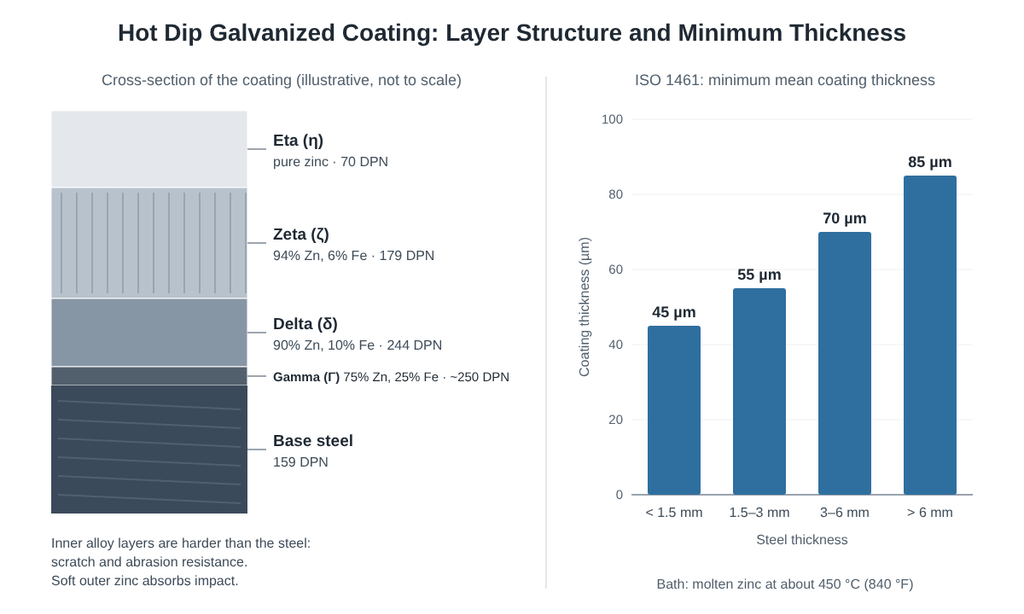
Cut, polish, and etch a cross-section of galvanized steel and four layers appear. From the steel outward:
| Layer | Approximate composition | Hardness (DPN) | Character |
|---|---|---|---|
| Gamma (Γ) | 75% Zn, 25% Fe | about 250 | Very thin, bonded directly to the steel |
| Delta (δ) | 90% Zn, 10% Fe | 244 | Compact and hard |
| Zeta (ζ) | 94% Zn, 6% Fe | 179 | Columnar crystals, usually the thickest alloy layer |
| Eta (η) | Pure zinc | 70 | Soft and ductile, gives the shine and spangle |
| Base steel | – | 159 | – |
The three inner alloy layers are harder than the base steel, so the coating resists scratching and abrasion during shipping and erection. The soft outer eta layer absorbs impact. The metallurgical bond also gives galvanizing far higher adhesion than paint.
Steel chemistry controls how thick the alloy layers grow. Silicon (and phosphorus) have the largest effect, known as the Sandelin effect:
- Si below 0.04% or between 0.15% and 0.22%: normal, bright coating of the expected thickness. This is the range recommended in ASTM A385.
- Si between 0.04% and 0.15% (the Sandelin range): unpredictable reaction; the coating can be much thicker and uneven in appearance.
- Si above 0.22%: the alloy layers grow right to the surface, giving a thick, rough, matte gray coating.
A matte gray coating on reactive steel still protects the steel well, and lasts longer because it is thicker. The drawback is that very thick coatings are more brittle and more likely to flake under impact. Many galvanizers add a small amount of nickel to the zinc bath to reduce the effect.
Coating Thickness and Standards
Coating thickness sets the service life: in the atmosphere, the life of a galvanized coating is roughly proportional to its thickness. Standards set minimum thickness by steel thickness, because thicker steel holds heat longer in the bath and grows a thicker coating.
ISO 1461 (articles not centrifuged):
| Steel thickness | Local minimum | Mean minimum |
|---|---|---|
| Over 6 mm | 70 µm | 85 µm |
| 3–6 mm | 55 µm | 70 µm |
| 1.5–3 mm | 45 µm | 55 µm |
| Under 1.5 mm | 35 µm | 45 µm |
| Castings, 6 mm and over | 70 µm | 80 µm |
| Castings, under 6 mm | 60 µm | 70 µm |
A coating of 85 µm corresponds to a coating mass of about 610 g/m². Small parts that are spun (centrifuged) after dipping to remove excess zinc, such as bolts and nuts, have lower limits. In practice, coatings are often well above these minimums.
ASTM A123 in North America sets minimums by product category (structural shapes, plate, pipe and tubing, wire, reinforcing bar) as well as by steel thickness. For structural shapes, the minimum ranges from 45 µm (1.8 mils) for very thin steel to 100 µm (3.9 mils) for steel 1/4 in (6.4 mm) and thicker. In general, ASTM A123 requires slightly more coating than ISO 1461 for most sizes. Fasteners and small castings fall under ASTM A153, and continuously galvanized sheet under ASTM A653 or EN 10346.
For continuous sheet, the coating is specified as the total mass on both sides. Grade Z275 (EN 10346), for example, means 275 g/m² for both sides combined, or only about 20 µm per side; the familiar ASTM A653 G90 is close to it. That is why pre-galvanized sheet and tube rust much sooner outdoors than batch-galvanized sections.
Batch vs Continuous Galvanizing
Much of the galvanized steel sold at hardware stores is made from continuously galvanized strip, not dipped after fabrication.
| Aspect | Batch galvanizing | Continuous galvanizing (sheet, wire) |
|---|---|---|
| Products | Frames, sections, pipe, fasteners, castings | Sheet, corrugated roofing, coil for tube and light-gauge framing |
| Coating thickness | Typically 45–200 µm | Typically about 7–40 µm per side |
| Cut edges and holes | Coated, because dipping comes after cutting | Uncoated, protected only by the zinc around them |
| Welds on tube | Coated | Weld seam repainted or zinc-sprayed |
| Standards | ISO 1461, ASTM A123, ASTM A153 | ASTM A653, EN 10346 |
Galvannealed steel is a variant of continuous sheet: after leaving the bath, the strip is briefly reheated so the whole coating converts to zinc-iron alloy. The surface is dull gray with no spangle, paints well, and spot welds easily, which is why it is widely used for car bodies.
Hot Dip Galvanized vs Electrogalvanized vs Galvalume
| Coating | How it is applied | Coating composition | Typical thickness | Typical use |
|---|---|---|---|---|
| Hot dip galvanized (batch) | Dipped in molten zinc | Zn-Fe alloy layers plus pure zinc | 45–200 µm | Outdoor structures, poles, railings, structural bolts |
| Electrogalvanized | Electroplated from a zinc solution | Pure zinc | About 5–25 µm | Small fasteners, indoor parts, sheet for painting |
| Galvalume (Al-Zn) | Continuous dip | 55% Al, 43.4% Zn, 1.6% Si | Sheet, tens of microns | Roofing, wall cladding, light-gauge framing |
| Zinc-rich paint | Brush or spray | Zinc dust in a binder | 50–100 µm per coat | Galvanizing repair, primer |
| Thermal spray zinc | Sprayed molten metal | Zinc or Zn-Al | 100–250 µm | Structures too large for a galvanizing kettle |
Electrogalvanized steel has a smooth, even finish, but the coating is thin. Outdoors, a coating of a few microns can be used up in months to a few years, while hot dip galvanizing lasts decades in the same environment. Bolts with a bright silver-blue or yellow zinc finish are usually electroplated, not hot dip galvanized.
Galvanized vs Galvalume
Galvalume (a trademark; similar products are sold as Zincalume and others) is steel sheet coated with an aluminum-zinc alloy rather than pure zinc. The coating is 55% aluminum, 43.4% zinc, and 1.6% silicon; by volume, about 80% of it is aluminum.
- Atmospheric durability: aluminum forms a passive oxide film that corrodes very slowly. Nippon Steel states that Galvalume sheet lasts about three to six times longer than galvanized sheet with the same coating mass. That is why most modern roofing and light-gauge framing uses Galvalume.
- Cut-edge protection: the zinc in a galvanized coating protects scratches and cut edges more actively. Galvalume still offers some sacrificial protection, but less, because most of the coating is aluminum.
- Heat resistance: Galvalume tolerates higher temperatures than galvanized steel.
- Alkaline environments: Galvalume should not be in direct contact with wet concrete or mortar, because alkaline conditions attack aluminum, as explained in our article on aluminum corrosion.
- Product form: Galvalume is made only as sheet and coil; it cannot be used to dip a fabricated frame. For frames, railings, poles, and bolts, hot dip galvanizing remains the option.
So the choice between galvanized and Galvalume is not about which is better overall. For roofing and wall sheet, Galvalume usually lasts longer. For fabricated structures and components, hot dip galvanizing is used.
Does Galvanized Steel Rust?
Galvanized steel is not rustproof, but it resists rust for a long time. The zinc still corrodes, only far more slowly than steel, and as long as zinc remains the steel does not show red rust. How fast the zinc is consumed depends on the environment:
- Rural and moderately polluted urban air: an 85 µm coating can last decades. The Galvanizers Association quotes a maintenance-free life of 50 years or more in most atmospheric environments in the UK and Ireland.
- Coastal and industrial air: chlorides and sulfur compounds consume zinc faster. Here galvanizing is often combined with paint (a duplex system).
- Immersion and burial: life depends heavily on pH, salt content, and oxygen. Soft water and strongly acidic or alkaline water accelerate zinc corrosion.
- High temperature: for continuous exposure, the commonly recommended maximum for hot dip galvanized steel is about 200 °C (392 °F).
White rust
White rust (wet storage stain) is a white, powdery deposit that forms on new galvanized steel stored wet and tightly packed, such as stacked sheet or pipe exposed to rain or condensation. Without air circulation, the zinc forms zinc hydroxide, which does not protect, instead of the dense zinc carbonate patina.
Light white rust does not significantly reduce coating life and turns into normal patina once the steel is exposed to open air. Heavy white rust that leaves dark spots should be checked with a thickness gauge. Prevention is simple: store galvanized steel on spacers, slightly inclined so water runs off, with gaps for air to circulate. Passivation after galvanizing also helps.
Designing for Hot Dip Galvanizing
Articles to be batch galvanized must be designed so cleaning solutions, flux, and zinc can get in, flow, and drain out.
- Vent and drain holes. Pipe, tube, and enclosed spaces need holes at both ends. Trapped air or water can expand violently in zinc at 450 °C (840 °F) and cause an explosion. Without holes, the inside is not coated either.
- Avoid sealed overlapping surfaces. A narrow gap between two lapped plates holds pickling acid, which later weeps out and leaves rust stains. Seal-weld such joints or vent them.
- Balanced thickness. Assemblies that combine very thin and very thick parts tend to distort, because the parts heat and cool at different rates.
- Kettle size. Article length is limited by the galvanizer’s kettle. Slightly longer pieces can sometimes be double dipped, but this needs to be agreed in advance.
- Choose suitable steel. Ask for mill certificates and check silicon and phosphorus. Steel ordered for galvanizing, including low-carbon steel with controlled silicon, gives the most predictable result.
- High-strength bolts and hardened steel. Very high-strength steel risks hydrogen embrittlement from pickling, so the highest bolt grades are generally not hot dip galvanized. Steel that has been quenched and tempered should have a tempering temperature above the zinc bath temperature, because dipping at around 450 °C (840 °F) can reduce its hardness.
Galvanizing Cast Iron and Castings
Castings, whether cast iron or cast steel, can be galvanized, and ISO 1461 has separate rows for castings. Galvanized water pipe fittings, for example, are usually made of malleable cast iron that is hot dip galvanized.
Castings differ from rolled steel in several ways:
- They must be blast cleaned first. Burnt-on molding sand, surface graphite on cast iron, and mold coating residue do not dissolve in hydrochloric acid. Castings are usually cleaned by shot blasting before galvanizing and given only a short pickle.
- Surface porosity and cavities can trap acid or flux and leave uncoated spots.
- High silicon. Cast iron contains far more silicon than steel, so it reacts quickly and the coating tends to be thick and matte. Gray cast iron, with its flake graphite, is also more sensitive to thermal shock when dipped.
- Simple designs with uniform section thickness reduce the risk of cracking and distortion.
Welding and Painting Galvanized Steel
Welding galvanized steel
Galvanized steel can be welded, but zinc boils at about 907 °C (1,665 °F), far below welding temperature. Zinc vapor disturbs the arc and causes weld porosity, and zinc oxide fumes can cause metal fume fever in welders.
Common practice:
- Grind the zinc coating off the joint area, a few centimeters back from the weld line.
- Use local exhaust ventilation or suitable respiratory protection.
- After welding, repair the bare area with zinc-rich paint, thermal spray zinc, or zinc solder. ISO 1461 requires a repair thickness of at least 100 µm unless otherwise agreed, and ASTM A780 covers repair methods.
Where possible, it is better to finish all welding and fabrication first and then galvanize the whole assembly.
Filler selection, technique for thin tube, zinc fume hazards, and coating repair are covered in detail in our guide to welding galvanized steel.
Painting galvanized steel (duplex systems)
Paint applied directly to new, smooth galvanized steel often peels. The surface needs preparing first, for example with a light sweep blast or a phosphate or etch treatment, followed by a primer suitable for zinc. Ordinary alkyd paint is not recommended because it reacts with zinc.
Galvanizing plus paint is called a duplex system. The paint shields the zinc from the environment, and the zinc stops rust from creeping under scratched paint. Duplex systems are used in coastal and industrial environments or where a color is needed, and they generally last longer than either galvanizing or paint alone.
Surface preparation, suitable primers, and powder coating over galvanizing are covered in detail in our guide to painting galvanized steel.
Applications of Hot Dip Galvanized Steel
- Structural steel: warehouse frames, transmission and telecom towers, footbridges
- Street light poles, sign structures, highway guardrail
- Fencing, chain-link mesh, and grating
- Water pipe and fittings, solar panel mounting structures
- Structural bolts, nuts, and anchor bolts
- Agricultural equipment, livestock buildings, and greenhouses
- Castings such as pipe fittings, clamps, and power-line hardware
Common Mistakes
- Treating all galvanized steel as equal. Pre-galvanized tube with a coating of a dozen or so microns is not equivalent to a batch-galvanized section with 85 µm or more.
- Leaving pipe and closed tube without vent holes. Besides the safety risk during dipping, the inside stays uncoated and rusts from within.
- Painting new galvanizing without surface preparation, so the paint peels within months.
- Storing new galvanized steel in wet stacks, which causes white rust.
- Welding without repairing the coating, so the weld line rusts first.
- Laying Galvalume directly on wet concrete, or connecting galvanized steel to copper in damp conditions.
Frequently Asked Questions
What is the difference between galvanized and hot dip galvanized? Galvanizing is any zinc coating on steel. Hot dip galvanizing is one method, in which the steel is dipped in molten zinc at about 450 °C (840 °F). It gives the thickest coating and bonds metallurgically with the steel, unlike thin electrogalvanizing.
Does hot dip galvanized steel rust? Eventually, but slowly. The zinc corrodes gradually and protects the steel as long as it remains. In moderate environments, a hot dip galvanized coating can last decades before red rust appears.
Is Galvalume better than galvanized? For roofing and wall sheet, Galvalume usually lasts longer in the open air. For frames, railings, poles, and bolts that are dipped after fabrication, hot dip galvanizing is the choice, because Galvalume is only made as sheet.
How thick is a hot dip galvanized coating? Under ISO 1461, the minimum mean thickness is 85 µm for steel over 6 mm, 70 µm for 3–6 mm, 55 µm for 1.5–3 mm, and 45 µm for steel under 1.5 mm. Actual coatings are often thicker.
Can you weld galvanized steel? Yes. Remove the coating around the joint first, ventilate well because zinc fumes are hazardous, and repair the weld area afterwards with zinc-rich paint or thermal spray zinc.
Conclusion
Hot dip galvanizing protects steel in two ways: as a barrier and as a sacrificial anode. The coating consists of hard zinc-iron alloy layers and an outer layer of pure zinc, so it resists scratching and does not peel easily. Its thickness depends on the thickness and chemistry of the steel, and standards such as ISO 1461 and ASTM A123 set the minimums. For the best result, design the article for galvanizing, choose steel with suitable silicon content, finish fabrication before dipping, and use a duplex system in aggressive environments.
Related Articles
- How to Prevent Corrosion in Metals
- Types of Metal Corrosion
- Aluminum Corrosion: Causes, Types, and Prevention
- Shot Blasting: Process, Machine Types, Media, and Cleanliness Standards
- Malleable Cast Iron: Definition, Types, Properties, and Uses

Dagus R. Djuanda is a metallurgical engineer with more than 20 years of experience in materials engineering, specializing in magnetic materials. He holds a master’s degree in magnetic materials engineering, is a doctoral candidate in industrial engineering, and works as an engineer at the Ministry of Industry of the Republic of Indonesia. Founder of Metalurgika.