Welding stainless steel is not the same as welding carbon steel. Stainless warps more easily, is more sensitive to excess heat, and can lose its corrosion resistance next to the weld if the procedure is wrong. The good news is that austenitic grades such as 304 and 316 are among the easiest metals to weld, as long as the filler metal is right, heat is controlled, and the weld is cleaned afterward.
This guide covers welding stainless steel from start to finish: how it differs from carbon steel, choosing filler metal and electrodes, TIG, MIG, and stick welding, thin sheet, sensitization and intergranular corrosion, other weld defects, welding stainless to carbon steel, cleaning and passivation, and safety. Stainless steel families and grades are covered in our guide to the types of stainless steel.
Can All Stainless Steels Be Welded?
Yes, but the difficulty depends on the family.
| Family | Example grades | Weldability | Notes |
|---|---|---|---|
| Austenitic | 201, 304, 304L, 316, 316L, 321 | Easy | Most commonly welded; main risks are sensitization and distortion |
| Duplex | 2205, 2507 | Moderate | Needs heat input control and ferrite balance |
| Ferritic | 409, 430 | Moderate to difficult | Grain growth in the weld zone; tends to be brittle |
| Martensitic | 410, 420 | Difficult | Crack-prone; needs preheat and post-weld heat treatment |
Most shop work involves sheet, pipe, and tanks in 304, 316, and 201, so this guide focuses on austenitic grades. Welding duplex is covered separately in our guide to duplex stainless steel.
How Is It Different from Welding Carbon Steel?
- Heat does not spread quickly. Austenitic stainless conducts heat only about a third as well as carbon steel. Heat builds up near the weld, so the same amperage “runs hotter,” and the metal burns through or discolors more easily.
- It expands more. Austenitic stainless expands about 1.5 times as much as carbon steel. Combined with concentrated heat, that means more distortion.
- Chromium oxidizes readily. Hot surfaces without gas protection turn blue, brown, or black and lose part of their passive film. The unprotected back of a weld can form a rough, crusty scale known as sugaring.
- It picks up iron contamination easily. Particles from carbon steel wire brushes, grinding discs, or work tables embed in the surface and rust.
- It needs its own filler metal. Carbon steel filler must never be used on stainless, because the weld metal will lose its corrosion resistance.
Choosing Stainless Steel Filler Metal and Electrodes
The basic rule: the filler should match or slightly over-alloy the base metal. AWS designations use ER for bare wire and rod for TIG and MIG (for example, ER308L) and E for stick electrodes (for example, E308L-16). The L stands for low carbon (0.03% maximum in the filler), which helps prevent sensitization.
| Base metal | Common filler or electrode | Notes |
|---|---|---|
| 304, 304L | 308L (ER308L, E308L) | The most common choice; 308LSi for MIG gives better wetting |
| 316, 316L | 316L (ER316L, E316L) | Contains molybdenum; don’t use 308L on 316, or the weld becomes the weak point for corrosion |
| 321, 347 | 347 (ER347) | Stabilized grades for high-temperature service |
| 201, 202 | 308L | Common shop practice |
| 309, 309S | 309L | Heat-resistant stainless |
| 310 | 310 | Furnace parts; fully austenitic weld metal is more prone to hot cracking |
| Stainless to carbon steel | 309L (ER309L, E309L) | See the section on welding stainless to carbon steel |
| Duplex 2205 | 2209 | See our duplex guide |
| 410 | 410 (with preheat) or 309L | Martensitic; needs a specific procedure |
| 430 | 430 or 309L/308L | Ferritic |
Using 308L on 304 seems odd, but there is a reason. 308 is slightly richer in chromium and nickel than 304, so the weld metal contains a little ferrite. A small amount, typically around 3 to 7 FN (ferrite number), keeps the weld from hot cracking as it solidifies.
Stick electrode suffixes:
- -15: basic (lime) coating, DC only; for out-of-position work and welds that need toughness.
- -16: rutile coating, AC or DC; the most common and easiest to run.
- -17: rutile with higher silica; smoother arc and flatter bead, especially in the flat position.
TIG Welding Stainless Steel (GTAW)
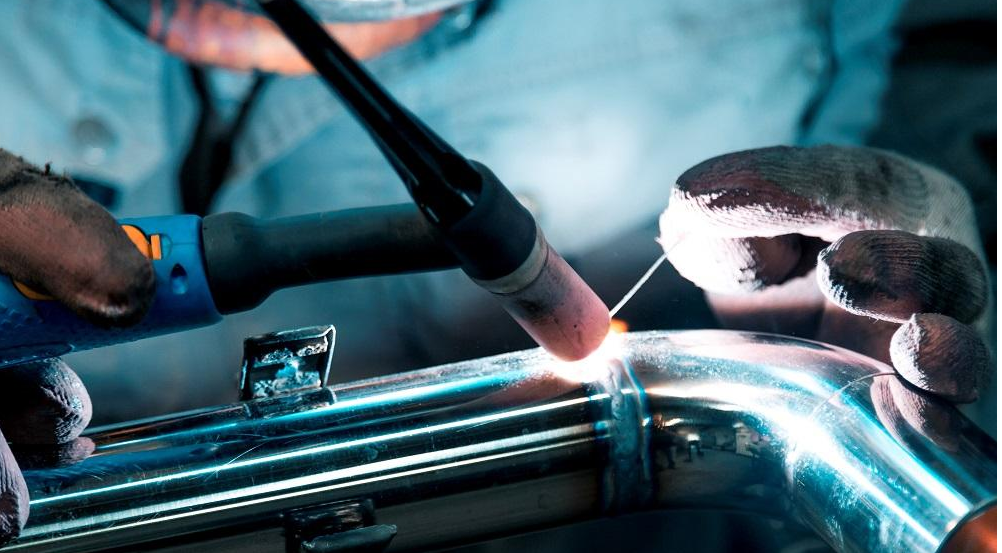
TIG is the most common process for stainless, especially for thin sheet, pipe, and visible work. It is clean, easy to control, and leaves no slag.
- Polarity: DC electrode negative (DCEN). Stainless is not welded on AC as aluminum is.
- Tungsten: 2% lanthanated (blue) or ceriated tungsten is a common replacement for thoriated; grind it to a point lengthwise.
- Shielding gas: pure argon. Argon-helium mixes are used on thicker material for deeper penetration.
- Back purging: for pipe and full-penetration welds, purge the inside with argon or nitrogen so the root does not oxidize. An unpurged root often looks black and crusty (“sugared”) and has poor corrosion resistance.
- Filler rod: ER308L or ER316L. Keep the hot end of the rod inside the gas shield.
- Post-flow: keep gas flowing for several seconds after the arc stops, until the weld no longer glows.
Settings depend on thickness, position, and joint design. Start low and increase gradually; on stainless, too much amperage causes heat tint and distortion faster than on carbon steel.
MIG Welding Stainless Steel (GMAW) and Flux-Cored Wire (FCAW)
MIG is faster for medium to thick material and production work.
- Wire: ER308LSi or ER316LSi (the extra silicon helps the puddle wet the joint edges).
- Gas: argon with a small active addition, such as argon + 2% CO₂ or argon + 1 to 2% O₂. For short-circuit transfer, helium-argon-CO₂ tri-mix is common. Don’t use pure CO₂ or high-CO₂ mixes with solid stainless wire, because carbon can pick up in the weld metal.
- Transfer mode: spray or pulsed spray for thicker material in the flat position; pulse also reduces heat on thinner sheet.
- Flux-cored wire (FCAW): wires such as E308LT1 run with argon-CO₂ or CO₂ as the wire maker specifies. They suit heavy fabrication and out-of-position work; remove the slag.
Stick Welding Stainless Steel (SMAW)
Stick welding works well for repairs, field work, and shops without argon.
- Electrodes: E308L-16 for 304, E316L-16 for 316, E309L-16 for stainless to carbon steel.
- Current: usually DC electrode positive (DCEP); -16 electrodes also run on AC. Follow the amperage range on the box.
- Short arc: a long arc causes spatter, porosity, and loss of alloying elements.
- Keep electrodes dry. The coating absorbs moisture, which causes porosity. Store electrodes in a dry place or rod oven, and re-bake damp electrodes as the manufacturer specifies.
- Remove the slag between passes.
Stick welding suits material from about 2 mm (0.08 in) up. For thinner sheet, TIG is far easier to control.
Welding Thin Stainless Steel Sheet
Sheet under about 1.5 mm (1/16 in), such as sinks, thin tanks, and kitchen equipment, burns through and warps easily. These steps help:
- Use TIG at low amperage, with pulse if the machine has it.
- Tack weld first, closely spaced, for example every 25 to 50 mm (1 to 2 in), before running the full weld.
- Clamp and use a chill bar of copper or aluminum under or beside the joint to draw heat away.
- Skip weld rather than running one long bead, so heat doesn’t build up on one side.
- Keep the fit-up tight. A wide gap makes thin sheet burn through.
- Let it air cool. Quenching rigidly clamped thin sheet with water can increase stress and distortion.
Sensitization and Intergranular Corrosion (Weld Decay)
Sensitization is the classic problem when welding austenitic stainless. If the area next to the weld spends enough time at about 425 to 815 °C (800 to 1,500 °F), carbon combines with chromium to form chromium carbides at the grain boundaries. A thin zone along each boundary is depleted of chromium and is no longer stainless. In a corrosive environment, attack runs along those boundaries. This is called intergranular corrosion, or weld decay.
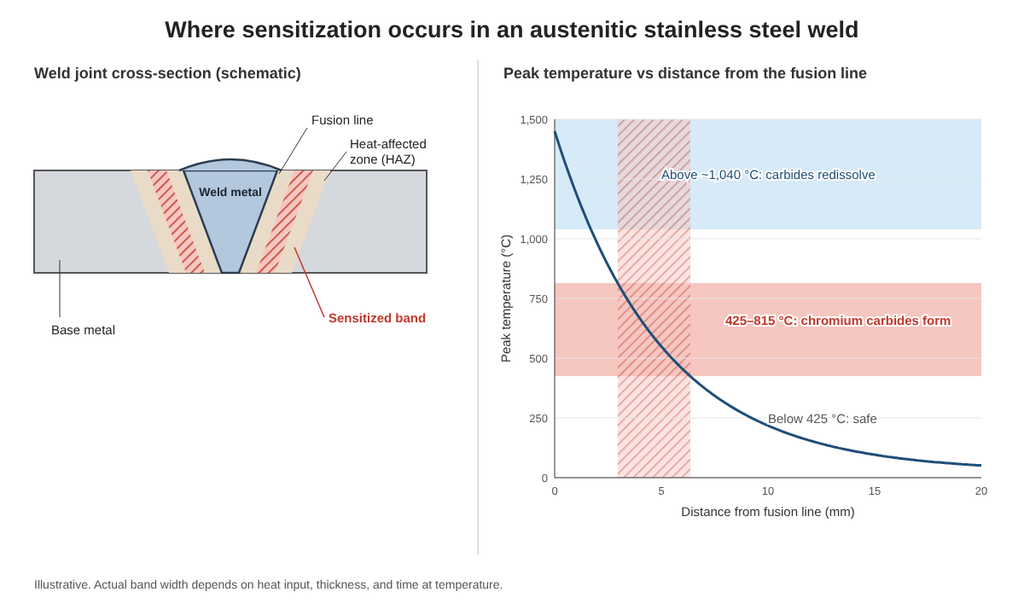
What makes weld decay distinctive is its location: not in the weld metal, but in a narrow band in the heat-affected zone (HAZ), a few millimeters from the fusion line. The weld metal and the area right next to it get hot enough to dissolve carbides again, while areas farther away never get hot enough. Only the band in between is “baked” in the sensitizing range.
How to Prevent Sensitization
- Use low-carbon (L) grades such as 304L and 316L for the base metal, and L fillers. With 0.03% carbon maximum, too few carbides form to cause trouble during normal welding times.
- Use stabilized grades such as 321 (titanium) and 347 (niobium) for high-temperature service.
- Limit heat input and interpass temperature. In multipass welds, let the weld cool below about 150 °C (300 °F) before the next pass.
- Solution anneal after welding (about 1,040 to 1,120 °C / 1,900 to 2,050 °F, then cool rapidly) to redissolve carbides, where the part size allows. Annealing is explained in our article on annealing.
- Avoid stress relief in the sensitizing range on standard-carbon grades. Unlike carbon steel, austenitic stainless is generally not given conventional post-weld heat treatment.
Stabilized grades have a special problem called knife-line attack: corrosion in a very thin line right next to the fusion line when the weld is later exposed to the sensitizing range. It is rare but worth knowing for chemical process equipment.
Testing for Susceptibility to Intergranular Corrosion
The usual standard is ASTM A262, which includes several practices: an oxalic acid etch (Practice A) for quick screening under the microscope, and immersion tests in corrosive solutions such as the Streicher test (B), the Huey test in boiling nitric acid (C), and the Strauss copper-copper sulfate-sulfuric acid test followed by bending (E). Other forms of corrosion are summarized in our guide to the types of metal corrosion.
Other Stainless Steel Welding Problems
| Problem | Cause | Prevention |
|---|---|---|
| Hot cracking (solidification cracking) | Fully austenitic weld metal without ferrite; sulfur or phosphorus contamination | Filler with enough ferrite (308L, 316L, 309L); clean the joint |
| Distortion | High expansion and concentrated heat | Clamping, close tacks, skip welding, low amperage, chill bars |
| Heat tint | Oxidation of hot surfaces | Adequate shielding, post-flow, clean after welding |
| Sugaring at the root | Unprotected back side | Back purge with argon or nitrogen |
| Porosity | Damp electrodes, poor gas coverage, dirty surfaces | Dry electrodes, correct gas flow, remove oil and paint |
| Rust around the weld | Iron contamination, heat tint left in place | Separate tools, pickling and passivation |
| Stress corrosion cracking | Residual weld stress, chlorides, high temperature | Choose a resistant grade, reduce stress; see our article on stress corrosion cracking |
Welding Stainless Steel to Carbon Steel
Joining stainless to mild or carbon steel, such as a stainless bracket on a steel frame, calls for 309L filler (ER309L for TIG and MIG, E309L-16 for stick). As the weld mixes with carbon steel, its chromium and nickel content drops. The richer 309L keeps the weld metal austenitic with a little ferrite, so it stays tough and crack-resistant. Using 308L on this joint risks brittle martensitic weld metal.
A few notes:
- Aim the arc slightly toward the stainless side to reduce dilution from the carbon steel.
- Protect the carbon steel side from rust, for example with paint or galvanizing, keeping the coating off the stainless at the weld.
- Watch for galvanic corrosion in wet conditions: carbon steel next to stainless will rust faster. The principles are covered in our guide on how to prevent corrosion in metals.
Cleaning, Pickling, and Passivation of Stainless Steel Welds
The blue, gold, or brown colors around a weld are not just cosmetic. That oxide layer means the surface has lost chromium, making it prone to rust and pitting corrosion. Here are the main ways to clean it:
| Method | How it works | Advantages | Notes |
|---|---|---|---|
| Mechanical (stainless wire brush, abrasives, flap discs) | Removes the oxide layer | Cheap and quick | Use stainless-only brushes and abrasives; the passive film is not fully restored |
| Pickling paste or solution | Acid (usually nitric and hydrofluoric) dissolves the oxide and the chromium-depleted layer | Best corrosion resistance | Very hazardous; needs full PPE and thorough rinsing |
| Electrochemical cleaning | A carbon brush with electrolyte and electric current | Fast, safer than HF paste, bright finish | Needs a weld cleaning machine |
| Passivation | Nitric or citric acid removes free iron and helps the passive film form | Restores corrosion resistance after cleaning | Does not remove heat tint; do it after pickling or mechanical cleaning |
Pickling removes scale and heat tint, while passivation removes free iron so the passive film can form fully. The main passivation standard is ASTM A967, and ASTM A380 covers cleaning, descaling, and passivation practices for stainless parts. Citric acid passivation has become popular because it is safer than nitric acid. As an example, A967 citric treatments use about 4 to 10% citric acid, with immersion times that range from about 4 minutes at 60 to 71 °C (140 to 160 °F) to about 20 minutes at 21 to 49 °C (70 to 120 °F). Results are verified with tests such as water immersion, high humidity, salt spray, or copper sulfate.
Steps, treatments, and testing are covered in our guide to passivation of stainless steel.
Restoring the shine: once heat tint is gone, blend the weld with progressively finer abrasives (for example 80, 120, then 240 grit) and polish to match the original finish. On brushed No. 4 or hairline finishes, follow the direction of the original grain. Rinse clean and let the passive film re-form, or passivate.
Safety When Welding Stainless Steel
- Hexavalent chromium fumes. Welding stainless produces fumes containing hexavalent chromium [Cr(VI)], which causes lung cancer. OSHA’s permissible exposure limit is 5 µg/m³ as an eight-hour average, with an action level of 2.5 µg/m³. Use local fume extraction or good ventilation and suitable respiratory protection, especially for stick and flux-cored welding, which produce more fume.
- Pickling paste contains hydrofluoric acid, which penetrates skin and damages deeper tissue. Wear gloves, a face shield, and acid-resistant clothing, and dispose of waste properly.
- TIG arc radiation is intense; protect skin and eyes.
Common Mistakes
- Using carbon steel filler on stainless. The weld will rust.
- Using 308L on 316. The weld becomes the weak point in chloride service; use 316L.
- Using 308L for stainless to carbon steel. Use 309L.
- Running too hot. Stainless holds heat; the result is heat tint, burn-through, and warping.
- Skipping the back purge on pipe. The root scales and rusts.
- Leaving heat tint. Clean it by pickling or electrochemical cleaning, then passivate.
- Using brushes or discs that touched carbon steel. Embedded iron rusts.
- Cooling welds with dirty or chloride-containing water. It can start pitting.
Repairing defects by welding is covered in our article on repair welding.
Frequently Asked Questions
What filler metal is used for welding 304 stainless steel? Use 308L: ER308L for TIG and MIG, or E308L-16 electrodes for stick welding. For 316, use 316L; for joining stainless to carbon steel, use 309L.
Can you weld stainless steel with a stick welder? Yes, with stainless electrodes such as E308L-16. Stick welding suits material from about 2 mm (0.08 in) up. For thin sheet, TIG is much easier to control and gives a cleaner result.
Why does a stainless steel weld rust? Usually because heat tint was left in place, the root was not purged, the wrong filler was used, or iron particles contaminated the surface. On standard-carbon grades, sensitization next to the weld can also be the cause.
What is sensitization of stainless steel? Sensitization is the formation of chromium carbides at grain boundaries when austenitic stainless is held at about 425 to 815 °C (800 to 1,500 °F), for example next to a weld. The boundaries lose chromium and corrode easily. It is prevented with low-carbon grades (304L, 316L), stabilized grades (321, 347), or solution annealing.
What is the difference between pickling and passivation? Pickling removes heat tint, scale, and the chromium-depleted layer, usually with nitric-hydrofluoric acid. Passivation, with nitric or citric acid under ASTM A967, removes free iron so the passive film can form fully. Welds are usually pickled first, then passivated.
Conclusion
Welding stainless steel comes down to four things: the right filler (308L for 304, 316L for 316, 309L for stainless to carbon steel), controlled heat to avoid discoloration, distortion, and sensitization, gas protection on both sides of the weld, and cleaning by pickling or electrochemical methods followed by passivation. TIG is the best choice for thin sheet and pipe, while stick welding handles thicker material and field work. With the right procedure, a stainless weld is as corrosion resistant as the base metal.
Related Articles
- Types of Stainless Steel: Austenitic, Ferritic, Martensitic, Duplex, and Common Grades
- 304 vs 316 Stainless Steel (and 201): Composition, Corrosion Resistance, Cost, and How to Choose
- Duplex Stainless Steel: 2205, Super Duplex 2507, Properties, Welding, and Duplex vs 316
- Types of Metal Corrosion and How to Prevent Them in Industry
- Repair Welding for Metal Castings
Dagus R. Djuanda is a metallurgical engineer with more than 20 years of experience in materials engineering, specializing in magnetic materials. He holds a master’s degree in magnetic materials engineering, is a doctoral candidate in industrial engineering, and works as an engineer at the Ministry of Industry of the Republic of Indonesia. Founder of Metalurgika.